


 For all latest news, follow the Daily Sun's Google News channel.


Dengue demands vaccine action
Experts warn mosquito drives alone won’t stem the rising death toll

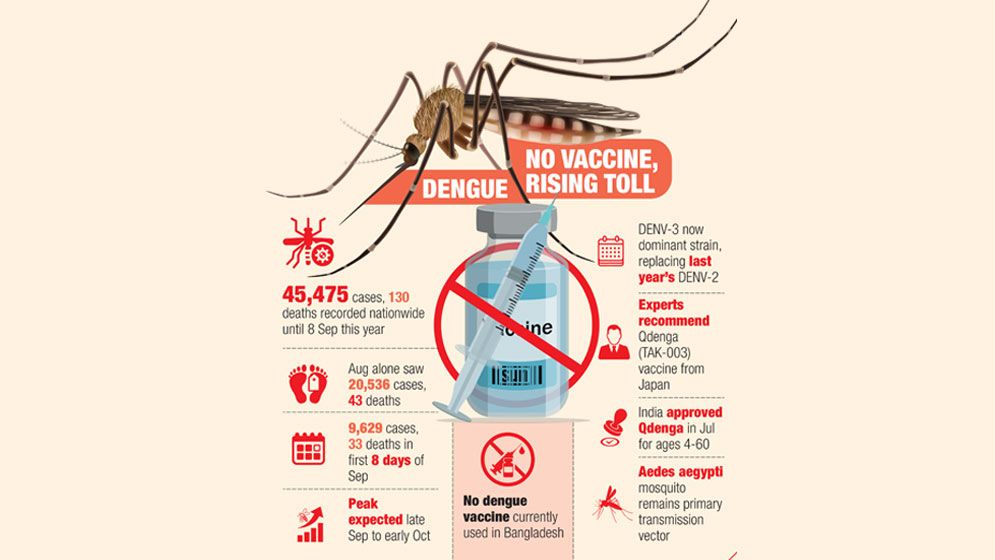
The dengue situation in the country is worsening, with 1,571 new cases and nine deaths recorded in the 24 hours to 8am on Tuesday – the highest single-day figures this year – taking the national toll to 130 deaths and 45,475 cases so far.
With infections and fatalities surging and the outbreak expected to peak in late September or early October, health experts are pressing the government to adopt a national vaccine strategy alongside intensified mosquito-control measures.
The Directorate General of Health Services (DGHS) data shows infections have surged sharply since June, climbing from single-digit monthly death tolls earlier in the year to 43 deaths in August alone, with 33 more recorded in just eight days of September.
Case numbers followed the same trajectory: from 1,081 in January to 20,536 in August and 9,629 in the first eight days of this month.
“So far I know there is no dengue vaccine in the world now,” said Prof Dr Foara Tasmim, DGHS additional director general (planning and development), confirming that while anti-mosquito measures are under way, the vaccine question has not yet reached the government’s agenda.
Health experts believe the official figures understate the true scale of the outbreak, pointing to widespread underreporting and a significant number of asymptomatic cases going undetected.
State Minister for Health Dr MA Muhit told journalists at the Jatiya Sangsad on Sunday that thesituation could worsen considerably, with the outbreak likely to peak in the last week of September or the first week of October.
He said the projection was based on three to four years of epidemiological data showing rainfall patterns, warm temperatures and climate change driving the seasonal spike.
“Unless preventive measures are intensified immediately, the number of infections and deaths could rise at an alarming rate next month,” he said.
Amid the heightened risk, Prime Minister Tarique Rahman on Tuesday directed the authorities to launch a three-month special cleanliness and public awareness campaign from Saturday, involving local administrations, voluntary organisations and students.
Every Saturday, volunteers and students will visit homes and establishments to identify potential Aedes breeding grounds and encourage people to keep their surroundings clean.
The government has also instructed civil surgeons across the country to strengthen hospital preparedness, prioritise dengue patients for admission, increase dedicated beds where possible and provide free dengue tests at public hospitals.
Virologist Prof Dr Saif Ullah Munshi, director of the Super Specialised Hospital of Bangladesh Medical University, called vaccination “a must” given the country’s repeated dengue outbreaks in recent years.
“For many years, we have been emphasising the dengue vaccine, but none pay any heed to our call. Whether it is a public or private initiative, the dengue vaccine should be brought to the country in a bid to save lives,” he said.
Shafiul Alam, a scientist at icddr’b, said mosquito-control drives and public awareness campaigns remain essential, but urged authorities to also explore alternatives such as Wolbachia-based control methods and vaccination.
Vaccine specialist Dr Tajul Islam A Bari said three dengue vaccines currently exist worldwide, and recommended Qdenga (TAK-003), manufactured by Japan’s Takeda, as the most suitable option for Bangladesh.
“Qdenga vaccine is now being used by India and it is approved by the WHO. The country should bring any dengue vaccine available in the country to control the fatality and prevent the dengue disease immediately before further worsening the situation,” he said.
India’s health ministry approved its first dengue vaccine on 21 July this year for people aged four to 60.
An official statement described Qdenga as “a live, attenuated tetravalent dengue vaccine developed using recombinant DNA technology,” administered in two 0.5ml doses three months apart.
The World Health Organisation maintains that dengue vaccination should form part of a wider strategy encompassing vector control, case management, and community education, rather than a standalone solution.
The WHO also notes there is no specific treatment for dengue, making early detection and proper medical care critical to reducing severe-case fatality rates.
Adding to concerns, a study by the Institute of Epidemiology, Disease Control and Research (IEDCR) found that the DENV-3 serotype has overtaken DENV-2 as the dominant strain circulating in Bangladesh this year.
Experts warn that this shift could result in more severe illness, particularly among those previously infected with a different serotype, as the dengue virus carries four distinct strains overall.
The Aedes aegypti mosquito remains the primary transmission vector, with health experts noting that Bangladesh’s current intermittent rainfall is creating ideal breeding conditions for the species.