



 For all latest news, follow the Daily Sun's Google News channel.


No letup in measles
Death toll climbs past 997 as experts cite vaccination gaps, malnutrition

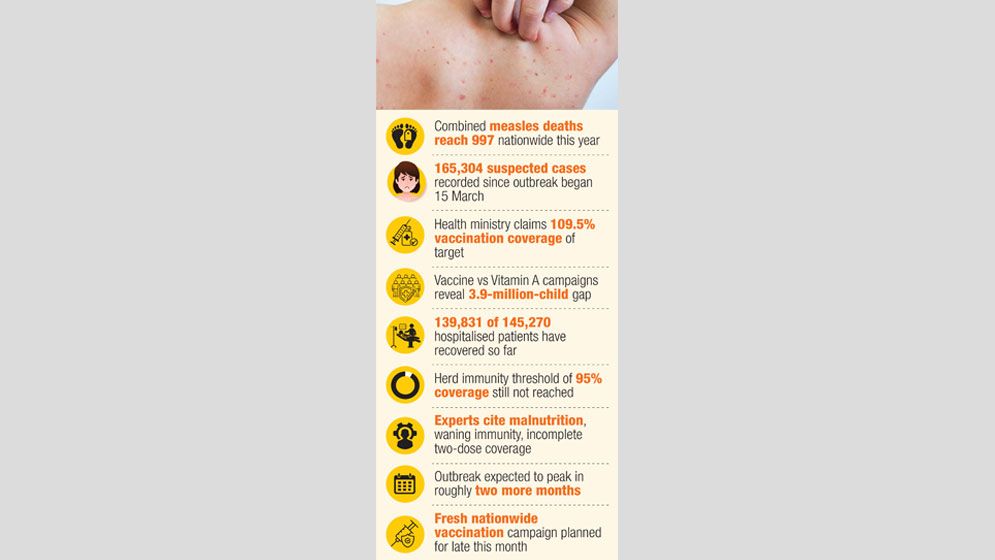
Measles outbreak has killed nearly 1,000 people and infected over 165,000 across the country six months after it began, with health officials attributing the continuing surge to a persistent vaccination gap, waning immunity after incomplete dosing, malnutrition among vaccinated children, and a failure to reach the herd immunity threshold – despite a nationwide campaign the health ministry says exceeded its target.
The Directorate General of Health Services (DGHS) recorded three more suspected deaths and 1,156 new suspected cases in the 24 hours to 8am Monday, taking the combined confirmed and suspected death toll to 997.
Suspected cases nationwide now stand at 165,304, of which 19,756 are laboratory-confirmed.
Confirmed deaths remain at 100; suspected deaths have reached 897. Since 15 March, 145,270 suspected patients have been hospitalised, with 139,831 recovering.
The emergency vaccination campaign ran from 30 high-risk upazilas from 5 April, expanding to four city corporations a week later before going nationwide from 20 April to 20 May, targeting all children aged six to 59 months.
The health ministry says it reached 19.72 million children against a target of 18.02 million – 109.5% coverage.
Yet officials and independent experts say a vaccination gap persists.
Prof Dr Md Halimur Rashid, DGHS director (Disease Control), said the government had planned a fresh campaign.
“It is unknown to me what exactly the reason is behind the prevalence of measles even after vaccination. However, I think multiple factors are working behind the current measles situation of the country,” he said.
Health and Family Welfare Minister Sardar Md Sakhawat Husain said on Friday that a new nationwide measles vaccination campaign would begin towards the end of this month.
A comparison with a separate immunisation drive points to the scale of the shortfall.
A nationwide Vitamin A Plus campaign on 28 June, targeting the same age group, reached 22.36 million children, against 18.47 million recorded for measles vaccination – a gap of nearly 3.9 million children, according to National Nutrition Institute figures.
DGHS sources said officials had flagged this discrepancy to the ministry, prompting the decision to hold another vaccination drive.
Public health specialist Dr Mushtaq Hossain, a former principal scientific officer at the Institute of Epidemiology, Disease Control and Research, said undercounting was partly to blame.
“Fewer children received the vaccine in the special campaign because government statistics underreported the total number of children. In reality, the actual number of children is higher than the projection,” he said, adding that children over five were also contracting measles without having been vaccinated.
Virologist Prof Dr Saif Ullah Munshi, director of the Super Specialised Hospital of Bangladesh Medical University, attributed the outbreak to years of accumulated unvaccinated and incompletely vaccinated children.
“Some vaccinated children fail to develop adequate immunity after the first dose, making the second dose essential, and vaccination coverage has also not consistently reached the ≥95% level required to prevent sustained measles transmission,” he said.
Prof Dr Mirza Md Ziaul Islam, director of Bangladesh Shishu Hospital & Institute, said around 100 measles patients were being treated there on Monday, and linked some vaccine failures to malnutrition.
“Even after taking the vaccine, many children are being infected with measles due to malnutrition. That’s why vaccination sometimes doesn’t work to create immunity against the respective diseases,” he said.
He estimated the outbreak was roughly two months from its peak, after which herd immunity would begin to take hold.
Read More