



 For all latest news, follow the Daily Sun's Google News channel.



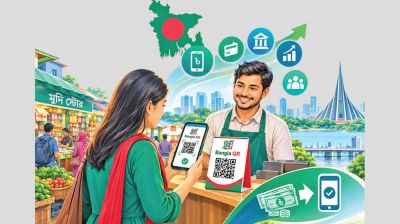
At a neighbourhood shop in Dhaka, a customer places several household items on the counter. The merchant announces the price. No currency note changes hands.
The customer opens a payment application, scans the black-and-white square displayed beside the till, verifies the merchant’s name, confirms the amount and authorises the payment. Within moments, the customer receives a notification, and the merchant checks the corresponding confirmation before releasing the goods.
To the two participants, the transaction appears simple, almost weightless, yet its apparent simplicity is the final expression of an intricate institutional process. Behind that small square lies an interconnected chain of merchant identification, customer authentication, transaction authorisation, payment routing, clearing, settlement, reconciliation, cybersecurity and legal accountability. The QR image is therefore not the payment system. It is merely the visible doorway into it.
Bangla QR is Bangladesh Bank’s national standard for open-loop, interoperable, merchant-presented QR-code payments. In practical terms, the merchant displays a standardised code, and the customer scans it through an application offered by a participating financial institution or approved payment provider. Its central purpose is to prevent merchant acceptance from remaining confined within separate institutional networks. A merchant using the national standard should not require a different QR display for every participating bank, mobile financial service or payment provider, while the customer should not be compelled to adopt whichever proprietary wallet the merchant happens to accept.
Bangladesh did not move directly from cash to QR-based payments. Its modern payment environment evolved through several technological and institutional layers. Bank branches, cheques and traditional clearing mechanisms formed the early architecture of formal payments. Automated teller machines later extended access to funds beyond branch counters and banking hours. Debit and credit cards enabled electronic purchases, while point-of-sale terminals carried card acceptance into shops, hospitals, hotels, restaurants and other commercial establishments. Internet banking subsequently permitted customers to transfer funds and settle obligations without visiting a physical branch.
A Bangla QR transaction begins with the code presented by the merchant. If the merchant uses a static QR, the code generally identifies the merchant while requiring the customer to enter the payment amount.
If a dynamic QR is used, the merchant’s system may generate a transaction-specific code containing the amount and other relevant information. Static QR is inexpensive and convenient for small establishments, but manual entry may create an amount-error risk.
Dynamic QR may improve accuracy and reconciliation, although it ordinarily requires deeper technological integration with the merchant’s billing or payment system.
Meaningful adoption begins when merchants receive transactions repeatedly, customers return to the system without promotional inducement and the payment channel remains commercially useful after the initial onboarding period. A merchant completing a single transaction cannot reasonably be treated as equivalent to a merchant receiving payments throughout the business day.
The quality of adoption also matters. A merchant may remain technically active but discourage customers from using QR because of uncertainty about settlement, charges, refunds or confirmation. Another merchant may display the code but continue directing customers toward cash. A third may receive payments only when a temporary discount is offered. Sustainable adoption occurs when the service survives beyond promotional campaigns and becomes a normal payment choice. The decisive evidence lies in continuity, frequency, reliability and merchant satisfaction rather than in the number of stickers visible across the market.
For a micro or small merchant, settlement time is not an abstract matter of payment-system engineering. It is working capital. Money awaiting settlement may be needed to replenish inventory, pay suppliers, meet wages or take advantage of a time-sensitive purchase discount. A delay that appears immaterial within a national aggregate may be commercially decisive for an enterprise operating with little financial reserve.
Bangla QR can reduce certain physical-payment risks while introducing or concentrating different digital risks. A criminal may paste a fraudulent code over the merchant’s genuine display, causing customers to pay an unrelated account. A fraudster may impersonate customer-support personnel or persuade a victim to authorise a transaction falsely described as verification. Weak merchant onboarding can introduce illegitimate recipients into the ecosystem. Compromised mobile devices, stolen credentials, manipulated interfaces and deceptive confirmation messages can exploit the distance between the apparent simplicity of scanning and the complexity of the payment process.
Static codes require particular physical vigilance because they may remain displayed without continuous supervision. Dynamic codes can reduce certain substitution and amount-entry risks, yet they cannot eliminate account takeover, compromised devices or social engineering. Effective protection requires merchant-name verification, immediate alerts to both parties, regular inspection of physical codes, risk-sensitive transaction limits, common transaction references, behavioural monitoring and rapid account suspension. Merchants should verify receipt independently, and customers should never authorise a payment until they have checked both the merchant identity and the amount.
A national payment system earns confidence by acknowledging risk transparently rather than attempting to manufacture trust through silence. Fraud reporting should distinguish complaints, suspected incidents, confirmed incidents, confirmed losses, recovery and resolution time. Institutions should share anonymised threat information so that a method detected by one provider can be addressed across the ecosystem. Consumer education should explain not only how to scan a code but also how to verify a merchant, recognise manipulation, preserve transaction evidence and report a suspicious payment immediately.
Bangla QR can lower the hardware barrier associated with conventional card terminals and provide small merchants with a digital record of sales. Such records may improve bookkeeping, reconciliation and access to responsible formal credit.
A responsible lender must still consider operating expenses, household withdrawals, existing obligations, seasonality, tax liabilities, working-capital requirements and an appropriate financial buffer.
Digitisation does not automatically create inclusion. A citizen without a suitable telephone, reliable connectivity, formal identification, accessible interfaces or sufficient digital confidence may remain outside the system. Women may benefit from greater privacy and control over funds, yet unequal device ownership and household decision-making can reproduce exclusion electronically. Persons with visual, physical or cognitive disabilities may face applications that were never designed for them. Rural adoption requires more than distributing codes. It requires connectivity, local support, Bangla-language education, accessible design and complaint mechanisms usable without advanced digital knowledge.
Singapore’s SGQR offers a different lesson. It consolidates multiple payment schemes within a single QR label, reducing visual clutter and simplifying recognition for customers and merchants.
Bangla QR has already become a national regulatory interoperability standard. Its open-loop architecture and EMV-based design give it the technical characteristics of shared payment infrastructure. The regulatory replacement and implementation directions demonstrate a clear ambition to move beyond the coexistence of proprietary codes. The available regulatory evidence does not, however, justify describing universal operational interoperability or national economic transformation as completed achievements.
__________________________________________________
The writer is Company Secretary, City Bank Limited
Read More