



 For all latest news, follow the Daily Sun's Google News channel.


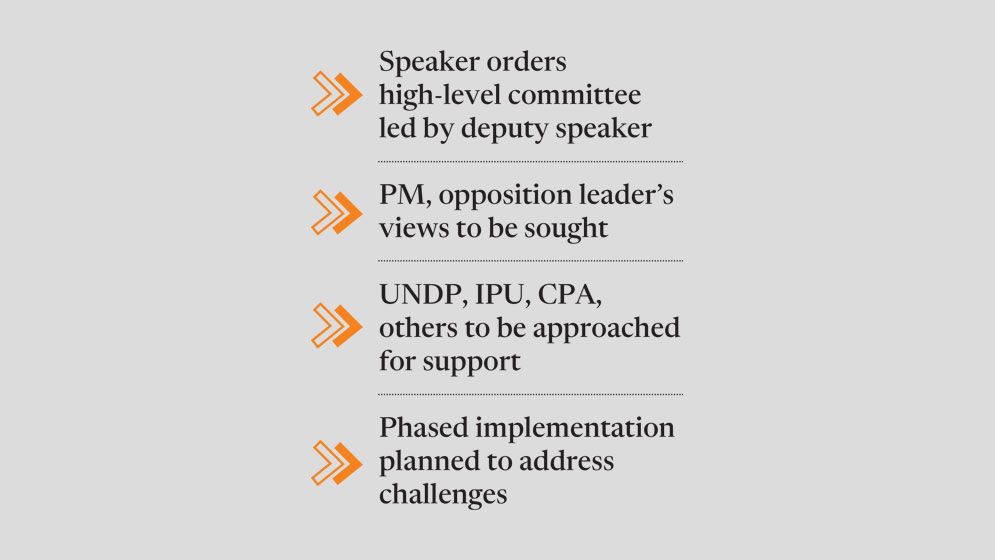
Steps are being taken to establish a paperless, technology-driven e-Parliament in Bangladesh, with the speaker ordering the formation of a high-level committee to oversee the initiative.
The committee, to be headed by Deputy Speaker and Library Committee Chairman Barrister Kaisar Kamal, will examine the proposed system’s structure, implementation process, technological infrastructure and other related issues before recommending the next course of action.
The initiative aims to transform the Jatiya Sangsad’s conventional paper-based operations into a digital system, with both Bangla and English versions. It is expected to make the management, preservation and exchange of parliamentary documents faster, easier and more efficient.
A concept paper has already been prepared with support from the United Nations Development Programme (UNDP) under its Strengthening Institutions for Participatory Systems (SIPS) project.
The proposal, however, identifies several challenges, including high implementation costs, legal and regulatory constraints, cybersecurity threats, a shortage of technically skilled personnel, resistance to change and data privacy concerns.
It recommends phased implementation, appropriate legal and regulatory frameworks, capacity building and robust cybersecurity measures to address the challenges.
The authorities also plan to approach the UNDP, donor countries and development agencies for technical and other support. The Inter-Parliamentary Union (IPU) and Commonwealth Parliamentary Association (CPA) have also been identified as potential partners for technical assistance and knowledge exchange.
The initiative was discussed at a meeting of the Library Committee of the 13th Jatiya Sangsad. The committee decided to seek the opinions of the prime minister and the leader of the opposition through the Speaker.
On Sunday, Deputy Speaker Kaisar Kamal, along with committee members Nayab Yusuf Ahmed and ABM Mosharraf Hossain, paid a courtesy call on the Speaker to discuss the initiative.
The Speaker instructed that a presentation on the proposed e-Parliament system be arranged by the end of September. The presentation will cover its operational mechanism, technological capabilities, implementation plan and other key aspects.
The broader objective is to make parliamentary operations more efficient, transparent, accessible and participatory. Under the proposed system, parliamentary, legislative and administrative activities would gradually shift to digital platforms, reducing paper use and saving time.
MPs would be able to submit questions, private members’ bills and call-attention motions digitally to the Speaker’s Office. Interactive web interfaces would also enable citizens to track legislative proceedings, view committee reports and provide feedback on draft bills.
The concept paper proposes a secure data centre, robust network infrastructure, software solutions and capacity-building programmes for MPs, parliamentary officials and other stakeholders.
It also cites digital parliamentary practices in the UK, Canada, Brazil, India, Argentina, Austria and Singapore. India’s Digital Sansad 2.0 and National eVidhan Application are highlighted as examples of paperless legislative platforms incorporating technologies such as AI, facial and speech recognition, real-time translation and automated webcasting.