


 For all latest news, follow the Daily Sun's Google News channel.


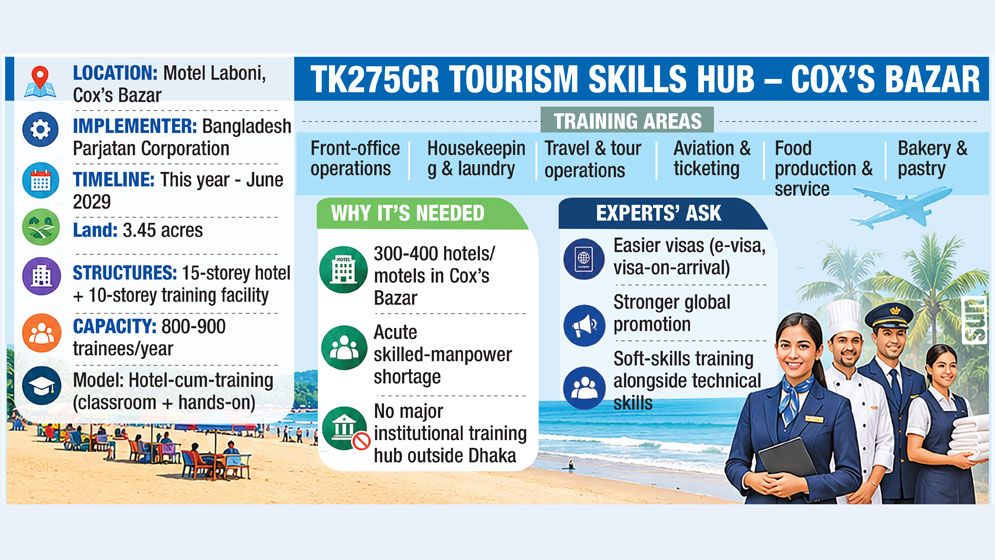
The government is planning a Tk275 crore training institute at Motel Laboni in Cox’s Bazar to address a chronic shortage of skilled workers in the country’s fast-growing tourism and hospitality sector, officials said.
The Ministry of Civil Aviation and Tourism has submitted a project proposal, titled “Establishment of a Training Institute at Motel Laboni Compound, Cox’s Bazar,” to the Planning Commission for approval, a senior ministry official told the Daily Sun.
If cleared, the Bangladesh Parjatan Corporation will implement the project from this year until June 2029, the official said.
The institute is designed as a hotel-cum-training facility, combining classroom instruction with hands-on learning, so trainees no longer need to travel to Dhaka for specialised courses.
Md Ziaul Haque Howlader, general manager (planning, statistics and training) at the Bangladesh Parjatan Corporation, said Cox’s Bazar’s rapid tourism growth had outpaced the supply of trained staff.
“Cox’s Bazar is becoming a tourism hub, with around 300-400 hotels and motels, but there is a shortage of skilled manpower,” he told the Daily Sun.
The institute will be built on about 3.45 acres at the existing Motel Laboni compound, where the current facility has fallen into disrepair, the official said.
Training will cover front-office operations, housekeeping and laundry, travel and tour operations, aviation and airline ticketing, food production and service, and bakery and pastry.
The Parjatan Corporation’s existing trainers will deliver the courses, with practical sessions held at the hotel facility itself.
“The idea is to make it a hotel-cum-training institute so that trainees can learn directly through practical work instead of simply receiving classroom instruction,” Ziaul Haque said.
Under the preliminary plan, two buildings are envisaged: a 15-storey hotel and a 10-storey training and student facility, though the designs are still being revised. The institute is expected to train 800-900 people annually.
The project comes as tourism operators and academics warn that the skills shortage is becoming a major brake on the industry’s development.
Mohammed Hanif, president of the Tour Operators Association of Bangladesh (TOAB), said the gap was particularly acute in tourism-related services.
“The shortage of skilled people is very serious. The government should have taken this decision much earlier,” he told the Daily Sun.
He said Bangladesh lacked adequate institutional arrangements to train tourism professionals, including tourist guides and tour operators. TOAB runs periodic training on areas such as visa processing and medical tourism, but Hanif said a larger institutional system was needed as the sector expands.
Nusrat Jahan, associate professor at Dhaka University’s Department of Tourism and Hospitality Management, said workers needed both technical and soft skills.
“A service worker in tourism has to understand how to deal with people. Soft skills are particularly important alongside technical skills,” she told the Daily Sun, citing booking, food preparation and service delivery as core technical competencies alongside communication and courtesy.
She said skills development should be linked to the wider tourism ecosystem, including hotels, restaurants, airlines, travel agencies and tour operators.
The training institute is part of a broader push to diversify Cox’s Bazar as a tourism destination. Howlader said the Parjatan Corporation was separately developing plans for multi-purpose tourism facilities around Motel Laboni and Hotel Shaibal under a public-private partnership (PPP).
Proposed facilities include entertainment and recreational attractions, a food zone, shopping outlets, a cineplex, swimming and water-based activities, a gym and spa, an aquarium, a game zone, and spaces for handicrafts and cultural performances – aimed at encouraging visitors to stay longer rather than confining their trip to the beach.
The corporation has invited proposals from shortlisted consultancy firms for a detailed study of the broader development, which will assess land use, design, investment requirements, commercial viability and risks before investors are approached.
The preliminary estimate puts the potential investment at around Tk2,500 crore, subject to the study’s findings.
Hanif said improved infrastructure alone would not draw more foreign visitors. He called for easier visa arrangements, including e-visa and visa-on-arrival facilities, alongside stronger international promotion of destinations such as Cox’s Bazar’s coastline, the Sundarbans, and the country’s hills, forests and heritage sites.
The reporter can be reached at: [email protected]