





 For all latest news, follow the Daily Sun's Google News channel.


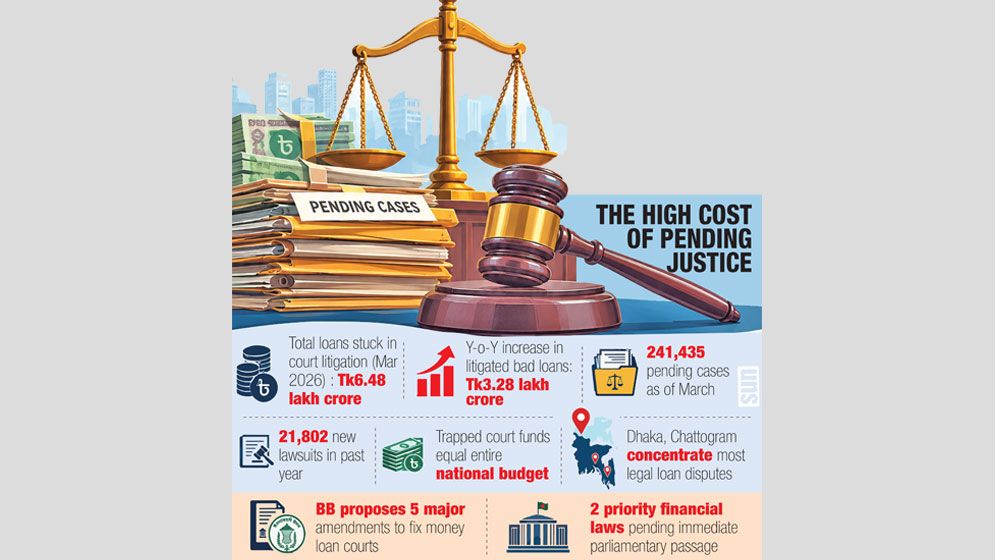
More than Tk6.48 lakh crore of banks’ bad loans is now trapped in money loan courts (Artha Rin Adalat), doubling in a single year even as banks pour money into lawyers and litigation with almost nothing recovered, latest Bangladesh Bank data show.
The stuck amount stood at Tk648,366 crore at the end of March this year, up from Tk320,761 crore in March 2025 – a rise of Tk327,605 crore in twelve months. Over the same period, the number of cases filed by banks climbed to 241,435 from 219,633.
Cases are multiplying faster than they are resolved, leaving a growing pile of money frozen on banks’ balance sheets and squeezing their liquidity and capital.
Banks earn nothing from these loans while they sit in litigation, and must keep paying legal fees and maintaining case records for years, with no guarantee of recovery.
Bangladesh Bank sources say most of the litigated loans are concentrated in Dhaka and Chattogram. Cases routinely drag on for years because of legal complications, repeated adjournments and court stay orders, which the central bank regards as one of the biggest obstacles to recovery.
The country’s total default loans crossed Tk6.06 lakh crore by the end of June. Many defaulters use stay orders to freeze legal proceedings indefinitely, leaving recovery uncertain.
Stay orders create a further complication: they allow some loans to continue appearing as regular loans in Credit Information Bureau (CIB) reports.
That opens the door for unscrupulous borrowers to take fresh loans from other banks without clearing existing debts, exposing more of the banking system to the same defaulters.
Cases rising, disposal slow
Bankers and industry figures say a significant share of the litigated loans involves irregularities and fraud, with many borrowers already given repeated rescheduling and other concessions without repaying.
Banks are legally obliged to sue, but disposal is so slow that filing a case rarely translates into recovery. Bangladesh Bank officials cite too few financial loan courts, a shortage of judges, and banks’ own failure to submit collateral documents on time.
Repeated postponement of hearings and poor preparation by the parties further prolong cases.
Mustafa K Mujeri, former chief economist of the central bank, told The Daily Sun the backlog had made it impossible to predict when cases would clear.
Court stay orders, he said, had effectively put a large share of non-performing loans into “cold storage”, stopping banks from classifying them as defaulted even after repayments stopped.
He blamed loopholes in the legal framework that let defaulters secure stay orders and stretch out proceedings indefinitely, warning that money loan courts would stay clogged without comprehensive legal reform.
He added that recovery remained low because authorities had not taken sufficiently strong action against entrenched wilful defaulters.
Dr Toufic Ahmad Choudhury, former director-general of the Bangladesh Institute of Bank Management, said the sum stuck in litigation had grown so large it was now almost equivalent to the national budget.
He said the situation was hurting both the banking sector and the wider economy, and called for immediate, effective measures to recover the funds.
He pointed to a contradiction in policy: Bangladesh Bank was pushing new courts, private consultation and one-time settlements to speed up cases, while simultaneously offering large defaulters generous rescheduling and restructuring facilities.
“This dual policy is creating prolonged delays instead of solving the problem,” he said.
Bankers said the rising caseload showed growing pressure to recover defaulted loans, but slow disposal was hurting banks’ liquidity, capital adequacy and overall stability.
They called for speedy trials, effective collateral management, strict action against wilful defaulters, and changes to banks’ lending practices.
Push for two laws
Bangladesh Bank Governor Mostaqur Rahman has urged Parliament to speedily pass amendments to the Financial Loan Court Act, 2003, and the new Distressed Asset Management Act, 2026, to accelerate recovery and protect banking-sector stability.
In a letter to Finance Minister Amir Khosru Mahmud Chowdhury on 31 August, the governor requested that both laws be tabled and passed during the current parliamentary session, describing the reforms as vital to strengthening governance and improving banks’ balance sheets.
Bangladesh Bank has proposed five changes to the Financial Loan Court Act: creating an appeal tribunal with High Court status; setting reserve prices for auctioned assets; appointing a separate recovery officer to enforce court orders; shortening the legal time limit for case disposal; and raising the deposit required to file an appeal.
Bangladesh Bank executive director and spokesperson Arief Hossain Khan said pressure on the financial loan courts was mounting.
“The governor has requested that the amendment to the Financial Loan Court Act be passed in Parliament as soon as possible. Once it is implemented, we hope cases will be disposed of more quickly,” he said.