



 For all latest news, follow the Daily Sun's Google News channel.


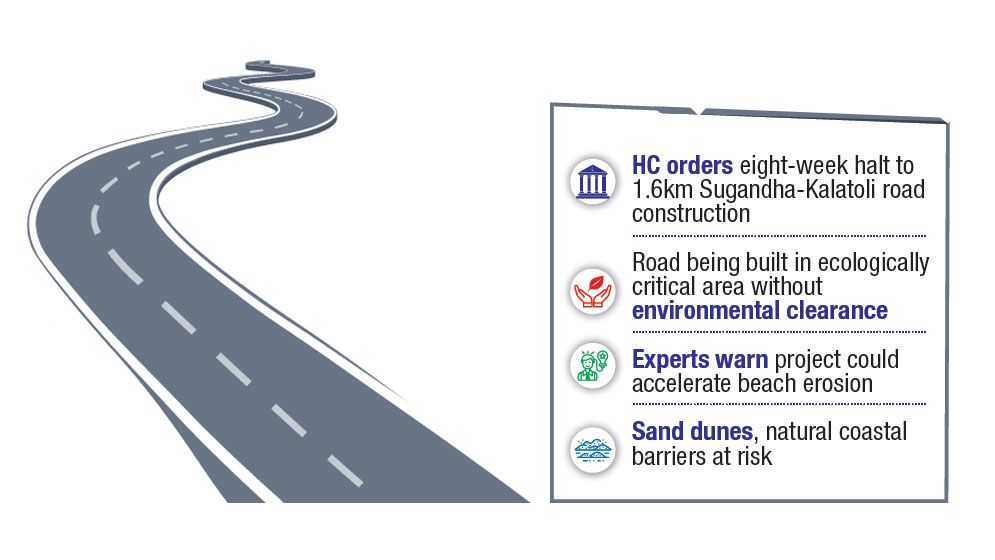
A road construction project along Cox’s Bazar sea beach has raised serious concerns among environmental experts, human rights activists and urban planners, who warn that the project was being implemented without the required environmental clearance and could damage the beach’s fragile ecosystem.
The 1.6-kilometre road from Sugandha Point to Kalatoli Point is being constructed within the Cox’s Bazar Ecologically Critical Area (ECA) by Cox’s Bazar Municipality with funding from the Japan International Cooperation Agency (JICA).
The 28-metre-wide road is scheduled for completion in October 2027 at an estimated cost of Tk63.5 crore.
Cox’s Bazar Department of Environment (DoE) Director Md Zamin Uddin confirmed that no valid environmental clearance had been obtained for the road project from Sugandha Point to Kalatoli Point.
The DoE has recently sought eight sets of information from the authorities concerned and the contractor involved in the construction, citing potential environmental and coastal risks.
HC halts road construction
The High Court on Wednesday ordered an eight-week halt to road construction on the sand dunes of Cox’s Bazar sea beach, following allegations that the work was being carried out in violation of an earlier court directive to preserve the beach’s natural features.
The bench of Justice JBM Hassan and Justice Aziz Ahmed Bhuiyan passed the order after hearing a writ petition filed by the Bangladesh Environmental Lawyers Association (BELA).
The court also issued a rule asking the authorities to explain why the road construction should not be declared illegal and unconstitutional and why the portions of the road already constructed should not be removed and the beach and its biodiversity restored.
At the same time, the High Court adjourned for eight weeks the hearing on a contempt petition filed by Human Rights and Peace for Bangladesh (HRPB).
The project is being implemented in an area declared an ECA in 1999. Section 12 of the Bangladesh Environment Conservation Act, 1995 requires prior environmental clearance for projects before they are established or operated in an Ecologically Critical Area.
The environmental protection framework also restricts activities that could alter the natural characteristics of land and water in designated ECAs. The High Court has also directed the authorities concerned to maintain the basic environment of the Cox’s Bazar ECA.
According to project-related information, earth-moving operations began before the DoE issued environmental clearance, while environmental groups and planners have raised concerns over the impact of filling and levelling the beach’s sand dunes.
Experts warn of coastal damage
Khondker Neaz Rahman, an urban and regional planner, told the Daily Sun that the Cox’s Bazar Marine Drive has already affected the environment and surrounding areas of the beach.
He warned that the new JICA-funded road could cause further damage to the beach within a few years and questioned the legality of constructing the road without the required environmental clearance.
Experts and urban planners fear that construction of a concrete road close to the shoreline could disrupt the natural movement of coastal sediments.
Sand dunes act as natural barriers against coastal erosion, storm surges and high tides. Paving over or removing these natural formations could weaken the shoreline’s natural defence and accelerate beach erosion, they said.
Dr Adil Mohammed Khan, a professor at the Department of Urban and Regional Planning at Jahangirnagar University, said Cox’s Bazar’s flooding and waterlogging problems could not simply be attributed to seawater.
Existing structural barriers prevent rainwater from flowing from the hills towards the sea, contributing to waterlogging, he said.
“Rather than saving the town, this new road construction will isolate its natural drainage system and make the situation worse by trapping water flowing down the mountains into the sea,” he added.
Khondker Neaz Rahman said the project could affect not only the ecosystem and beach but also the lives and livelihoods of people in Cox’s Bazar.
He also said the road project was not included in the Master Plan.
He warned that continuous reflection of ocean waves against an artificial structure could wash away fine sand over time and turn the world’s longest natural sandy beach into a narrower and degraded shoreline.
“Road construction here must be stopped soon,” he said.
Planners demand reassessment
The Bangladesh Institute of Planners (BIP) has also protested against the construction of the coastal road from Sugandha Point to Hotel Simon and Kalatoli Point under the Urban Development and Urban Governance Project.
In a statement, BIP Secretary General Md Musleh Uddin Hasan said the project is damaging the beach’s sand dunes and coastal environment — natural systems that protect Cox’s Bazar from waves, storms, tidal surges and coastal erosion.
The BIP said removing, levelling or filling sand dunes for road construction could destroy coastal habitats and weaken the shoreline’s natural defence against increasingly severe climate-related hazards.
The planners’ body also questioned the rationale behind the project, which was reportedly undertaken to help protect erosion-prone areas and improve facilities for tourists.
It said a project intended to improve coastal resilience should not undermine the natural barriers that protect the coastline from erosion and storm impacts.
The BIP called for clarification on whether alternative alignments had been considered and whether the environmental and disaster-risk implications of the selected alignment had been adequately assessed.