


 For all latest news, follow the Daily Sun's Google News channel.


Govt trying utmost to resolve RMG crisis: Mirza Fakhrul
BGMEA seeks urgent action on gas shortages, rising costs, financing and post-LDC trade challenges
Daily Sun Report, Dhaka
Published: 03 Sep 2026, 12:00 AM
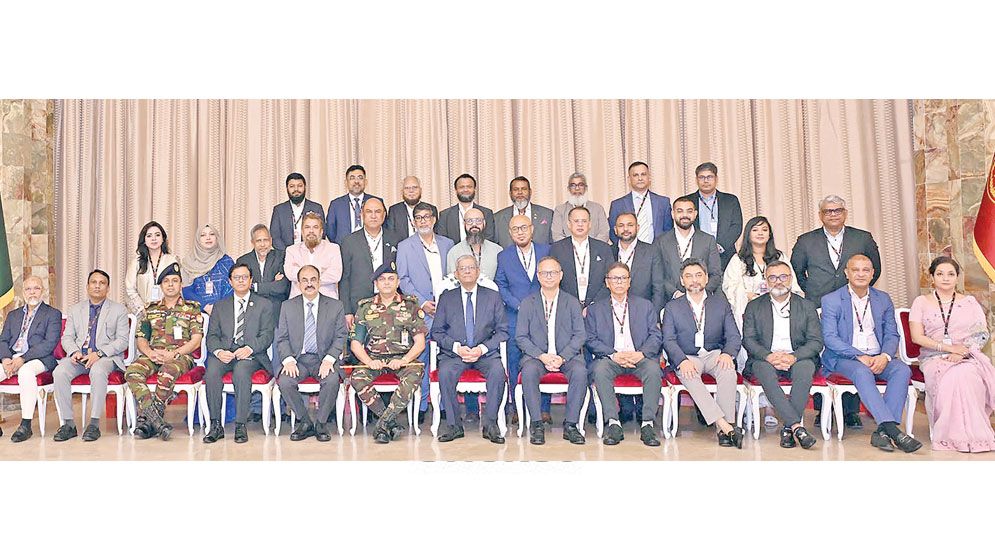
President Mirza Fakhrul Islam Alamgir said that the government was making every effort to resolve the problems facing Bangladesh’s ready-made garment (RMG) sector.
“The government is working to address the mismanagement and irregularities that have persisted in the country’s garment industry for a long time. Utmost efforts are continuing to resolve the existing problems quickly,” he said.
The president made the remarks when a delegation of the Bangladesh Garment Manufacturers and Exporters Association (BGMEA) Board of Directors paid a courtesy call on him at Bangabhaban on Wednesday. BGMEA President Mahmud Hasan Khan led the delegation.
During the meeting, the delegation briefed the president on the problems facing the RMG industry and sought his cooperation in resolving them. The president assured them that necessary steps would be taken to address their concerns.
The BGMEA invited Mirza Fakhrul to attend the closing ceremony of the 25th BATEXPO 2026 as the chief guest on 19 November. The president expressed interest in attending the event.
BGMEA’s concerns
During the meeting, BGMEA President Mahmud Hasan briefed the president on critical challenges facing the RMG sector, including high production costs, energy instability, declining exports and investment, and widespread factory closures.
He also highlighted pressing concerns around infrastructure, access to financing, ease of doing business, worker welfare, and trade security ahead of Bangladesh’s LDC graduation.
Mahmud said inadequate gas supplies had forced most factories to operate at less than half of their production capacity, increasing the risk of losing export orders.
He said production costs had risen by nearly 40% over the past three years due to higher energy prices, increased interest rates on bank loans and wage adjustments.
RMG exports declined by 1.64% in FY2025-26 and by 1.92% in July of FY2026-27, he said, adding that new investment had also stagnated as imports of capital machinery declined.
Nearly 400 garment factories have closed over the past three years amid rising production costs and an order crisis, raising concerns about employment, Mahmud said.
BGMEA recommendations
To address the crisis and revitalise the RMG sector, the BGMEA delegation placed several policy recommendations before the president.
The association called for the installation of two additional Floating Storage and Regasification Units (FSRUs) at the earliest to ease the gas shortage by increasing the capacity to supply imported LNG to the national gas grid.
In the long term, it recommended measures to stabilise energy prices and withdraw all duties and taxes at the import stage.
It also called for priority gas connections for small and medium-sized factories with boilers of 150-500kg capacity, along with long-term, low-interest financing to encourage the use of environmentally friendly solar power.
The BGMEA recommended expediting the Dhaka-Chattogram Expressway, temporarily constructing additional cargo sheds at Hazrat Shahjalal International Airport, and accelerating the completion and commissioning of the Bay Terminal and Matarbari Deep Sea Port.
It also called for lower interest rates on working capital and trade financing, a specialised post-shipment financing scheme for the RMG sector, and increased allocations to the Green Transformation Fund (GTF) and Technology Development Fund (TDF).
The association urged the government to simplify and institutionalise the customs bond audit process and resume yarn imports through Benapole Land Port to ensure timely supplies of raw materials.
It also called for intensified diplomatic efforts to conclude a free trade agreement (FTA) with the European Union at the earliest to maintain duty-free market access after Bangladesh’s graduation from the LDC category.
It recommended similar efforts to conclude FTAs, preferential trade agreements (PTAs) and economic partnership agreements (EPAs) with major trading partners and regions.
The BGMEA also urged the government to expedite the allocation of land in Gazipur for a modern hospital and welfare centre for garment workers and formulate a policy to institutionalise and formalise the jhut (garment waste) business.
Later, President Mirza Fakhrul described the RMG industry as one of the principal “backbones” of the national economy and stressed the importance of overcoming the sector’s temporary difficulties to maintain Bangladesh’s leading position in the global apparel market.
He said he would discuss the issues with the relevant ministries and authorities and provide the necessary policy support to ensure the sustainable development and protection of the industry.
Read More