




 For all latest news, follow the Daily Sun's Google News channel.


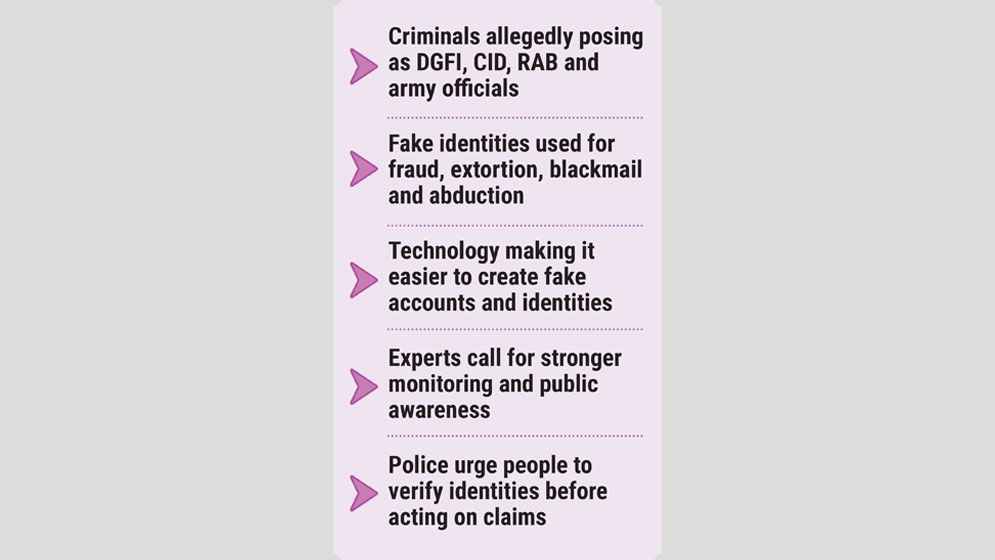
Criminals are increasingly exploiting public trust in government officials and security personnel by assuming their identities to commit fraud, extortion, blackmail, abduction and other crimes, with recent cases highlighting the growing threat posed by fake identities both online and offline.
Using forged identity cards, uniforms, photographs, names and social media accounts, impostors can gain access to people and places, extract information, influence decisions and demand money by exploiting the authority associated with senior officials and state institutions.
Experts and law enforcement officials say the easy availability of technology has made such impersonation easier, while stronger monitoring, public awareness and quicker law enforcement action are needed to curb the trend.
Recent cases highlight threat
Police on Sunday arrested Md Saif Imran, 37, for allegedly impersonating an assistant director of the Directorate General of Forces Intelligence (DGFI).
He allegedly parked his motorcycle beside the Pakistan High Commission in Gulshan and identified himself as a DGFI official when police personnel on duty asked him not to park there.
Last week, police arrested Kakon Rana, 35, who was later placed on six-day remand by a Dhaka court over allegations of blackmail and fraud using the names and photographs of several people, including the Prime Minister’s wife, Dr Zubaida Rahman.
According to the case documents, his mobile phone was found logged into multiple fake Facebook pages and accounts opened in the names of members of the prime minister’s family, Additional Press Secretary Atikur Rahman Ruman, Personal Assistant Abdur Rahman Sani and other prominent individuals. The accounts were allegedly used to offer various forms of assistance to people.
In another incident on 27 August, local residents in Savar caught four people who allegedly posed as magistrates and demanded Tk500,000 from the owner of a shop at an open market sale (OMS) outlet of the Directorate General of Food.
The accused allegedly threatened to raid the shop and publish news about alleged irregularities after the owner refused to pay. Local people became suspicious and caught them, although one of the accused, Pintu Sheikh, managed to flee.
In a separate case, the Detective Branch (DB) of Dhaka Metropolitan Police arrested Md Nurul Chowdhury, 40, in Uttara on 11 August for allegedly taking money from people by promising them jobs while posing as a senior government official.
Police said they recovered two walkie-talkies, a fake passport, 10 army uniforms, a fake ID identifying him as an army major, another fake ID identifying him as a RAB deputy director with the rank of colonel, fake army recruitment notices and job application forms.
On 26 August, police in Magura arrested seven alleged gang members for attempting to abduct a woman while posing as members of the Criminal Investigation Department (CID).
Police seized four jackets bearing CID insignia, 10 toy pistols, a microbus allegedly used in the attempted abduction and eight mobile phones.
Technology adds to challenge
Md Omar Faruk, professor of Criminology and Police Science at Mawlana Bhashani Science and Technology University, said criminals exploit public confidence in uniforms, identity cards and the names of senior officials because these are symbols of authority.
“Criminals exploit this trust to create fear or confidence among their victims,” he said.
He called for stronger monitoring of fake identities, particularly online, and urged the Bangladesh Telecommunication Regulatory Commission (BTRC) to strengthen its monitoring. He also called on the CID Cyber Cell to take more proactive measures instead of acting only after complaints are lodged.
“These crimes are now more common online than in face-to-face interactions,” he said, stressing the need for law enforcement agencies to better understand how criminals exploit official identities.
Assistant Inspector General (Media and Public Relations) of Bangladesh Police AHM Shahadat Hossain said such crimes were mainly driven by the exploitation of public trust and identities, the easy availability of technology and the desire for quick financial or other gains.
He said impersonation also damages the reputation of genuine officials and urged people not to act on any instruction or claim without first verifying the person’s identity.
He also advised people to promptly inform the police about suspicious incidents.
Read More