


 For all latest news, follow the Daily Sun's Google News channel.


Interview
‘Oligarchs of fallen fascists plotting to fail govt’
BNP always wants to resolve crisis through talks with opposition, Rizvi tells Daily Sun in exclusive interview

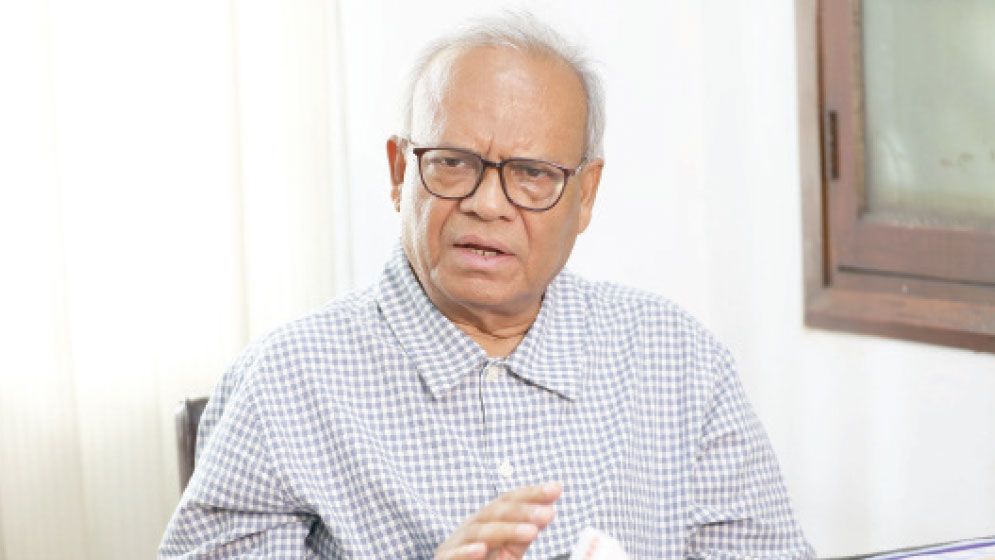
BNP Acting Secretary General Ruhul Kabir Rizvi has alleged that oligarchs loyal to the ousted fascist regime are working in various ways to make the incumbent government fail even as it strives to rebuild Bangladesh.
Rizvi, also political and industry affairs adviser to Prime Minister Tarique Rahman, told Daily Sun in an exclusive interview that the BNP remains committed to preserving anti-fascist unity and resolving national crises through dialogue with the opposition.
“There is a secret conspiracy to bring down the government. Fascism has fallen, and many of its beneficiaries have fled. Their oligarchs have vast sums in hand – money embezzled from mega projects and laundered from banks. It is natural that they will try to disrupt the path of a government elected by the people, and that is exactly what is happening,” he said.
He added that despite this, the task of rebuilding a country reduced to rubble by a “defeated dictatorship” must continue, and that everyone must remain vigilant so Tarique Rahman can carry through his reform programme “defeating any conspiracy”.
Asked whether there is any plot against the Zia family or Tarique Rahman, Rizvi – who rose from a Chhatra Dal activist to become the ruling party’s second-in-command – said history offers many examples of plots to topple nationalist leaders in order to erase nationalist ideology. “In that case, we also have some doubts, some fears, about the security of the Prime Minister and his family,” he said.
“I believe those currently responsible for his security will think this through carefully. An invisible fence should be built so that no conspirator’s plot can break through it. That is why we remain alert, and I think the various intelligence agencies responsible are working sincerely for the security of the Zia family, especially the prime minister and his family,” he added. ‘Fully committed to July Charter’
Responding to the opposition’s warning that it will not allow the government to stay in power unless the July National Charter and referendum results are implemented, Rizvi said such claims are untrue, noting that a special parliamentary committee has already been formed to amend the constitution accordingly.
“It is entirely up to the people of this country whom they keep in power, because it is they who brought the BNP to power with huge support. But I can say the current government is fully committed to implementing the July Charter,” he said.
He noted that the prime minister and senior ministers have repeatedly affirmed that the government will follow the charter to the letter, barring a few points on which the party had recorded notes of dissent. “Everything else, we will implement according to the constitution.”
“We want to resolve our national issues by bringing the opposition along – that is the character of this democratic government. That is why we have asked for their nominees for the Constitutional Amendment Committee. We have always said: let us sit at one table and talk. Whatever you consider a problem, whatever we consider a problem – we will fix it together,” he said.
Rizvi blamed the opposition’s “stubbornness” for hampering the broader democratic process.
“They are not joining the discussion, not participating in the special committee, and merely making noise to mislead the people. Yet even when they run their own programmes, they get no public support.”
Asked about claims by the opposition Bangladesh Jamaat-e-Islami and the National Citizen Party that the government has failed in its first six months, Rizvi said it is natural for opposition leaders to criticise the government, though “sometimes they resort to a lot of rhetoric merely to draw public attention. But they should not spread untruths to mislead people.”
“It is normal in a democracy for opposition parties to criticise the government; there is no problem with that. But under this government, no one has fallen victim to enforced disappearance, nor is any opponent’s voice being suppressed. Alongside criticising our shortcomings, the opposition should also acknowledge the government’s positive initiatives,” he said.
Achievements and crises
Rizvi credited the government with bringing down inflation significantly while keeping food prices under control.
He cited the introduction of family and farmer cards, the waiving of farmers’ loans, canal excavation, the reopening of the Malaysian labour market, and reduced Hajj airfares as key achievements.
“One of the government’s main priorities in its first six months has been restoring public confidence in the state, alongside a qualitative shift in political culture and society driven by the prime minister’s various initiatives,” he said.
He acknowledged persisting crises, including in power and gas, blaming the previous Awami League government for having “devastated almost all sectors of the country through plunder and politicisation”.
He added that the energy crisis has also been worsened by a global crunch stemming from the US-Iran war, for which “the BNP government is not responsible”.
On the Awami League’s potential return to politics, Rizvi said the matter now rests with the courts, since party leaders face various cases, including murder charges.
“What happened to the Nazis in Germany, what happened to fascists elsewhere – the state will take its own steps after weighing all this. Ultimately, the court will decide on the Awami League’s fate, as its activities remain banned.”
Organisational strength intact
Asked about the BNP’s organisational vigour since forming the government, Rizvi rejected suggestions that it had weakened. “It may slow down slightly at times, but it never stops. Various organisational activities are already under way.”

He said government and party work had been complementary rather than divided under the leadership of the party chairman and the Prime Minister. “Our chairman holds weekly meetings with district, upazila, municipal and thana unit leaders, taking stock and issuing instructions accordingly,” he said, adding that further programmes were being planned and that, as newly appointed acting secretary general, his responsibility was to sustain that momentum.
On local government elections, Rizvi said the chairman has already instructed grassroots leaders on extending support to candidates.
“Although the polls this time will not be contested under a party symbol, our units will identify the most qualified and popular person in each area and back them – even a general supporter, if they have popularity, regardless of formal affiliation. Popularity will be our priority,” he said.
He added that party discipline requires activists to accept whichever candidate is backed, failing which local units may take organisational action, permanently barring the person from future re-entry into the party.
Asked about complaints from party activists that opportunists are securing government privileges, Rizvi said dedicated leaders who took part in the anti-fascist movement would receive their due recognition, alongside a few others chosen purely on merit and competence.
“Apart from cabinet posts, dedicated party leaders have already been appointed as district and city corporation administrators,” he said.
On the thousands of cases filed against BNP leaders and activists over the past decade and a half, he said most have already been withdrawn and others remain under trial, with lawyers working through a compiled list. “I expect this to be completed within two to three months.”
On the party’s seventh national council, Rizvi confirmed it will be held soon, though a date has yet to be announced.
On ties with India
Asked about the current friction with India ahead of the prime minister’s prospective visit, Rizvi said Bangladesh’s relationship with its neighbour “has never been cold; it has always been warm” – but stressed that ties cannot be one-way.
“Neighbouring countries must understand why the people of Bangladesh sometimes feel so deprived,” he said, citing what he called killings along the border and the unilateral use of shared river waters as sources of public anger that “policymakers in India should understand”.
He said a visit by the prime minister to India is possible, but must happen “with an open mind, without conditions”, with any negotiation reflecting what serves Bangladesh’s interests. “Only the people of Bangladesh will decide which country we deal with and on what terms. That cannot be a headache for any other country,” he said.
“Our foreign policy is that we will not accept anyone’s dominance. We have friends abroad, but no masters. We consider no one an enemy, and no one a master – everyone is our friend. Other countries must respect our independence and sovereignty,” Rizvi added.
Read More