


 For all latest news, follow the Daily Sun's Google News channel.


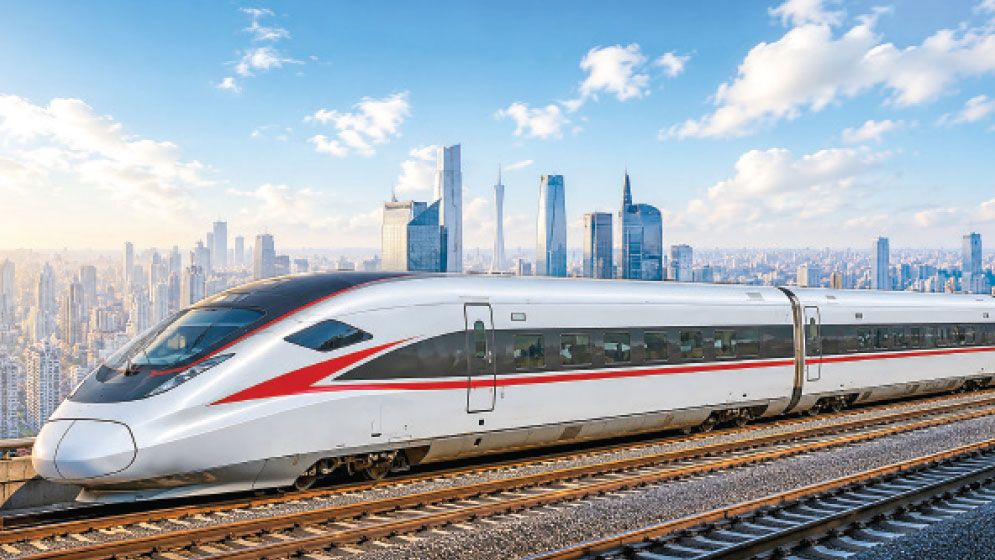
The first thing that struck me as I boarded China’s high-speed bullet train in Beijing was not the speed. It was the calmness.
There was no dramatic roar or sudden jolt. Passengers were reading, working on laptops, watching videos or simply gazing through the large windows as Beijing’s sprawling landscape began slipping away.
Only when I glanced at the information display and saw the train cruising at 340-350 kilometres per hour did I fully grasp how fast we were travelling.
I was travelling from Beijing to Nantong as part of the Immersive Workshop for Asian Media Professionals. Five days later, I boarded another high-speed train from Nanjing to Beijing.
By then, the bullet train no longer felt like a technological spectacle. I had begun to see it for what it really is: a routine part of everyday life.
Those two journeys offered me a first-hand glimpse into why high-speed rail has become so deeply woven into China’s transport system.
From experiment to railway giant
China’s high-speed railway story is relatively young. Research and development began in the 1990s, followed by a major national railway plan in 2004.
The breakthrough came on 1 August 2008, when the Beijing-Tianjin intercity railway began operations, with trains designed to run at speeds of up to 350 kilometres per hour.

That marked the beginning of China’s high-speed railway era. What followed was a breathtaking expansion.
By the end of 2025, China’s high-speed railway network had surpassed 50,000 kilometres – more than the combined high-speed rail mileage of all other countries.
The broader railway system is equally vast. China’s railways carried nearly 4.59 billion passenger trips in the last year, up 6.4% from the previous year, while total railway operating mileage reached 165,000 kilometres.
Yet statistics alone cannot capture what it feels like to travel on the system.
Speed without the drama
Inside the train, efficiency is the first impression.
The coaches are clean, bright and remarkably quiet. Second-class coaches generally feature a 3+2 seating arrangement, while first class offers wider seats and more space.
There are luggage racks, power outlets, toilets, information displays and air conditioning.
Passengers can also buy meals and snacks from dedicated dining facilities and mobile food trolleys operated by train attendants.
Outside, the landscape changes rapidly. Inside, the ride remains extraordinarily smooth.
For passengers, that combination of speed and comfort makes high-speed rail more than simply a transport option.
The choice is often not between train and plane, but between saving time by rail and spending more time dealing with airports.
Technology that keeps moving
China’s bullet trains have also evolved rapidly.
The country initially drew on foreign high-speed railway technologies but gradually developed its own systems.
The introduction of the Fuxing trains in 2017 marked a major milestone.
Using domestically developed core technologies, the trains operate commercially at speeds of up to 350 kilometres per hour.
Now, China is preparing for another leap.
The next-generation CR450 is being developed for commercial operation at around 400 kilometres per hour. Its prototypes have already reached a test speed of 453 kilometres per hour.
But engineers are not pursuing speed alone. Energy efficiency, passenger comfort and noise reduction are also central to the project.
It reflects how high-speed rail is evolving. The question is no longer simply: How fast can a train go?
It is: How fast, safely, efficiently and comfortably can it move millions of people?

Making distance feel smaller
During my journeys, I noticed something that no statistic could fully convey: the bullet train has changed the Chinese perception of distance.
A city several hundred kilometres away no longer necessarily feels far away.
High-speed rail has expanded commuting and business networks, boosted domestic tourism and brought cities closer together.
Official data show that the average rail travel time between China’s 31 provincial-level capitals had fallen by nearly half in 2024 compared with 2012.
Perhaps that is the greatest achievement of China’s bullet trains. They have made extraordinary speed ordinary.
Yet as my train approached Beijing, I realised that the most impressive part of the journey was not simply travelling at 350 kilometres per hour.
It was seeing how speed, accessibility and convenience had been turned into an everyday service for millions of people.
For a visitor, a bullet train ride may be an experience to remember.
But for Chinese passengers, travelling at such speed is no longer a technological spectacle. It is simply part of everyday life.
During my journeys from Beijing to Nantong and from Nanjing to Beijing, I experienced that transformation not as a statistic, but from a window seat.