




 For all latest news, follow the Daily Sun's Google News channel.


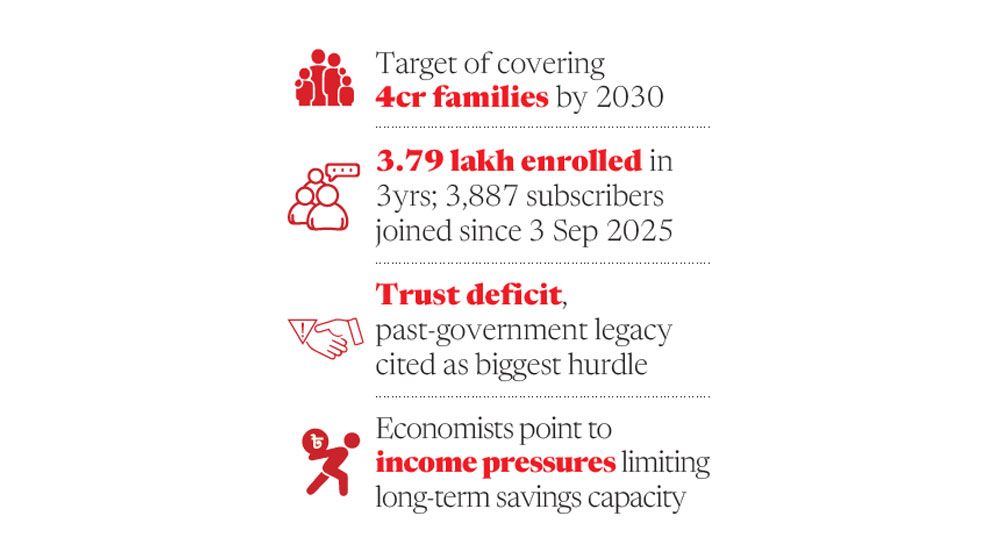
Three years after its high-profile launch, the Universal Pension Scheme has enrolled just 3,79,167 subscribers, official figures show, leaving the government’s target of covering one member from each of nearly four crore families by 2030 badly off track.
Data from the National Pension Authority, updated to 27 August 2026, put combined contributions across the scheme’s four components – Probash, Progoti, Surokkha and Somota – at Tk284.18 crore.
But growth has all but stopped: only 3,887 new subscribers joined in the roughly one year since 3 September 2025, when enrolment stood at 3,75,280.
The stagnation is striking given the scale of the need.
Around 85% of Bangladesh’s labour force works in the informal sector, largely without institutional pension cover, and the scheme was designed precisely to give this population financial security in old age.
Three years in, only a fraction of the working-age population has signed up, and a growing number of existing subscribers have stopped paying in regularly.
Trust deficit at the core
National Pension Authority Executive Chairman Dr Md Suratujjaman identified public trust as the central obstacle.
“Several initiatives have been taken to address the problems, particularly to overcome the trust deficit created during the previous government,” he told Daily Sun, adding that the results of these measures should become visible soon.
People familiar with the matter said concerns over the safety of deposited funds, transparency in investment decisions and doubts about the scheme’s long-term continuity have all fed into that trust deficit among both potential and existing subscribers.
Somota draws the crowds, Progoti holds the money
Of the four schemes, Somota – designed for low-income earners – has attracted the most subscribers, with 2,87,177 people contributing a combined Tk56.43 crore.
Under Somota, subscribers pay Tk500 a month, matched by an equal government contribution of Tk500, a subsidy that has made it comparatively more attractive.
Surokkha, aimed at informal-sector workers, has 65,113 subscribers and Tk81.13 crore in contributions.
Progoti, for employees of private organisations, has fewer subscribers – 25,751 – but holds the largest pool of funds, at Tk134.88 crore.
Probash, aimed at expatriate Bangladeshis, trails furthest behind with only 1,126 subscribers and Tk11.74 crore in contributions.
Why the hesitation?
Experts note that a pension is inherently a long-term commitment, often requiring contributions over 10 to 30 years, which makes certainty about the eventual payout critical to persuading people to join.
A lack of clear information on where pension funds are invested, the risks involved, expected returns and the real value of future benefits after inflation has further discouraged prospective subscribers, they said.
Zahid Hussain, former lead economist of World Bank’s Dhaka office, said the problem runs deeper than trust alone.
“The problem is not limited to a lack of trust; people’s current income and expenditure realities are also a major barrier to long-term savings,” he said, pointing to rising prices and living costs that leave many households unable to set aside money regularly.
He added that the challenge is especially acute for informal-sector workers and the self-employed, whose irregular incomes make sustained contributions difficult.
Incentives so far have not moved the needle
The government has rolled out several measures to encourage enrolment, including income-tax rebates on contributions, tax-free pension income, and the ability to contribute via mobile financial services without needing a bank account.
Loan facilities are also available under certain conditions.
Authorities are additionally developing Islamic versions of all four schemes and working to incorporate insurance benefits into the programme.
National Pension Authority officials said government offices and institutions are being enlisted to raise public awareness, alongside media campaigns and stakeholder seminars and workshops, with more planned at divisional and district level.
No decision has yet been taken on extending such outreach to union or upazila level.
Given demand for Shariah-based financial products in the Muslim-majority country, the authority is working on the institutional framework, investment methods and other details of Islamic pension schemes, a matter that may be finalised at the next board meeting.
ADB loan stirs debate
The government’s decision to take a $100 million loan from the Asian Development Bank to strengthen the scheme has triggered fresh debate.
According to official plans, the funds will go towards administrative modernisation, IT infrastructure, skills development and expanding the authority’s overall capacity.
Pension authority officials said scheme funds are currently invested in bonds issued by Bangladesh Bank, and that expert advice may be needed to shape a more effective investment strategy going forward – the authority is considering appointing consultants for this purpose.
Some economists, however, question whether spending a foreign loan primarily on infrastructure and promotion will deliver much long-term benefit, arguing instead that the priority should be ensuring pension funds are invested safely and profitably.
Zahid Hussain said restoring public confidence requires an independent, professional and politically insulated structure for managing pension funds.
“People must be assured that their deposited money will remain safe and that they will receive the promised benefits when they become due,” he said, calling also for transparency and regular accountability in investment decisions, fund income and expenditure, and overall management of the scheme.