


 For all latest news, follow the Daily Sun's Google News channel.


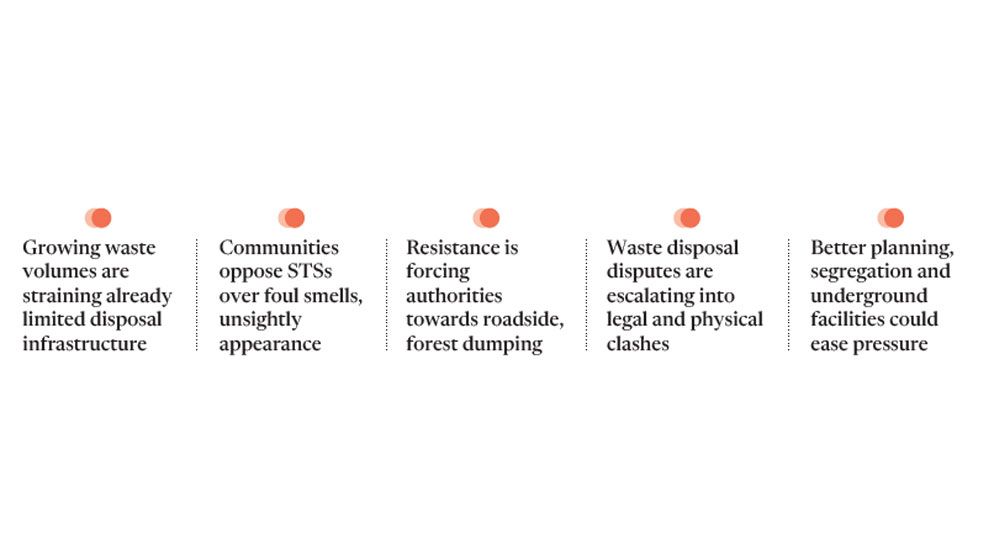
Local government bodies are struggling to manage mounting household waste as communities increasingly oppose secondary transfer stations (STSs) and disposal sites near homes, offices, businesses and schools, citing foul smells, traffic congestion and their unsightly appearance.
With little alternative, city corporations and municipalities are dumping collected waste beside highways, water bodies, open spaces and even forests, drawing objections from regulatory bodies such as the Department of Environment and the Forest Department.
Officials of the Department of Public Health Engineering (DPHE), which constructs waste management facilities for municipalities, told the Daily Sun that many municipalities were failing to establish waste facilities because of public opposition.
They said rising populations and growing volumes of waste were making it increasingly difficult to find land for waste management infrastructure and, more importantly, to keep STSs and dumping stations operational.
A number of waste facilities could not be completed, while some had to be dismantled after construction because of resistance from local communities, government agencies and non-government organisations, officials said.
The conflict has already turned physical.
Recently, cleaners of Dhaka North City Corporation (DNCC) clashed with garment factory workers in Rajabari, Uttarkhan, under Ward 46, when the cleaners went to dump waste at an STS.
Earlier, garment owners had filed a writ petition seeking an order to stop the STS from operating.
In Gazipur, the dispute has also spilled into a protected forest.
On 21 April this year, cleaners of Gazipur City Corporation (GCC) dumped a large amount of rubbish overnight in front of the main gate of Bhawal National Park, amid protests against plans to establish a waste dumping site inside the protected forest.
Earlier, on 11 April, the GCC began constructing an STS inside the Bhawal reserve forest.
The Forest Department claimed the GCC had dismantled a boundary wall and started construction inside the forest, while GCC officials said the work was being carried out on private land.
Municipalities in suburban areas are also facing resistance, making it difficult to construct and operate waste facilities.
DSCC Superintending Engineer Dr Md Sufi Ullah Siddik Bhuya said, “In 75 wards, we have 63 STSs. We have planned to construct more but the problem is the resistance from the community. In Ward 60 we started our work but locals were obstructing our work. People think when there will be a transfer station there will be a problem. Mainly foul smell from waste. Traffic congestion which is caused by waste transport vans.”
He said, “We are facing pressure from the government and non-government entities. There was a demand during the interim government to remove the waste disposal site from Matuail as methane causes fire incidents regularly in the waste valleys. We have an STS in the Sobji Bagan area. There was a pressure to remove the STS.”
Asked about a solution, he said, “If we can transfer all collected waste from our STS within the same day, wash it and spray bleaching powder, we can get rid of the smell related problem. We now cannot transfer all the waste collected daily because of the shortage of waste trucks. When one or two get out of order, there are no supporting vehicles for the day.”
He added, “Besides, we are planting flower trees inside the STS and having outside painted with beautiful messages and graffiti. We have done it in Sobji Bagan, Palashi STS and Kalabagan STS. Besides, there was a problem with the waste being loaded standing in line in front of Kalabagan STS on the road. We have created a separate space for the vans.”
Regarding underground STSs, he said, “We have not advanced in such a way yet. We can construct underground STSs but our practices are yet to be compatible with the underground STS operation.”
DNCC Waste Management Department Superintendent Engineer (additional charge) Tabassum Abdullah said people had two main complaints about STSs: they were “eye soring” and produced foul smells.
She said, “Those who live or have businesses by the STS, send letters to us in the construction phase. Nobody wants STS beside their house to manage their own waste. It is our main problem. Many people make writ with the court to remove the existing ones. I have a lot of legal notices.”
“We are now constructing a STS in Kafrul. There is an objection over the construction. We have gotten letters from Kafrul police station and local residents regarding their objection against it. They said they are eye soring and spread a foul smell. But our STSs are far better than open dumping.”
She added, “Apparently, I don’t see any better solution than STSs for transferring waste because it does not have bad odour like open dumping stations.”
On the Uttarkhan clash, she said, “The garment owners wanted to stop operation of the STS and went to the court but the court issued their verdict in favour of us. we are not using the STS.”
GCC Chief Waste Management Officer Sohel Rana said, “Nobody wants to allow the waste processing activities but we are trying our best to manage the land. We have 7 STSs and are constructing two more. People have objections but we have to do our work.”
He said the corporation was dumping waste in Kodda after collecting it from different wards, but planned to establish a new 100-acre sanitary landfill at Majlishpur.
Former president of the Bangladesh Institute of Planners Adil Mohammed Khan recommended shifting to underground waste facilities, although he acknowledged that doing so would be technologically and otherwise challenging for developing countries such as Bangladesh.
He said, “When a city is designed the planning of the city must have designated spaces for waste management. Still in the planning we are making for sub urban areas not keeping scope for the structures. A buffer zone is needed for waste management.”
He also said, “Waste segregation and material resource recovery can be another immediate solution. It can reduce the foul smell. The waste should be collected in separate containers from households.”