


 For all latest news, follow the Daily Sun's Google News channel.


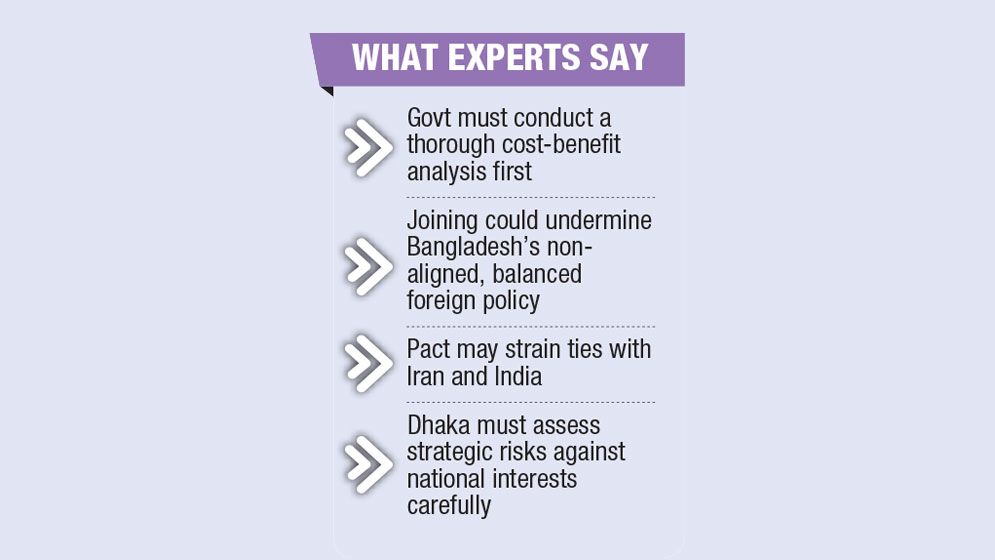
Experts have urged Bangladesh to carefully assess the strategic, security, economic and diplomatic implications before deciding whether to join the Mecca Joint Defence Agreement signed by Saudi Arabia, Türkiye and Pakistan on 7 August.
Their comments came after State Minister for Foreign Affairs Humaiun Kobir said on Monday that Bangladesh was interested in joining the alliance.
Former diplomats, researchers, academics and security analysts cautioned that any decision should not undermine Bangladesh’s longstanding policy of maintaining balanced relations with major regional and global powers or draw the country into conflicts beyond its national interests.
“We have seen in the newspapers that Saudi Arabia, Türkiye and Pakistan have urged Iran to join the alliance. So, it may be a platform where participation depends on bid invitation. Has Bangladesh received any invitation in this regard? If it receives such invitation, only then we can discuss the matter,” former ambassador Humayun Kabir told the Daily Sun.
Asked whether the state minister had raised the issue a little too early, Kabir, president of the Bangladesh Enterprise Institute, declined to comment.
The agreement stipulates that an attack on any one of the three signatories will be treated as an attack on all three, a provision similar to Article 5 of the NATO treaty.
Independent researcher Altaf Parvez said it remained unclear whether the pact would have a unified command structure like NATO. He also suggested that the signatories might seek to bring Bangladesh into the arrangement.
“The way the US-Iran conflict is coming to an end has helped Tehran build a strong and courageous image across the Muslim world. This has put Saudi Arabia and Türkiye in competition to maintain their leadership positions among Muslim-majority countries. Both countries will increasingly seek Bangladesh’s support to manage this rivalry. There has been a clear interest from Türkiye in strengthening military ties with Bangladesh for the past two to three years,” he said.
Some experts said the recent US-Iran war had prompted countries to reassess and restructure their defence policies, with strategic diversification emerging as a broader trend. They viewed the Mecca pact as its first major manifestation.
Security analyst Air Cdre (retd) Ishfaq Ilahi Choudhury favoured maintaining Bangladesh’s longstanding non-aligned policy.
Pointing to Egypt, the UAE, Oman, Kuwait and Qatar, which have not joined the pact, he said Dhaka should understand why three countries without common borders had entered into such a trilateral defence arrangement.
“Pakistan has been facing challenges along its border with Afghanistan and India and facing complicated situations in Khyber Pakhtunkhwa and Balochistan. Its economy is struggling to bear the burden of its vast military structure and manpower, while Saudi Arabia is concerned about Iran as the country is patronising Yemen’s Houthis who are attacking Saudi oil tankers in the Red Sea,” he said.
As for Türkiye, he said, the country was dealing with the Kurds and had a longstanding dispute with Greece over Cyprus.
“Are we facing similar problems? Our participation in the agreement will definitely annoy Iran and its allies. Besides, India will never like it. We have issues like trade expansion, import of energy and renewal of the Ganges Water Sharing Treaty with them,” he said.
Ishfaq Ilahi Choudhury also questioned whether joining the pact would help Bangladesh address its energy and investment-related crises.
Altaf Parvez said the economic dimension of the agreement could not be ignored, as the Gulf countries are major hubs of global capitalism. Iran’s retaliatory strikes following the US-Israel attack had shaken assets and investments in the region, he noted.
“Protecting these capitalist hubs was also seen as a priority by many. Therefore, the Mecca Pact is not simply a matter of the interests of the three countries. We have to watch closely how seriously the three countries implement and make use of it before taking any decision of joining it,” he said.
He said the emergence of competing agreements and alliances could also affect Bangladesh, Nepal and Sri Lanka, making it harder for these countries to keep pace with the militarisation of larger powers while they were already struggling with the economic fallout of the war in the Middle East.
Prof Sabbir Ahmed of Dhaka University’s Department of Political Science urged the government to scrutinise the intention behind the pact.
“Joining such a pact would be a bit risky for a country like Bangladesh, given its military capabilities and geographical realities. We have to examine what interests and loss are waiting for us. Without a cost-benefit analysis we cannot join such a pact,” he said.
He suggested that the government consult stakeholders and experts before taking a decision and explain to the public why it wants to join such a defence agreement.