




 For all latest news, follow the Daily Sun's Google News channel.


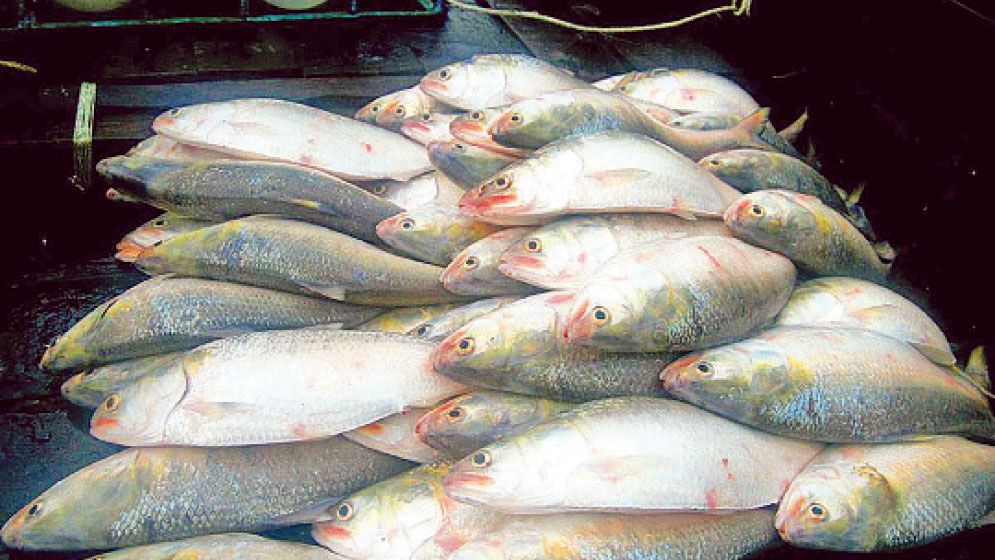
Hilsa caught in the River Meghna in Lakshmipur’s Ramgati and Kamalnagar upazilas is fetching three to four times its price by the time it reaches consumers, with fishermen claiming that a syndicate of middlemen controls much of the trade.
The fish, prized for its taste, passes through several hands, from fishermen and traders to

wholesalers and retailers, before reaching consumers. As a result, fishermen are allegedly being deprived of fair prices while consumers have to pay exorbitant rates. According to a study by the Bangladesh Trade and Tariff Commission (BTTC), hilsa passes through at least five stages before reaching consumers. At each stage, its price increases, adding to the financial burden on buyers.
The two upazilas have around 34,000 registered fishermen, 20,000 in Ramgati and 14,000 in Kamalnagar. There are also 16 fish landing centres and ghats, including 10 in Ramgati and six in Kamalnagar, where hilsa caught in the Meghna is first brought for sale.
Visits to several fish ghats showed that hilsa is generally sold by the hali (four pieces) or by individual pieces rather than by weight. Fishermen said this system creates a significant gap between the price they receive and the price consumers eventually pay. According to fishermen, they currently sell one-kilogram hilsa for around Tk1,200-Tk1,500 at the ghats. The same fish can later be sold to consumers for Tk4,000-Tk5,000. A similar price gap was found at the Boyarchar Fisheries Landing Centre in Ramgati. A one-kilogram hilsa bought from a fisherman for about Tk1,200 was later sold to a shop for Tk2,000, while consumer Lokman Hossain purchased it for Tk4,000.
Fishermen said their dependence on dadan traders, who provide advance loans for fishing, also limits their bargaining power. Many fishermen borrow large sums at high interest rates to meet the costs of taking boats and trawlers to the river and are then obliged to sell their catch to the lenders.
Hasim Majhi, a fisherman at Alexander Centre Ghat, said, “We hunt hilsa day after day, working under the sun and rain. Yet we have to hand over our hard-earned catch at a nominal price. We have no way to break the syndicate cycle.”
Another fisherman, Nizam Uddin, said a fishing trip can cost more than Tk2 lakh, forcing fishermen to borrow from dadan traders. Fishermen’s association leaders said easy-term institutional loans could help fishermen reduce their dependence on dadan traders and sell their catch directly in the market. They also called for stronger monitoring by the Fisheries Department and local administration to ensure transparency in the trade.
Kamalnagar Upazila President of the National Fishermen’s Association ABM Siddique Fakir said hilsa is Bangladesh’s national fish and an important part of the country’s fisheries economy. Thousands of fishing families in the region depend on the Meghna for their livelihoods, he said, adding that the income gap between fishermen and traders needs to be addressed. Belal Hossain Jewel, upazila secretary of Citizens for Good Governance (Sujon), said the high price of hilsa appeared disproportionate compared with farmed fish, whose production involves high costs for ponds, fry, feed and disease management.
He said hilsa is naturally available, with fishermen mainly investing in boats, nets and labour, yet its retail price remains exceptionally high.
District Fisheries Officer Md Jasim Uddin, however, said the current high price was partly due to lower-than-expected hilsa catches. “Hopefully, fishermen will catch more hilsa in the coming days. The price will then return to normal,” he said.
He acknowledged that wholesalers and retailers raise the price after hilsa leaves the fish markets, putting the fish beyond the purchasing power of many consumers.
The Fisheries Department is working to monitor and control the situation, he added.
Read More