


 For all latest news, follow the Daily Sun's Google News channel.


$1b IsDB boost for energy security
Govt secures $1b IsDB loan to expand Eastern Refinery, deal on 3 Sep

Bangladesh is set to sign a more than US$1 billion financing deal with the Islamic Development Bank (IsDB) on 3 September to expand the state-owned Eastern Refinery – a move expected to nearly triple the country’s crude-oil refining capacity, reduce dependence on imported finished petroleum products and strengthen energy security.
The loan agreement for the long-delayed “Modernisation and Expansion of Eastern Refinery” project is expected to be signed at the Secretariat, with ERD Secretary Md Shahriar Kader Siddiky saying Bangladesh and the IsDB had made significant progress in finalising the financing arrangement.
“IsDB will provide $1 billion for the ERL-2 project. We have made significant progress and hope to sign the loan agreement on 3 September,” he said.
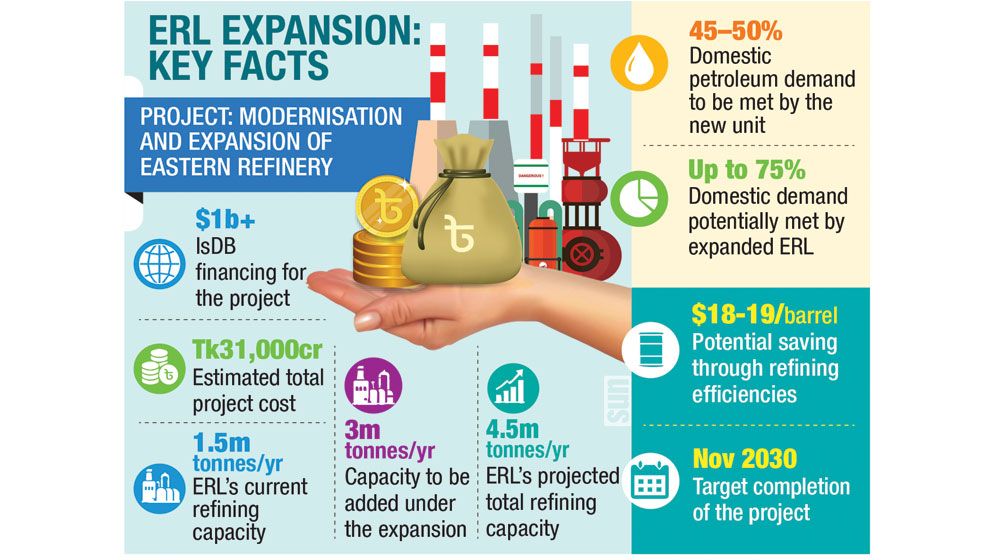
The project, implemented by Bangladesh Petroleum Corporation (BPC), is estimated to cost around Tk31,000 crore, with the government financing 60% and BPC providing the remaining 40% from its own resources. It is scheduled for completion by November 2030.
Refining capacity to triple
Eastern Refinery Ltd (ERL), Bangladesh’s only state-owned petroleum refinery, currently processes around 1.5 million tonnes of crude oil a year.
The proposed second unit will add another 3 million tonnes of annual capacity, taking the refinery’s total capacity to approximately 4.5 million tonnes and enabling it to meet around 75% of domestic petroleum-product demand, according to project officials.
The new facility will produce LPG, Euro-5 petrol, Jet A-1 aviation fuel, Euro-5 diesel, Group III base oil, furnace oil, bitumen and sulphur.
The expansion will also allow Bangladesh to import more crude and refine it domestically, reducing its reliance on imported finished fuels and helping it benefit from periods of lower international crude prices.
At present, limited refining capacity prevents Bangladesh from taking full advantage of cheaper crude because it cannot import and stock significantly more crude than its existing refinery can process.
The country consequently remains heavily dependent on imported refined petroleum products.
$1b IsDB financing
According to the financing proposal, the IsDB loan will come in two instalments of approximately $520.59 million and $483.10 million under a Shariah-compliant forward lease arrangement.
The IsDB will purchase the equipment needed for the project and lease the assets to Bangladesh, with ownership subsequently transferred under a rent-to-own arrangement after the financing obligations are fulfilled.
The financing package includes a grace period and repayment over several years. Disbursement will be subject to legal, financial and environmental conditions, while the financing cost will be linked to the six-month SOFR benchmark plus an applicable spread.
Bangladesh must also meet specified conditions within the agreed implementation schedule, with delays potentially affecting financing availability.
A decade-long wait
The ERL expansion has been under consideration for more than a decade. BPC initiated the ERL Unit-2 project in 2012 at an estimated cost of around Tk7,500 crore.
The cost was revised several times, reaching Tk16,739 crore in 2016 and later rising further because of delays.
France’s Technip was appointed the front-end engineering design (FEED) contractor and India’s Engineers India Ltd the project management consultant, but physical implementation did not begin as planned.
The estimated cost later rose to Tk23,058.93 crore in late 2022 and Tk23,736.10 crore in October 2023.
Following the change of government in August 2024, BPC moved to implement the project under its own management rather than through the earlier proposed arrangement involving private-sector interests.
A restructured development project proposal was subsequently prepared under the name “Modernization and Expansion of Eastern Refinery in Bangladesh (BGD1103)”. Its estimated cost was initially more than Tk43,000 crore before being reduced through two rounds of revision to around Tk31,000 crore.
A feasibility study has been completed and Technip has prepared the FEED for the project.
Lower import dependence
Project officials said the expanded refinery could save around $18-$19 per barrel through crude-oil blending and refining efficiencies.
The proposed second unit alone would process around three million tonnes of crude annually and meet an estimated 45-50% of domestic petroleum-product demand.
The expansion is therefore expected to reduce imports of finished petroleum products, conserve foreign exchange and give Bangladesh greater flexibility in managing international oil-price volatility.
A larger domestic refining base would also enable the country to take greater advantage of lower crude prices and reduce its exposure to sudden increases in the prices of finished fuels.
Expert calls for state ownership
Energy expert Dr M Shamsul Alam told the Daily Sun that the expansion would be more beneficial if the second refinery unit remained under government ownership and control.
He said keeping the second unit under state ownership would help ensure that the additional refining capacity remained aligned with national energy-security and public-supply requirements.
The project’s wider significance lies in ensuring that the additional capacity translates into a reliable increase in domestic refining capability rather than merely expanding infrastructure.
Strategic energy-security project
BPC, which oversees Bangladesh’s petroleum imports, refining and marketing operations, has long sought to expand ERL’s capacity. ERL was established at Guptakhal in Chattogram in 1966. Its present plant was installed in 1967 and began commercial production on May 7, 1968. The plant was built by France’s Technip.
More than five decades later, its capacity remains limited to around 1.5 million tonnes of crude a year despite growing demand for petroleum products.
The proposed expansion would mark a major structural change in Bangladesh’s petroleum supply system by increasing domestic refining capacity, reducing dependence on imported finished fuels, easing pressure on foreign exchange and strengthening the country’s ability to withstand global oil-market shocks.
If implemented on schedule, it could become one of Bangladesh’s most important long-term investments in petroleum-sector resilience and energy security.
The reporter can be reached at: [email protected]
Read More