


 For all latest news, follow the Daily Sun's Google News channel.


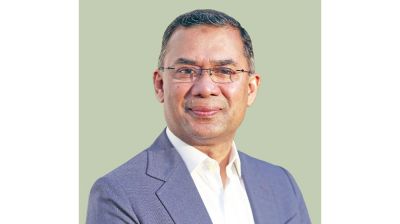
Mirza Fakhrul Islam Alamgir’s election as the 23rd President of Bangladesh marks an important moment in the country’s political and constitutional history. He secured 255 votes against 88 for his opponent, Colonel (Retd.) Oli Ahmad, in the first contested presidential election in Bangladesh since 1991.
At the age of 78, he has entered Bangabhaban with extensive experience in politics, public administration, teaching, parliamentary affairs and government. His elevation to the presidency is therefore more than an individual achievement; it offers him an opportunity to strengthen public confidence in an institution that has too often been viewed as merely ceremonial.

For many years, Mirza Fakhrul was known primarily as an opposition leader. He experienced political confrontation, imprisonment, legal cases, street agitation and prolonged uncertainty. He frequently represented his party at difficult moments, often employing a comparatively restrained and measured style of communication. Those experiences should help him understand the suffering caused by political repression, intolerance, arbitrary action and the denial of democratic space. They should also remind him that state institutions must never be used to humiliate or persecute political opponents. His greatest test is now beginning. Until his election, he belonged to a particular political party and spent decades advancing its programmes and defending its decisions.
Upon assuming the presidency, however, he must rise above that identity. He should no longer see himself as the representative of the BNP, its government or its parliamentary majority. He is now the head of state and the President of approximately 17 crore Bangladeshis. This transformation must be visible in both his conduct and his decisions. Formal resignation from party responsibilities is not enough; political neutrality must be demonstrated every day. His speeches, appointments, meetings and interventions should reflect equal respect for all citizens. Bangabhaban should not become an extension of the ruling party’s office, nor should access to the President be restricted to ministers, government supporters and political allies. Opposition leaders, representatives of smaller parties, civil-society organisations, religious and ethnic minorities, women, young people, workers, farmers, professionals and families affected by injustice should all feel that the doors of the presidency are open to them.
The President should become a guardian of constitutional morality. Under Article 48 of the Constitution, the President is the head of state and exercises the powers and performs the duties conferred upon him by the Constitution and other laws. Although the President is generally required to act on the advice of the prime minister, that limitation does not reduce the office to irrelevance. The President takes an oath to preserve, protect and defend the Constitution. That oath creates a solemn moral and constitutional obligation that cannot be dismissed as ceremonial. A responsible President can influence the direction of the country without exceeding constitutional authority. The President should be especially careful in making constitutional appointments. Wherever he has a formal or consultative role, merit, competence, integrity and political impartiality should take precedence over party loyalty. He should resist any effort to place clearly partisan or professionally unsuitable individuals in institutions that are expected to remain independent.
He should also exercise the presidential power of mercy under Article 49 with exceptional care. Pardons, reprieves and commutations must never become instruments for protecting politically influential offenders or rewarding party loyalty. Every mercy petition should be examined against transparent principles, the seriousness of the offence, judicial findings, humanitarian circumstances and the wider interests of justice. Arbitrary clemency can undermine the courts and weaken public trust in the rule of law. As commander-in-chief of the armed forces, the President should uphold the professional, disciplined and politically neutral character of the military. He must not encourage the armed forces to become involved in party politics, nor should political leaders be permitted to exploit military institutions for partisan purposes.
He should regularly engage with the prime minister, the leader of the opposition and other parliamentary leaders. During periods of severe political conflict, he can offer Bangabhaban as a neutral venue for dialogue. He may not be able to impose solutions, but he can encourage communication before disagreement turns into violence. A President who listens to all sides and quietly helps prevent confrontation performs a service far more valuable than one who merely attends ceremonies. The new President should also become a voice for national unity. Bangladesh has suffered from destructive political polarisation in which every question is interpreted through party identity. President Fakhrul should honour all nationally recognised contributions to the country’s history and avoid selective or partisan interpretations of the Liberation War, independence and democratic movements. National days and state commemorations should unite citizens rather than deepen division. He should recognize the sacrifices of freedom fighters, political activists, students, workers, farmers and ordinary citizens without attempting to monopolise history for any party.
He must speak firmly against communal violence, mob justice, political intimidation, corruption, extrajudicial conduct and attacks on freedom of thought. When minorities or vulnerable communities feel threatened, the President should not remain silent merely because executive authority lies elsewhere. A timely statement from the head of state can provide reassurance, awaken the administration and establish a moral standard for the nation. He should not remain silent when constitutional values are violated. The challenge is to be active without being interventionist, independent without being confrontational and influential without becoming partisan.
A President does not need unlimited executive power to be effective. Moral authority, constitutional knowledge, integrity, accessibility and the courage to speak at critical moments can make the office highly consequential. A ceremonial President who signs papers without scrutiny may appear to be a “paper tiger”, but a conscientious President can become the nation’s constitutional conscience. Mirza Fakhrul Islam Alamgir has spent much of his political life demanding democracy, fair elections, accountable government and respect for citizens’ rights. As President, he now has the opportunity, and responsibility, to apply those same principles without fear or favour. If he can become a patriotic, compassionate and constitutionally courageous head of state, he may redefine the presidency for future generations. He can demonstrate that the President of Bangladesh is neither a rival centre of executive power nor a silent ornament of the state, but a respected guardian of the Constitution, a mediator in moments of national difficulty and a symbol of the collective dignity and aspirations of all the people of Bangladesh.
_____________________________________
The writer is a former Major General, military diplomat, security and political analyst, researcher and author. He can be reached at [email protected]
Read More