


 For all latest news, follow the Daily Sun's Google News channel.


Nine years after more than 700,000 Rohingyas fled a brutal military crackdown in Myanmar and crossed the River Naf into Bangladesh, not a single one has been repatriated, and no credible timeline for their return exists.
The exodus began on 25 August 2017, when Myanmar’s military launched sweeping “clearance operations” after an attack by the Arakan Rohingya Salvation Army (ARSA) on security posts in Rakhine state.
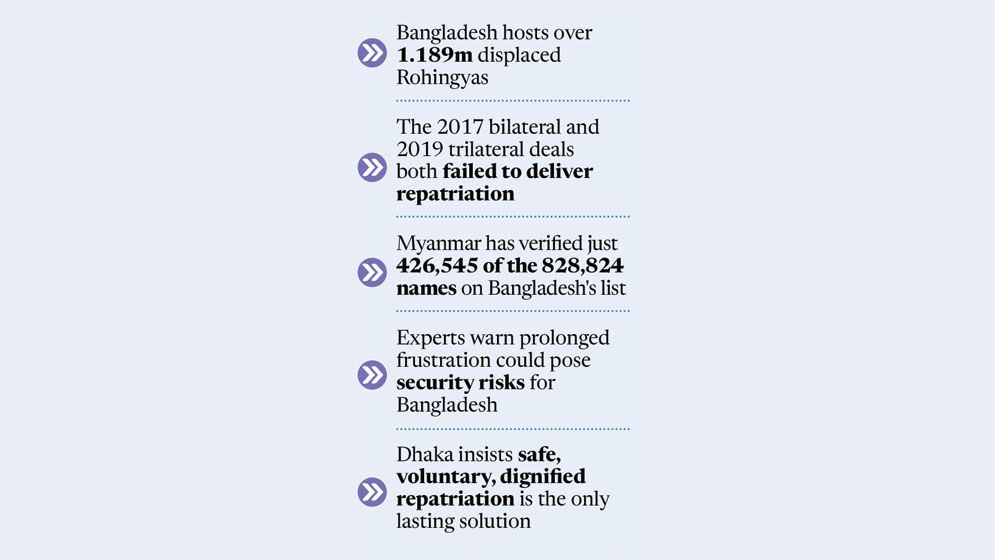
Bangladesh now hosts more than 1.189 million Rohingyas in overcrowded Cox’s Bazar camps, Foreign Minister Dr Khalilur Rahman told Parliament on 28 April.
“Rohingya repatriation cannot happen through words alone. Since 2018, we have been hearing that repatriation will begin today or tomorrow. But we have seen no reflection of those promises in reality,” United Council of Rohingya President Syed Ullah told the Daily Sun.
Myanmar says it has verified 426,545 of the 828,824 Rohingyas on a list submitted by Bangladesh as of 31 July 2026.
Referring to them as “Bengalis,” it confirmed 308,797 as former Rakhine residents, left 113,507 unverified, and flagged 4,241 as allegedly linked to “terrorist activities.”
Naypyidaw says it is proceeding with “sincere goodwill” once the security situation stabilises.
Syed Ullah dismissed this as stalling. “They are putting on a ‘drama’ to avoid taking back the Rohingyas. If they really wanted to take us back they could mention a specific time and the way of repatriation,” he said, adding that Myanmar’s denial of Rohingya identity and shifting conditions were deliberate obstacles.
Analysts tracking the junta and its allied governments in Naypyidaw describe the verification exercise as an old ploy to confuse the international community.
Migration and refugee affairs expert Asif Munier said Myanmar’s junta and its allies were using it to deflect international criticism.
“As a counter to the discussions and criticism at the international level over resolving the Rohingya crisis, they have essentially put forward this,” he said.
Diplomacy running dry
The 2017 Bangladesh-Myanmar bilateral repatriation agreement collapsed as Myanmar delayed verification, attached conditions and never created safe conditions for return.
Attempts in 2018 and 2019 also failed after refugees refused to go back without guarantees of safety, rights and citizenship.
A 2019 Bangladesh-Myanmar-China trilateral mechanism fared no better, hampered by Myanmar’s limited commitment, the coronavirus pandemic and renewed fighting in Rakhine.
Bangladesh’s interim government tried to revive momentum by appointing Dr Khalilur Rahman as High Representative on the Rohingya crisis in November 2024.
During a Ramadan visit to the Ukhiya camps with UN Secretary-General António Guterres, then chief adviser Prof Muhammad Yunus promised Rohingyas they would celebrate the following Eid-ul-Fitr at home.
That promise, too, went unfulfilled. Meanwhile, some 136,518 Rohingyas crossed into Bangladesh over the past year alone, fleeing fresh fighting between junta forces and rebel groups, according to the UN refugee agency (UNHCR).
The security picture in Rakhine has only grown murkier. Fighting between Myanmar’s military and the Arakan Army has intensified across parts of the state, leaving Rohingyas deeply anxious about their safety, legal status and access to basic rights should they return.
South Asia ethno-politics expert Altaf Parvez sees no prospect of return.
“The situation of the Rakhine State for Rohingyas has changed completely compared to 2017. Now the state is controlled by the Arakan Army, which considers Rohingyas as enemies. So, I don’t see any minimum chance of their repatriation there,” he told the Daily Sun, noting that Bangladesh has built no relationship with the Arakan Army, while Myanmar’s army, despite its dominance in Naypyidaw, wields little influence on the ground in Rakhine.
“In fact, Bangladesh did not have any Rohingya policy. It did not receive much importance in the BNP’s election manifesto either. No one here is taking the new realities in Rakhine into account. The deep-rooted hatred between the Rohingyas and the Rakhine people is also an obstacle to repatriation. No effort has been made to improve relations between the two communities,” Parvez added.
Dhaka’s position
State Minister for Foreign Affairs Shama Obaed Islam said on Sunday that hosting such a large displaced population has strained Bangladesh’s infrastructure, environment, public services and host communities, even as “the country continues to provide food, shelter, healthcare, education and protection as part of its humanitarian and moral responsibility.” That generosity, she said, must not become an excuse for international inaction.
She noted the UN funding appeal had fallen 26 percent, from USD965 million in 2025 to USD710.5 million in 2026, despite a growing refugee population and rising needs, and stressed that humanitarian aid alone could never be a lasting solution.
“The crisis originated in Myanmar. Its sustainable solution must ultimately be found in Myanmar,” she said, reiterating that Dhaka’s objective remains the safe, voluntary, dignified and sustainable return of Rohingyas to Rakhine. “A camp should never become a permanent substitute for a homeland.”
A generation born in exile
The crisis is compounding for the young. A large proportion of the Rohingya population is under 18, meaning thousands of children born in Bangladesh are growing up without a clear future, formal citizenship or adequate access to mainstream education.
Bangladesh currently hosts close to 1.2 million Rohingya refugees across 33 Cox’s Bazar camps, with children making up more than half that population, a number still growing through births as well as fresh arrivals.
A 2023 Ministry of Defence report put births at 95 a day; Refugee Relief and Repatriation Commissioner Mohammed Mizanur Rahman cited 25,000 to 30,000 births annually.
Education remains one of the sharpest gaps. UNICEF said in 2025 that a severe funding crisis had put roughly 230,000 Rohingya children at risk of losing access to schooling; by October 2025 it had reached over 235,000 learners, yet some 350,000 children remained out of school.
The funding crisis has made the situation even more precarious, with humanitarian programmes squeezed not just on education but food, healthcare, protection and other essential services.
Myanmar does not recognise the Rohingya among its 135 official ethnic groups, leaving the community effectively stateless.
That absence of citizenship rights raises serious questions over whether children born in Bangladesh could ever return and enjoy equal rights, even if repatriation eventually begins.
Security analysts warn that this statelessness, layered onto years of deprivation, is a hazard in the making.
“The number of Rohingya population has increased by one and a half times in nine years. The boy who aged 9 when they came is now 18. They have no job or quality life. International assistance is reducing. History says if frustration grips refugees, they stand against the host countries. We need work considering this,” said security analyst Brig Gen (retd) Dr M Sakhawat Hossain, a former adviser to the interim government.
“We have to find out a solution. Be it showing our strength or depending on any other country, we have to work with all the options we have. There is no alternative to repatriating Rohingyas to their homeland,” he added.
Read More