



 For all latest news, follow the Daily Sun's Google News channel.


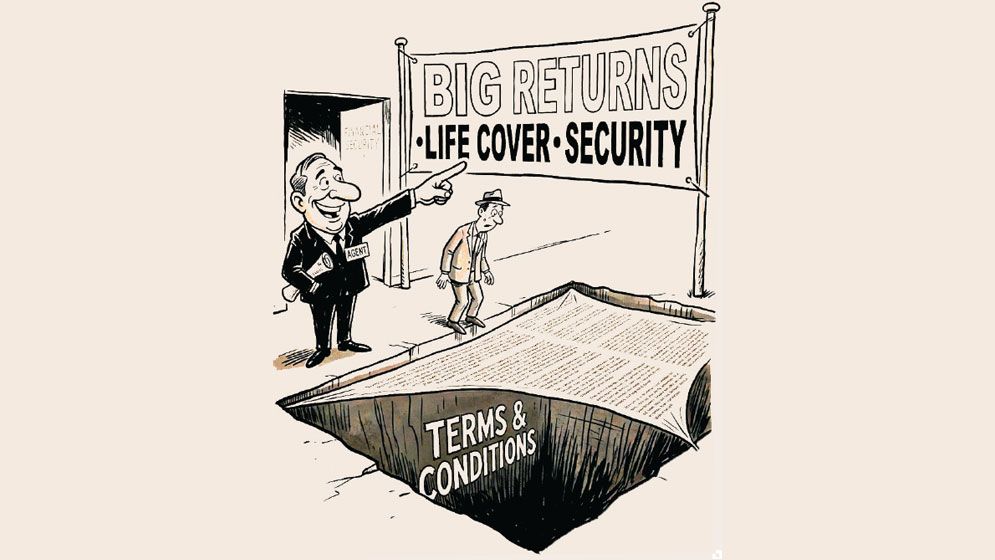

It was around 1pm on Sunday, 12 July 2026. Private company salesman Rafique Hossain and his wife, homemaker Salma Khatun, were sitting at a small tea stall behind Sonali Bank’s head office in Motijheel after finishing lunch when three agents from three separate life insurance companies approached and struck up a conversation.
Progressive Life Insurance agent Raju Mia (not his real name) introduced himself first and asked whether they had any plans for saving for the future, before explaining the benefits of a life insurance policy.
“Sir, you only have to pay premiums for five years. After that, you won’t have to pay any more instalments. At maturity, you will receive a large amount of money in a lump sum.”
Aastha Life Insurance agent Nazmul and Padma Islami Life Insurance agent Sohag (both pseudonyms) then joined in, and all three urged Rafique and his wife to buy a policy.
This reporter, seated at the same stall, observed the conversation throughout.
The agents compared life insurance to bank DPS schemes and government savings certificates, saying, “It is just like a DPS or savings certificate. You can withdraw the money whenever you need it. Your money will remain safe, and you will also get a good return in the future. Along with savings, you will also have life coverage. In the long run, it is a profitable investment.”
When Rafique asked what would happen if he needed the money mid-term, the agents assured him, “There is no problem. You can withdraw the money whenever you need it. Your money will not remain stuck.”
Pressed again on whether surrendering the policy in an emergency would cost him anything, they replied, “No sir, you can withdraw it when necessary. There is nothing to worry about.”
Over nearly 40 minutes, the three agents dwelt on profits, savings and security, but never mentioned the policy term, the consequences of discontinuing premiums or withdrawing early, the conditions for bonuses, health disclosures, or any other rules.
Rafique eventually said he had just started a new job and could not commit to regular savings, but took down all three numbers, promising to call later. This reporter noted the numbers too.
It was already known that life insurance customers often struggle to receive their money, with companies routinely finding pretexts to avoid paying claims.
What stood out at the tea stall was that the agents pushed only the upside, without a word on the risks or fine print.
That question prompted an investigation, which uncovered a long-running trap for deceiving customers, apparently running from policymakers down to field agents. Nearly 1.2 million customers are now caught in it, struggling to recover around Tk4,500 crore in claims.
Ten days later, on 26 July, this reporter called the three agents separately and asked why they had only touted the benefits to Rafique and his wife without explaining the conditions or even asking about pre-existing illness. Two declined to discuss it; one agreed to speak anonymously.
“If we explain all the conditions, risks and limitations at the very beginning, no customer will want to buy a policy,” he said. “We also have targets and commissions. Our families depend on that income. If we fail to sell a certain number of policies every month, we may not be able to keep our jobs.”
He added candidly that this was not the failing of one agent or company but a trend across the entire industry.
The investigation found that although life insurance forms carry customer information clearly in Bangla and English, companies print their conditions in tiny English text on the reverse.
Agents avoid raising these to protect their commissions and jobs, while customers rarely scrutinise the small print.
By the time a claim falls due, the customer’s money is tangled in conditions they never registered. Crucially, whether a policy was properly opened is checked only after a claim is filed, not before.
The insurance law allows a company’s licence to be cancelled, and the company shut down if necessary, for failing to pay a legitimate claim on time — but it does not clearly set out how customers recover their money.
An initiative to make three related laws more customer-friendly has, for unclear reasons, now been shelved.
No end to the suffering
Keya Akter, from Faridpur, bought a policy from Diamond Life Insurance but could not keep up payments amid financial hardship, and has since been unable to recover her money. Under the law, if premiums lapse in the first two years and the grace period expires, the policy becomes inactive — meaning even a nominee gets nothing on the policyholder’s death. Keya says she was never told this.
She had taken out a 15-year policy but, after depositing Tk30,027, could not continue.
“The person through whom I purchased the policy later went abroad. My husband had no income. I paid instalments for a few years but then could not continue. Nobody told me what would happen if the policy lapsed. I am only learning about these issues now,” she said.
She complained to the Insurance Development and Regulatory Authority (IDRA) on 10 September last year but has yet to see a remedy.
At Far East Islami Life Insurance’s head office in Motijheel, Rizia Parveen, a nurse from Tala upazila in Satkhira, has spent nearly two years chasing a Tk2.5 lakh claim. Widowed last year, she now supports her household and daughter’s education alone, and doctors say she needs urgent eye surgery or risks losing her sight permanently.
“I opened the policy in December 2012. The final premium adjustment was made in December 2024. According to the maturity receipt, I am supposed to receive Tk268,673. I properly filled out the maturity receipt and submitted the original documents and all premium payment receipts. The Satkhira office could not pay the money and told me to contact the head office. If I do not get the money soon, I may lose my eyesight. I may also lose my job. I do not know how I will survive with my daughter then,” she said.
Rizia’s story is not unique. Customers gather outside Far East every day.
When contacted to find out why customers were not receiving their money despite submitting valid documents, a case of financial embezzlement emerged at Far East.
An IDRA audit in 2021 found that Tk2,367 crore had been embezzled from Far East Islami Life. Another Tk432 crore in irregularities was also detected.
Acting CEO of Far East Islami Life Abdur Rahim Bhuiyan said the company was trying to recover the funds.
“If we can sell assets, it will be possible to pay the outstanding liabilities. At present, it is not possible to settle such a huge amount of liabilities with income from the existing business,” he added.
Behind hidden conditions
A routine question from agents — “How is your health?” — often draws a casual “fine,” which is then recorded without further probing.
Under the law’s principle of “utmost good faith,” any pre-existing condition such as heart disease, stroke, cancer, kidney disease or diabetes must be disclosed in writing.
If it later emerges that a customer concealed such a condition, the company can void the contract and pay nothing.
MetLife agent Naimul Molla told the Daily Sun that if a customer conceals a disease while filling out the policy form and an investigation proves it, the company has legal grounds to reject the claim.
He said the problem occurs most often when settling claims following a policyholder’s death. “Before paying a claim, if an investigation is conducted, family members easily disclose the pre-existing diseases. At that point, the company does not pay the policy money.”
Generally, premiums are mandatory for the first two years; missing this window and exceeding the 15-to-30-day grace period renders a policy “lapsed,” after which heirs receive nothing if the policyholder dies.
SM Ziaul Hoque, an insurance analyst and former CEO of Chartered Life Insurance, said all terms are printed on the reverse of the contract customers sign.
“The problem is that these conditions are written in very small English letters. They should definitely be written in Bangla. That would make them easier for everyone to read and understand.”
He identified underwriting at the claims stage, rather than at the point of sale, as another major flaw.
“Agents do not explain all the conditions to customers simply because of their desire for commissions. As a result, customers deposit money in good faith but become victims of legal complications at the final stage,” he said.
A review of policies from different insurance companies found that forms seek information in both Bangla and English, while the terms and conditions are written in English in small letters on the back.
Customers caught in this trap are creating a mountain of complaints at IDRA.
Tk4,500 crore in claims, 1.2 million customers
IDRA data show that, as of end-March this year, claims across the country’s 36 life insurers totalled Tk6,812.67 crore, of which only Tk2,402.55 crore had been settled, leaving Tk4,410.12 crore outstanding. Between IDRA’s founding on 26 January 2011 and December 2025, customers were owed Tk4,403 crore across 1,185,000 policies.
Far East Islami Life alone owes Tk3,320 crore to 567,000 customers, and Padma Islami Life owes Tk270 crore to 254,000 customers. Sunflower Life has Tk208.09 crore in pending claims, Progressive Life Tk159.23 crore, the state-owned Jiban Bima Corporation Tk69.92 crore, MetLife Bangladesh Tk60.99 crore, Delta Life Tk56.39 crore, Golden Life Tk53.93 crore, Sunlife Tk36.73 crore and Homeland Life Tk35.49 crore.
Far East Islami Life chairman Md Fakhrul Islam said, “We are trying in various ways to return the money to customers. We have taken an initiative to sell a piece of land and have also obtained approval from IDRA. We hope that after selling the land, it will be possible to pay all the outstanding dues to customers.”
Bangladesh Bank’s Financial Stability Report 2025 shows the life insurance claim settlement ratio fell from 72.43% in 2023 to 66.54% by the end of 2025.
New IDRA Chairman Mir Nadia Nivin said restoring customer confidence was her priority.
“The biggest crisis in the insurance sector is customer confidence. I have started working to restore that confidence. My first task will be to arrange payment of outstanding claims. Once claim payments begin, customer confidence will gradually return,” she added.
She said IDRA was also weighing asset sales at weak companies, an end to commission trading, risk-based supervision, and amendments to the insurance law, drawing on four sources to fund settlements: FDRs held with sound banks, government treasury bonds, saleable land and other investments.
“Regarding deposits stuck in risky banks, we will discuss the matter with Bangladesh Bank and seek a solution,” she said.
Experts note that many customers sign contracts without grasping the terms, only discovering the limitations when they file a claim.
“Insurance companies also have considerable responsibility for this mistake. They should explain every term and risk in simple language so that ordinary customers can make informed decisions,” they said.
Contract law itself requires that agreements be clear and understandable to both parties, regardless of the language used. Sustained public awareness campaigns, they say, could help turn insurance from a paper contract into genuine financial security.
A strange law
Under the Insurance Act 2010 and the Insurance Act 1938 (as amended), claims must be settled within 90 days of document submission, with interest due for delays. Customers can escalate unresolved claims to IDRA.
IDRA spokesperson Saifunnahar Sumi said that when a customer submits a written complaint after failing to receive a claim, IDRA instructs the company concerned, in writing or verbally, to settle it.
“If they still fail to make the payment, there is a provision to cancel the company’s licence (certificate of registration),” she said.
Section 10(10) of the Insurance Act 2010 allows IDRA to seek a company’s liquidation through the courts six months after a licence is finally cancelled – though Sumi cautioned this was not a final solution. “If the registration is cancelled, other policyholders of the company will also face losses,” she noted.
Dr Md Main Uddin, professor of banking and insurance at Dhaka University, said the government gave the sector little priority, letting irregularities go unchecked.
“It is deliberately done by leaving an ambiguity. The conditions are written in English and in long sentences. This is an attempt to hide information and open policies. It is dishonesty, it is deception. In our country, companies have treated insurance not as a service but as a fraudulent business.”
He argued IDRA must examine whether firms properly verified customers and communicated key conditions at the outset, something he said had never been scrutinised, adding that fine print in inaccessible language, enforced only at claim time, sits at odds with the principle of a fair contract.
Amendment initiative also put on hold
Draft amendments to the Insurance Act 2010, the Insurance Development and Regulatory Authority Act 2010, and the draft Insurer Resolution Ordinance 2026 had been prepared and sent to the Financial Institutions Division last year.
But IDRA has put the initiative on hold.
In a letter issued by IDRA’s Law Division on July 14, it said drafts of amendments to the Insurance Act 2010 and the IDRA Act 2010, as well as the “Insurer Resolution Ordinance 2026”, had earlier been sent to the Financial Institutions Division through three separate memoranda.
A review of the proposed amendment to the Insurance Act 2010 found that it included stricter provisions to increase government control over insurance companies, reduce family influence and protect customers.
It proposed banning companies that failed to meet capital requirements from selling new policies or collecting premiums and imposing fines ranging from Tk10 lakh to Tk1 crore.
The draft also proposed increasing IDRA’s powers, including allowing it to search company offices in suspicious cases, break locks and seize documents and, if necessary, sell company assets to pay customers’ claims.
It proposed reducing the first-year commission for life insurance agents from 35 percent to 25 percent and increasing the second-year commission from 10 percent to 15 percent.
For customer protection, it proposed establishing a special fund to pay customers’ dues if an insurance company became insolvent or entered a crisis.
The draft also strengthened the obligation to settle outstanding claims within a specified period after policy maturity and proposed giving IDRA authority to sell assets of weak companies when necessary to pay policyholders.
However, in its latest review, IDRA commented, “The drafts need to be reviewed more thoroughly and necessary amendments made.”
It therefore requested the Financial Institutions Division not to take any further action on the drafts until further instructions.
A letter signed by IDRA’s Director (Law) was sent to the Secretary of the Financial Institutions Division of the Ministry of Finance. The deputy secretary responsible for the insurance branch was also requested to take note of the matter.
In search of the authorities
On 29 July, seeking an update on the shelved drafts, this reporter was redirected from the Banking and Financial Institutions Division to the Insurance and Capital Market Division, where the Additional Secretary was unavailable, an employee saying, “We cannot meet him until the meeting is over.”
Two deputy secretaries also declined to comment, both saying, “Many people joined the division after 5 August 2024. So it is not possible for us to comment at this moment.”
One division official, speaking anonymously after repeated requests, said IDRA would review the matter afresh.
“They have said that they will make some provisions more up-to-date. After they submit the revised draft, a meeting will be held with the relevant stakeholders. A final decision will be taken only after that meeting.”
A source at IDRA, also speaking anonymously, said the amendment initiative had effectively been suspended under pressure from the owners of some insurance companies and other influential quarters.