



 For all latest news, follow the Daily Sun's Google News channel.


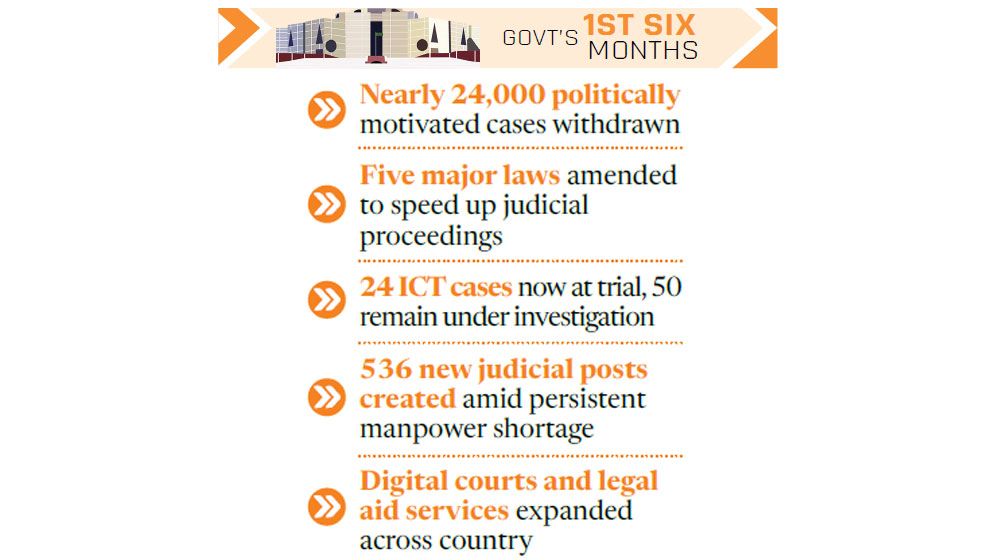
Six months into the BNP-led government’s term, judicial reform has emerged as a major priority, with nearly 24,000 politically motivated cases withdrawn and a series of legislative, administrative and digital measures introduced to tackle case backlogs and make justice more accessible.
Information from the Law Ministry shows that the government has focused on several fronts simultaneously – reviewing politically motivated cases filed during the previous fascist Awami League regime, expanding judicial capacity, modernising court procedures and bringing legal services online.
Nearly 24,000 cases withdrawn
As of July 2026, nearly 24,000 false, fabricated and politically motivated cases had been withdrawn nationwide following scrutiny by review committees.
Dhaka accounted for the highest number, with 7,600 cases withdrawn, followed by Chattogram with 2,185, Narayanganj 854, Sirajganj 692, Bogura 634, Rangpur 593, Sherpur 414, Mymensingh 406, Gazipur 389, Cumilla 282 and Sylhet 243. Other cases were withdrawn in other districts.
Law Minister Md Asaduzzaman said the review process was continuing across the country to identify remaining politically motivated cases while ensuring that genuine criminal cases were not arbitrarily dismissed.
Legislative overhaul
The government has amended several key laws to remove procedural bottlenecks and speed up court proceedings.
The “Code of Civil Procedure (Amendment) Act, 2026” allows digital service of summons through SMS and voice calls, permits plaints and written statements through sworn affidavits, enables direct cross-examination and allows execution petitions to be filed within the main suits, avoiding separate execution proceedings.
The “Code of Criminal Procedure (Amendment) Act, 2026” seeks to streamline trial procedures, introduce digital summons delivery and reduce cumbersome property proclamation and attachment procedures for absconding accused.
The “Women and Children Repression Prevention (Amendment) Act, 2026” was passed during the first session of the 13th parliament to accelerate trials and strengthen accountability in cases involving violence against women and children.
The “International Crimes (Tribunals) (Amendment) Act, 2026” seeks to bring tribunal proceedings in line with international standards and explicitly recognise enforced disappearances as crimes against humanity.
The “Commercial Court Act, 2026” provides for specialised courts to resolve business disputes more quickly, with the broader aim of strengthening investor confidence and economic activity.
ICT trials gather pace
Proceedings over crimes against humanity committed during the 2024 mass uprising have also advanced over the past six months.
The two International Crimes Tribunals – ICT-1 and ICT-2 – have delivered verdicts in six cases, convicting 60 people.
Some of the verdicts were delivered during the present government, while others were issued under the Prof Yunus-led interim government.
More than 80 cases have so far been filed with the ICT, with proceedings in 74 continuing. Of these, 24 are at the trial stage and 50 remain under investigation.
Former Awami League minister Abdul Latif Siddique was arrested in connection with the 2013 Shapla Chattar massacre case during the current government.
The ICT investigation has been completed and the case is now at the charge-framing stage.
ICT Chief Prosecutor Md Aminul Islam said efforts were under way to conclude 20 cases currently on trial within the next year. He expects the Shapla Chattar case to go to trial soon and be completed within a year.
He also said preparations were under way for Supreme Court appeal hearings in the ICT case involving ousted prime minister Sheikh Hasina over the 2024 atrocities.
Digital courts expand
The government has expanded the use of technology to make judicial services more accessible. e-Family Courts are operating in Dhaka and Chattogram, benefiting women, children and litigants who live far from district courts.
Cause lists of almost all courts are now available online, allowing litigants and lawyers to check hearing dates without visiting court premises.
Information and service centres have also been established at lower courts to assist litigants with case-related services.
An e-Bailbond Management system has been launched in 16 districts, enabling lawyers to submit bail bonds online.
An e-Judiciary project is also being pursued to digitise filing, case tracking, court management and preservation of judicial records.
Capacity remains a challenge
Despite the reforms, a shortage of judges remains a major challenge. Of 2,620 sanctioned judicial posts, 1,964 judges are currently serving.
Recruitment and promotion processes are under way, including the recruitment of 150 civil judges through the Bangladesh Judicial Service Commission.
According to the law minister, 536 new judicial posts have already been created and additional courts sanctioned, including Civil Judge, Senior Civil Judge and Additional District Judge courts.
Separate judicial magistrate courts are also being established to allow magistrates to focus more closely on adjudication rather than investigation-related and remand functions.
Infrastructure projects, including new Chief Judicial Magistrate court buildings and expansion of existing facilities, are also being considered to address courtroom shortages.
Legal aid gets wider reach
The “Legal Aid Services (Amendment) Act, 2026” seeks to reduce unnecessary litigation through mediation by District Legal Aid Offices.
The government is also expanding free legal support through 300 union-level digital legal aid centres and a toll-free helpline.
Law Minister Md Asaduzzaman said the government was advancing efforts to make legal aid services more accessible and efficient through digitalisation.
Online marriage and divorce registration is also being introduced in selected unions under the Civil Registration and Vital Statistics project, with the aim of reducing fraud, irregularities and disputes.
The reforms mark a broad attempt to address long-standing weaknesses in the justice system through legislative changes, expanded judicial capacity, digitalisation, mediation and wider access to legal services.
The reporter can be reached at: [email protected]