


 For all latest news, follow the Daily Sun's Google News channel.


DEATHS AT SHIPBREAKING YARD
No toxic gas in air, BUET team search water and sludge for clues

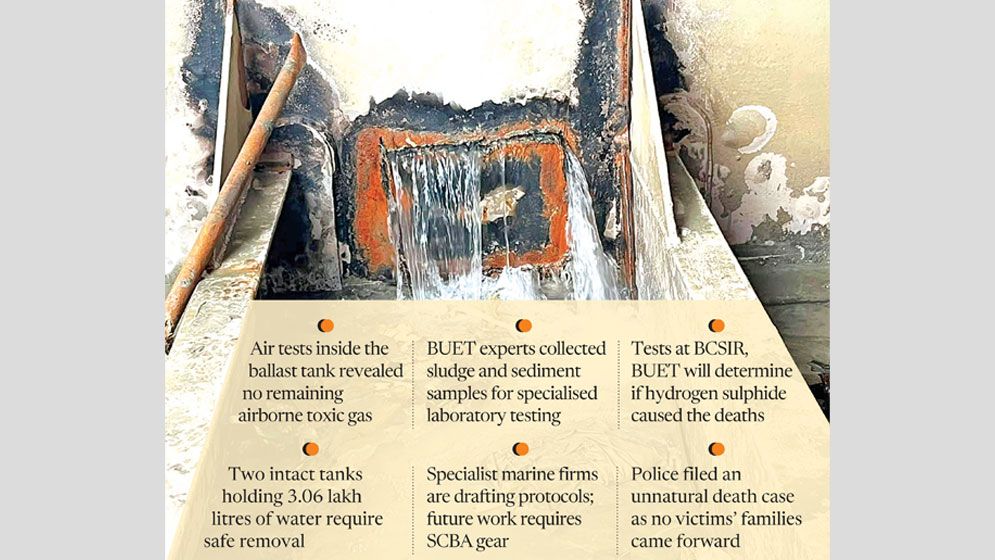
An expert investigation team led by Bangladesh University of Engineering and Technology (BUET) found no toxic gas in the ambient air of a ballast tank at the center of last Friday’s fatal shipyard accident, though investigators have taken sediment and sludge samples to uncover what killed nine shipbreakers.
The eight-member team, headed by Prof Dr Md Yasir Arafat Khan of BUET’s Chemical Engineering Department, began field investigations on Monday at Ferdous Steel Ship Recycling Industries in Sitakunda, Chattogram.
The tragedy unfolded when 19 workers were exposed to deadly fumes while scraping a vessel; nine died and ten others sustained injuries.
“The investigation team found no toxic gas after testing the air inside the ballast tank. However, they collected sediment and sludge samples from there,” ASM Shafiul Alam Talukder, Director General of the Bangladesh Ship Recycling Board, told the Daily Sun.
“The tests on these samples may provide important information about the chemical conditions inside the tank.”
The samples will be tested at the Bangladesh Council of Scientific and Industrial Research (BCSIR) laboratory in Chattogram and at BUET in Dhaka to determine if hazardous substances, such as hydrogen sulphide, generated inside the tank and caused the fatalities.
The vessel’s five ballast tanks originally held around one million litres of seawater used for vessel balance. Yard workers had cut open two tanks before the fatal leak occurred during work on the third. Two intact tanks still contain roughly 3.06 lakh litres of water, raising urgent concerns over safe discharge and cutting operations.
Shafiul Alam noted that two local marine firms, Alif Marine and Prantik Marine, have been tasked with drafting mitigation plans to safely drain and dismantle the remaining tanks. Workers will be required to wear Self-Contained Breathing Apparatus (SCBA) masks during subsequent cutting.
A member of the expert panel, speaking on condition of anonymity, revealed a three-stage plan: identifying remaining gas pockets and potential evacuation needs, containing contaminated water to protect marine life, and analyzing sludge samples to trace how hazardous fumes formed. The findings aim to establish whether safety negligence played a role.
Mahbubur Rahman, technical consultant to the Bangladesh Shipbreakers Association, stated that the vessel had been certified gas-free before dismantling began. “Under the HKC [Hong Kong Convention], responsibility is shared, and the investigation will determine whether any negligence led to the accident,” he said.
Meanwhile, Sitakunda Model thana police filed an unnatural death (UD) case on Monday night after no family members of the deceased came forward to register a complaint, confirmed Officer-in-Charge Mohinul Islam.