



 For all latest news, follow the Daily Sun's Google News channel.


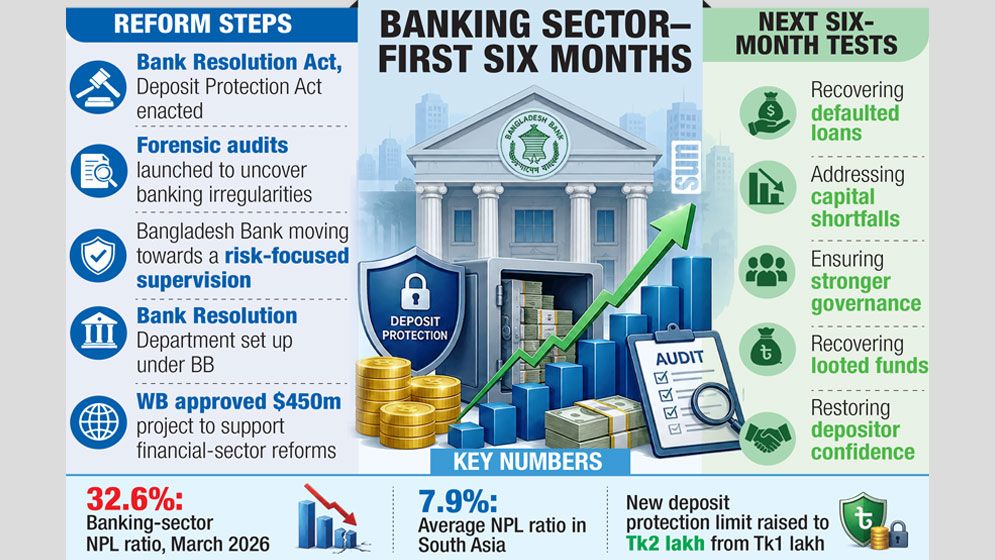
The incumbent BNP-led government, over its first six months in office, has advanced several structural reforms in the banking sector, including enacting the “Bank Resolution Act” and “Deposit Protection Act”, launching forensic audits and moving towards risk-based supervision.
But soaring non-performing loans (NPLs), capital shortfalls, weak governance and low depositor confidence remain formidable challenges, with no visible improvement yet in the sector’s key financial indicators.
Years of political influence, insider lending, weak corporate governance, irregularities, corruption, loan embezzlement and regulatory failures have left the banking sector in deep crisis. The problems cannot be resolved simply through new policies or circulars.
Stakeholders therefore view the government’s first six months not as a period in which the crisis has been solved, but as one in which long-hidden weaknesses have been exposed and a framework for addressing them has begun to take shape.
According to the World Bank, the banking sector’s NPL ratio reached 32.6 per cent at the end of March 2026, while its risk-weighted capital-to-assets ratio stood at negative 2.6 per cent at the end of December 2025. The average NPL ratio among South Asian banks was 7.9 per cent.
Dr Zahid Hussain, former lead economist of World Bank’s Dhaka office, said three issues would be the biggest tests for the government over the next six months.

“First, recovery of defaulted loans. It will not be enough simply to identify new NPLs. The government must make visible how much money has actually been recovered and from whom,” he said.
“Second, addressing the capital shortfall. There needs to be a clear policy on how much public money will be used to recapitalise weak banks, how much liability will be imposed on former owners and directors, and how similar looting will be prevented in the future.”
“Third, ensuring good governance. Simply appointing new boards does not constitute reform. Effective controls must be established over ownership structures, appointment of directors, related-party lending, loan approval processes and political influence.”
M Masrur Reaz, chairman of Policy Exchange Bangladesh, said the central question was not merely who would manage weak banks.
“The bigger question is how the liabilities of those who weakened the banks in the past will be determined and how the money that was looted will be recovered,” he said.
The success of banking reform, he added, would not be measured by the number of laws enacted, circulars issued or committees formed, but by how much banks’ balance sheets are cleaned up, defaulted money recovered, those involved in corruption held accountable and depositor confidence restored.
Major legal reforms
On 10 April, parliament passed the “Bank Resolution Act, 2026”, giving Bangladesh Bank a formal legal framework to intervene in distressed banks through restructuring, acquisition, recapitalisation or resolution. It provides a permanent legal basis for the framework earlier established through the “Bank Resolution Ordinance, 2025”. Bangladesh Bank has also established a separate Bank Resolution Department.
The new framework potentially allows authorities to restructure or resolve a non-viable bank instead of keeping it afloat for years through liquidity support, loan rescheduling and regulatory concessions.
However, when the ordinance was enacted as an Act, the government added Section 18(A), allowing former bank owners an opportunity to return to ownership. Following strong criticism, the government later decided to scrap the provision.
The “Deposit Protection Act, 2026”, also approved on April 10, replaced the “Bank Deposit Insurance Act, 2000”, and brought financial institutions alongside banks under the deposit protection framework. It doubled the protection limit for an individual depositor from Tk1 lakh to Tk2 lakh.
The move provides greater assurance to small depositors if a bank is closed or placed under resolution.
But stakeholders say the higher protection limit alone cannot address the sector’s fundamental problems unless loan recovery, governance and capital strength improve.
NPLs remain the biggest challenge
NPLs remain the most pressing weakness in the reform process. The World Bank has identified weak corporate governance, regulatory capture and related-party lending as major causes of the crisis.
However, the recent rise in NPLs cannot be attributed entirely to the present government. Stricter loan classification and provisioning rules over the past two years have brought many previously hidden bad loans onto banks’ books. The exposure of the sector’s actual financial losses has therefore also contributed significantly to the rise in NPLs.
Bangladesh Bank is now moving towards risk-based supervision, under which greater attention will be given to banks carrying higher risks, weak asset quality, poor management and governance deficiencies.
The approach marks a shift from a system focused largely on regulatory compliance and paperwork towards closer scrutiny of business models, risk management, asset quality and governance.
The World Bank has also stressed the need to strengthen Bangladesh Bank’s supervisory capacity, data analysis and risk-based supervision. In June, it approved a $450 million “Financial Sector Support Project-II” to support financial-sector reforms, including deposit protection, emergency liquidity assistance, bank restructuring and resolution, and reforms in state-owned banks.
Strengthening internal controls will also be crucial to preventing lending to multiple entities within the same business group, forged documentation, loans against overvalued assets and director-influenced loan approvals.
Meanwhile, Bangladesh Bank is preparing to introduce the “Expected Credit Loss (ECL)” methodology under “International Financial Reporting Standard (IFRS) 9”. The system will require banks to recognise provisions based on expected future losses rather than waiting until loans become defaulted.
Bangladesh Bank plans to implement ECL for funded and non-funded credit facilities from 1 January 2028.
The system could make banks’ financial positions more transparent. Higher provisioning for potential future losses could reduce reported profits and, in some cases, expose additional capital shortfalls.
For the government, therefore, the next six months will be crucial, analysts observe, adding the real test will be whether the reforms now under way translate into cleaner balance sheets, higher loan recovery, stronger governance, greater accountability and, ultimately, renewed depositor confidence.