


 For all latest news, follow the Daily Sun's Google News channel.


Export diversification has emerged as a key priority of the BNP government during its first six months, with a series of measures aimed at reducing Bangladesh’s heavy dependence on the ready-made garment (RMG) sector and building a broader export base ahead of LDC graduation.
Economists and exporters have welcomed the initiatives, particularly the push for new trade agreements, financial support and the development of non-RMG sectors, but said their success would depend on speedy implementation.
They also stressed the need to ensure reliable energy supplies, improve access to bank financing, strengthen supply chains and reduce the high cost of doing business.
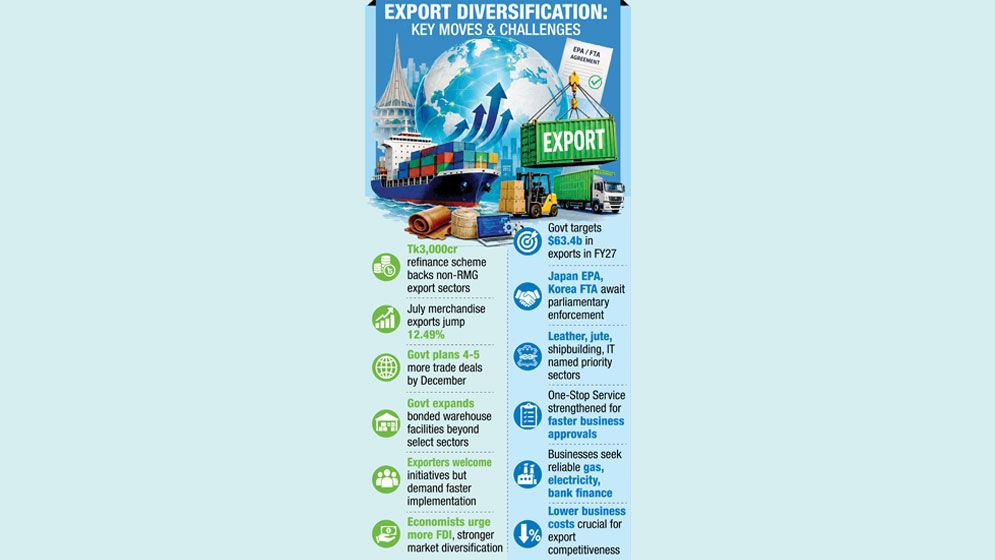
The government has set an ambitious export earnings target of $63.4 billion for the ongoing 2026-27 fiscal year (FY27), seeking 15% growth in exports of goods and services.
Of the total, $55.2 billion is expected to come from merchandise exports and $8.2 billion from services, according to Commerce Minister Khandakar Abdul Muktadir.
The target comes after merchandise exports fell 0.58% to $48 billion in FY26 from $48.28 billion in FY25, missing the previous target of around $55 billion, according to Export Promotion Bureau (EPB) data published on 2 July.
There was, however, a strong start to the new fiscal year, with merchandise exports reaching $4.72 billion in July, up 12.49% from $4.20 billion in June.
The commerce minister expressed optimism that exports would regain momentum, citing policy stability under the newly elected government and a series of business-friendly measures. He said diversification would remain a priority as RMG currently accounts for around 85% of export earnings.

The government has identified leather and leather goods, jute, shipbuilding and ship recycling, light engineering and information technology as priority sectors for expansion.
As part of the effort, Bangladesh Bank has launched a Tk3,000 crore export diversification refinance scheme to strengthen production capacity and expand the export base beyond RMG.
The scheme is intended to address product and market concentration risks arising from the country’s heavy reliance on the garment sector and support high-potential export industries.
New trade arrangements
The government has also moved to widen market access. Bangladesh has signed an Economic Partnership Agreement (EPA) with Japan and a Free Trade Agreement (FTA) with South Korea, which are to be placed before parliament for enforcement.
Negotiations are continuing with the European Union, New Zealand, Malaysia and the United Arab Emirates, among others. Muktadir said the government plans to conclude trade negotiations with four to five more countries by December.
On LDC graduation, the minister said uncertainty surrounding the process had largely been resolved and exporters would continue to enjoy existing market access facilities for the next three years.
Bangladesh Garment Manufacturers and Exporters Association (BGMEA) Director Mohammed Sohel said the government had taken several positive measures, including pursuing an FTA with Japan, providing financial packages for the RMG sector and increasing policy support for struggling factories.
“These measures could help exporters expand into new markets and remain competitive. The government’s initiatives are positive for export-oriented sectors. But many challenges remain in the industries and those should be resolved quickly. However, speedy implementation is now crucial,” he said.
Sohel, also a director of the Japan-Bangladesh Chamber of Commerce and Industry (JBCCI), said the government must address the high cost of doing business, ensure reliable gas and electricity supplies and improve access to bank financing.
Exporters also need stronger support to explore new markets as competitors such as India and Vietnam secure preferential trade access, he said, adding that rising energy costs, global uncertainty and declining orders were putting particular pressure on small and medium-sized factories.
Mohiuddin Rubel, founder of Bangladesh Apparel Voice and a former BGMEA director, also welcomed the government’s initiatives, particularly the bilateral trade agreements.
“We expect that the country’s exports will increase if the agreements are ratified properly in coming days,” he said.
Distinguished Fellow of the Centre for Policy Dialogue (CPD) Professor Mustafizur Rahman said the government had taken several positive steps over the past six months.
The FY27 budget has expanded bonded warehouse facilities beyond a limited number of sectors and widened facilities for opening letters of credit against bank guarantees and export orders.
The One-Stop Service has also been strengthened, with timelines set for registration, licensing and work permits.
However, he said policy support alone would not be enough to attract investment and diversify exports.
“Lack of reliable gas supply and quality electricity remains a major obstacle for new industries,” he said.
Bangladesh must do more to encourage local entrepreneurs and attract foreign direct investment, while addressing supply-side constraints to build competitive industries capable of producing diversified products for global markets, Mustafizur said.
He also called for more aggressive pursuit of FTAs and EPAs before existing market advantages begin to erode after LDC graduation, particularly as Vietnam and India are securing preferential access to the EU.
“FTAs, however, will bring both opportunities and challenges. Bangladesh will gain market access but will also have to open its own market to foreign competition. Therefore, the government must ensure that domestic industries, particularly import-substituting industries, are prepared to compete,” he said.
The economist stressed that Bangladesh needs to pursue both product and market diversification aggressively, using the available time to remove supply-side constraints, attract investment and secure new trade arrangements.
Read More