


 For all latest news, follow the Daily Sun's Google News channel.


Saltha jute farmers fear poor returns as production costs rise
Daily Sun Report, Faridpur
Published: 16 Aug 2026, 12:00 AM
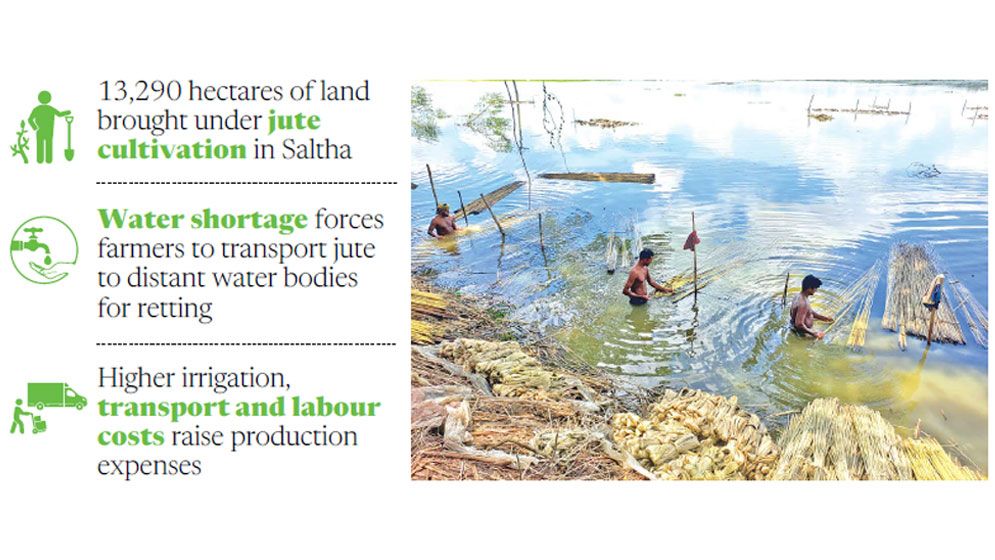
Jute growers in Saltha upazila of Faridpur are facing mounting production costs due to a lack of rain and water shortages in nearby ponds and other water bodies.
With insufficient water close to their fields, farmers have been forced to transport harvested jute to distant rivers, canals and ponds for retting, incurring additional costs for transport and labour. Extra irrigation at the beginning of the season, followed by the expense of carrying jute long distances for retting, has pushed up overall production costs considerably.
Recent rainfall, however, has brought some water back to local water bodies, allowing farmers to carry out retting, fibre extraction and drying activities.
A visit to different areas of the upazila, including Jadunandi, found farmers busy from early morning in rivers, canals and beels. Some were extracting fibre from jute bundles after retting, while others were washing the fibre and spreading it out in the sun to dry.
Farmers said the rural economy of Saltha depends largely on jute and onion cultivation.
“Since there was no water near my field, I had to hire a vehicle to transport the jute to the river for retting.
If we do not get a good price for jute, we will suffer a major loss this year,” said Miraj Molla, a farmer from the Jadunandi area.
Another farmer, Alauddin, said some growers had irrigated their own ponds to ensure sufficient water for retting because they feared the additional costs involved in transporting jute elsewhere. He called for a fair market price that would take the increased cost of production into account.
According to the Saltha upazila agriculture office, jute has been cultivated on 13,290 hectares of land in the upazila this season. The Tossa jute variety JRO-524, locally known as Nabil, accounts for the largest share of cultivation.
Abdul Bari, an assistant jute development officer at the upazila, said the lack of rain had increased farmers’ production costs, particularly for irrigation and transportation. “Due to the lack of rain, farmers’ production costs have increased to some extent because of irrigation and transportation expenses. Fibre extraction is now under way,” he said.
Upazila Agriculture Extension Officer Agriculturist Rezaul Karim said the agriculture department had provided farmers with necessary advice and support from the beginning of the season.
“However, adverse weather conditions have affected jute yields to some extent this year,” he said.