


 For all latest news, follow the Daily Sun's Google News channel.


The government plans to phase out existing battery-powered rickshaws in Dhaka within three months and replace them with a regulated system featuring mandatory registration, GPS tracking and geo-fencing, as authorities move to curb their rapid and largely unregulated expansion.
Under the proposed system, battery-powered rickshaws would be confined to designated feeder roads and barred from main roads. The vehicles would be divided into an eight-division system, with each division assigned a distinct colour.
The move comes amid growing concerns over road safety, illegal manufacturing, unauthorised electricity connections and worsening traffic congestion. At the same time, the vehicles have become a crucial source of income for thousands of rural migrants displaced by floods, unemployment and climate change.
Md Anisur Rahman, additional police commissioner (Traffic) at the Dhaka Metropolitan Police (DMP), told the Daily Sun on Wednesday evening that officials had met the LGRD minister to address the situation. “We on Thursday held a meeting with the LGRD minister to address the crisis being created due to the abnormal presence of battery-run rickshaws on the city streets,” he said. He said all existing rickshaws would be phased out within three months and replaced under the new eight-division system, with GPS and geo-fencing used to keep them on designated feeder roads.
“We will not allow the battery-operated rickshaw on the main roads, while registration under the respective city corporations will be made mandatory for the battery-run rickshaw to be plied on the feeder roads,” he said, adding that authorities were prepared for possible unrest.
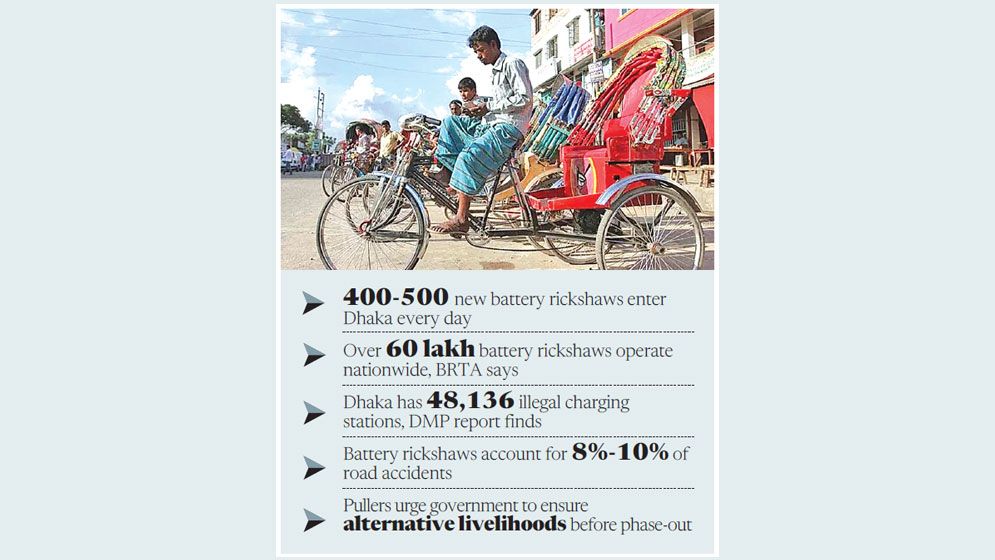
The rapid growth of the vehicles has been driven partly by migrants arriving in Dhaka after losing livelihoods in rural areas. A study estimates that around 400 to 500 new battery-run rickshaws take to the capital’s streets every day. Visits to Farmgate, Khamarbari, Raja Bazar, Shukrabad and Monipuri Para found migrants from north-western districts including Thakurgaon, Nilphamari, Panchagarh, Kurigram, Bogura and Jamalpur, as well as Barishal, Cumilla, Bhola and Chandpur.
Most of the pullers interviewed were aged between 20 and 40. Many said floods or unemployment had forced them to abandon farming, livestock rearing and fishing after losing their land and livelihoods.
A battery-powered rickshaw, which can be rented for around Tk1,000 a day, requires less physical effort than a traditional rickshaw, while drivers generally do not need a licence. For many migrants, it offers a relatively steady income.
Ziaur Rahman, about 30, from Kurigram, said he had received no training and knew little about traffic rules. “I came to Dhaka a few days ago as we have no work in our area, and everything, including seasonal crops, was swept away due to the recent flood. What will I do and how will I maintain my family with my wife, two sons and a daughter? Finding no other alternative, I took to the seat of the battery-run rickshaw,” he said.
Pullers said a single owner often operates 30 to 50 rickshaws, with garages and charging stations where drivers can sleep and eat cheaply.
Abdur Rahim, from Cumilla, who previously drove a CNG three-wheeler and a paddle rickshaw, said he earned around Tk1,500 to Tk1,800 a day, of which Tk600 went to the owner as rent.
“If we can run for all 30 days, we can earn at least Tk45,000, of which we spend Tk8,000 on accommodation and meals, Tk18,000 as rent and Tk4,000 to Tk5,000 on other expenses. At the end of the month, we save around Tk12,000 to Tk15,000,” he said.
Owners can also make substantial returns. One owner at Farmgate, who asked not to be named, said a rickshaw costs around Tk80,000 and earns its owner about Tk18,000 a month, allowing the investment to be recovered in roughly four and a half months. The battery is the most expensive component, costing around Tk30,000 and lasting about six months, he said.
The owner said battery-powered rickshaws, once mainly used by people unable to pedal conventional rickshaws, were now being driven by people from a wide range of backgrounds, including those with physical disabilities who had few other ways to earn a living.
Bashir Ahmed, from Rangpur, said he could not drive a paddle rickshaw because his right leg did not function properly. Driving a battery-powered rickshaw was his only source of income, he said, adding that he sent Tk12,000 home to his family each month.
The unregulated industry has also spawned a large manufacturing and charging network. At least 1,500 factories in Kamrangirchar, Keraniganj, Kamalapur, Sabujbagh, Manda, Gazipur and Tongi manufacture the vehicles, often illegally.
The Bangladesh Road Transport Authority estimates that more than 60 lakh battery-powered rickshaws operate nationwide, including 10 to 12 lakh in Dhaka.
A DMP report last year recorded 3,300 legal charging stations against 48,136 illegal ones and 992 garages. Many of the illegal facilities use unauthorised electricity connections.
Road safety experts have also raised concerns about the vehicles. Kazi Saiful Islam, an assistant professor at BUET’s Accident Research Institute, said battery-powered auto-rickshaws accounted for 8 to 10 per cent of road accidents nationwide, citing their weak braking systems and body structure.
The issue has been contentious for years. On 19 November 2024, the High Court ordered a ban on the vehicles in Dhaka within three days, prompting protests and clashes between drivers and police in Dayaganj and Mohakhali. Pullers later blockaded roads, leading to a temporary stay by the Supreme Court.
Following the latest government plan, a group of battery-powered rickshaw pullers at Khamarbari intersection urged the authorities to ensure alternative livelihoods for drivers and their families.
An outright ban would create severe hardship for drivers, they said, arguing that the vehicles should instead be brought under a clear regulatory framework.