



 For all latest news, follow the Daily Sun's Google News channel.


Six months into the BNP-led government, businesses are hopeful that investment will finally revive, but high lending rates, energy shortages, economic uncertainty and slow implementation of policy support continue to hold back new ventures and expansion.
The government came to power after the 13th parliamentary election following one-and-a-half years of interim rule, raising fresh expectations among businesspeople and industrial entrepreneurs. Yet the prolonged investment drought has shown little sign of easing, with private-sector credit growth falling to its lowest level in 33 years.
A contractionary monetary policy aimed at containing runaway inflation, sluggish implementation of development programmes and instability in the energy sector caused by the war in West Asia have combined to keep investment largely stalled.
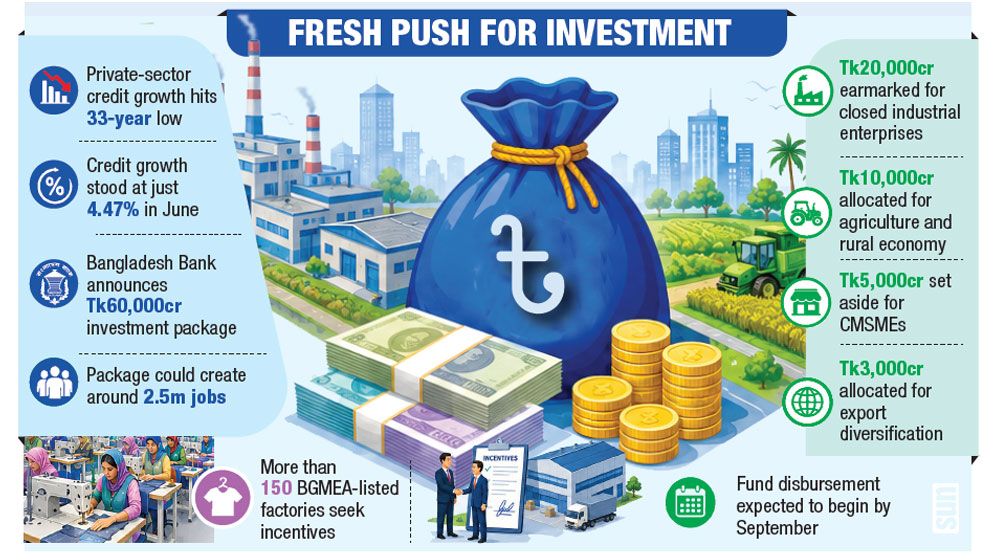
Bangladesh Bank has announced a Tk60,000 crore incentive package to revive economic activity and investment, but its implementation has yet to gather the expected pace. The central bank has already signed agreements with relevant banks for disbursing the funds, while agreements with banks holding excess liquidity are also expected to be signed. Officials said disbursement could begin by September.
Businesspeople and industrialists have welcomed the change in government and expressed optimism about the investment climate. But high borrowing costs, energy shortages and new conditions attached to policy support have emerged as major obstacles.
Bankers, meanwhile, say demand for new credit remains limited despite the policy measures. Complications have also emerged over the requirement that businesses seeking policy support withdraw ongoing legal proceedings against banks or the government.
Dr Zahid Hussain, former lead economist of World Bank’s Dhaka office, said it was too early to assess the new government's performance fully.
“It is still too early to assess the performance of the new government. More time is needed for the impact of its measures to become visible across various economic indicators,” he told the Daily Sun.
However, he said investment should be given top priority if the economy is to recover quickly.
“Private investment has remained stagnant for a long time. Without a recovery in new investment, it would be difficult to revive industrial production, employment and overall economic activity. Therefore, policy announcements and incentive packages alone would not be enough; their effective implementation would also be crucial,” he said.
Zahid said there were already some signs of initiatives to boost investment, pointing to the Tk60,000 crore incentive package designed in part to help reopen closed or distressed factories.
The success of the package, he said, would depend on whether funds reached the right entrepreneurs quickly and whether implementation was effective.
Problems in the banking sector, high credit risks and business uncertainty have discouraged many entrepreneurs from making fresh investments, he said. Unless those barriers are removed, investment would not pick up despite the incentive package.
M Masrur Reaz, chairman of Policy Exchange Bangladesh, said investment had reached an extremely low point and major reforms were needed to reverse the trend.
“As revenue collection is unlikely to meet the target next year either, the government will have to rely on public-private partnerships (PPPs) and private investment. Projects that have the potential to generate commercial returns should be opened up to the private sector instead of using public money,” he told the Daily Sun.
“The capacity of government institutions must be strengthened to implement the budget. Merely preparing ambitious or ‘aspirational’ plans will not be enough; emphasis must be placed on implementing those plans,” he added.
The private sector has been experiencing an investment drought for several years, while credit growth has fallen sharply amid the prolonged weakness in investment.
According to Bangladesh Bank data, private-sector credit growth stood at just 4.47% at the end of June, the lowest level in 33 years.
The contractionary monetary policy was introduced under the previous Awami League government through successive increases in the policy rate. The interim government led by Muhammad Yunus continued the tight monetary stance after the fall of the Awami League government in the student-led mass uprising on August 5, 2024, in an effort to contain inflation.
During the tenure of then governor Ahsan H Mansur, the policy rate was raised several times to 10%. While the move dealt a major blow to private-sector credit growth, inflation declined only marginally. After taking office, current Governor Mostaqur Rahman recently cut the policy rate from 10% to 9.50%.
Against this backdrop, Bangladesh Bank announced the Tk60,000 crore incentive package on 23 May.
Governor Mostaqur Rahman said the package would provide Tk41,000 crore through refinancing from surplus liquidity held by scheduled banks, while the remaining Tk19,000 crore would come from the central bank's own refinancing funds.
According to Bangladesh Bank, implementation of the package could create employment for around 2.5 million people. The central bank has issued detailed guidelines for 15 incentive schemes over the past two months.
Of the Tk41,000 crore bank-funded component, Tk20,000 crore has been allocated to closed industrial and service-sector enterprises, Tk5,000 crore to cottage, micro, small and medium enterprises (CMSMEs), Tk10,000 crore to agriculture and the rural economy, and Tk3,000 crore to export diversification.
Another Tk3,000 crore has been allocated for the first time to develop an agricultural hub in northern Bangladesh, with the initiative expected to create around 100,000 jobs.
Several existing Bangladesh Bank refinancing schemes have also been consolidated under the Tk19,000 crore refinancing fund, reducing the number of refinancing funds to 10 under the new framework.
But stakeholders say implementation remains slow. A new condition requiring applicants to withdraw lawsuits against the government, Bangladesh Bank and banks has added to the difficulties.
Dispute over lawsuit withdrawal
Bangladesh Bank introduced an exit policy on 29 June to reduce non-performing loans. The policy relaxed some earlier stringent conditions for waiving charged and uncharged interest on bank loans and also provided support for special loan rescheduling.
However, in a circular issued on 29 July, the central bank said customers seeking any incentive package or other policy support announced by the government or Bangladesh Bank would have to withdraw all lawsuits, including writ petitions, filed against the government, Bangladesh Bank or the concerned bank.
Applicants must also declare by affidavit that they have no pending cases against those institutions.
The condition has triggered mixed reactions among businesses and entrepreneurs. Many fear that if they withdraw lawsuits but ultimately fail to receive the promised support, they could face significant financial risks.
The Bangladesh Garment Manufacturers and Exporters Association (BGMEA) wrote to the Bangladesh Bank governor last Thursday over the condition. The leading apparel trade body has submitted a list of more than 150 factories seeking incentives.
BGMEA President Mahmud Hasan Khan said, “Our members are concerned about the new condition imposed by Bangladesh Bank. If a policy support is not granted after a lawsuit is withdrawn, the concerned entrepreneur could become a defaulter. There would be no safety net for them.”
He said applications for incentives or policy support and decisions on withdrawing lawsuits should proceed simultaneously. “The lawsuit withdrawal should take place at a specific stage. For example, a copy of the withdrawal could be submitted after the bank’s board approves the policy support file but before the decision becomes effective. We have written to the central bank requesting that these issues be considered,” he said.
Mahmud Hasan also said BGMEA had not recommended any factory that no longer existed. The factories on its list had been audited by two audit firms, he added.
Khondaker Golam Moazzem, research director at the Centre for Policy Dialogue (CPD), said investment should focus on factories that remain operational but are struggling financially rather than businesses that have been closed for a long time.
“Investment in factories that are still operating but facing financial constraints can help them run properly, create employment and increase export earnings,” he said.
Bangladesh Bank spokesperson and Executive Director Arief Hossain Khan acknowledged that implementation of the incentive package and other policy support had been somewhat slow.
“The incentive package and policy support were introduced considering the special circumstances facing the economy and businesses. That is why the implementation process is moving somewhat slowly. However, implementation of the packages aimed at reviving agriculture and the rural economy is progressing well. We are holding meetings with scheduled banks regularly,” he said.
Arief said support under the exit policy and special rescheduling was not mandatory.
“Implementation of this policy support will depend on the relationship between the bank and the customer. How can policy support be implemented while a customer continues a lawsuit against the bank? Both sides need to move forward with a spirit of compromise. That would help reduce banks’ non-performing loans while also bringing momentum back to the economy,” he said.
Syed Mahbubur Rahman, managing director of Mutual Trust Bank, said an investment-friendly environment was a prerequisite for investment in any country.
“There was a period when the country lacked stability and uncertainty prevailed. In such a situation, it was not reasonable to expect businesses and entrepreneurs to invest,” he said.
“The new government has come to power and the situation is now returning to normal. We hope investment will increase and employment will also rise,” he added.