


 For all latest news, follow the Daily Sun's Google News channel.


The Jatiya Party (JaPa) is battling to survive after a series of internal splits, factional disputes and a crushing defeat in the latest national election.
The party’s organisational weaknesses have deepened in recent years amid leadership disputes, attacks on party offices, cases against its leaders and activists, and growing uncertainty over its political future.
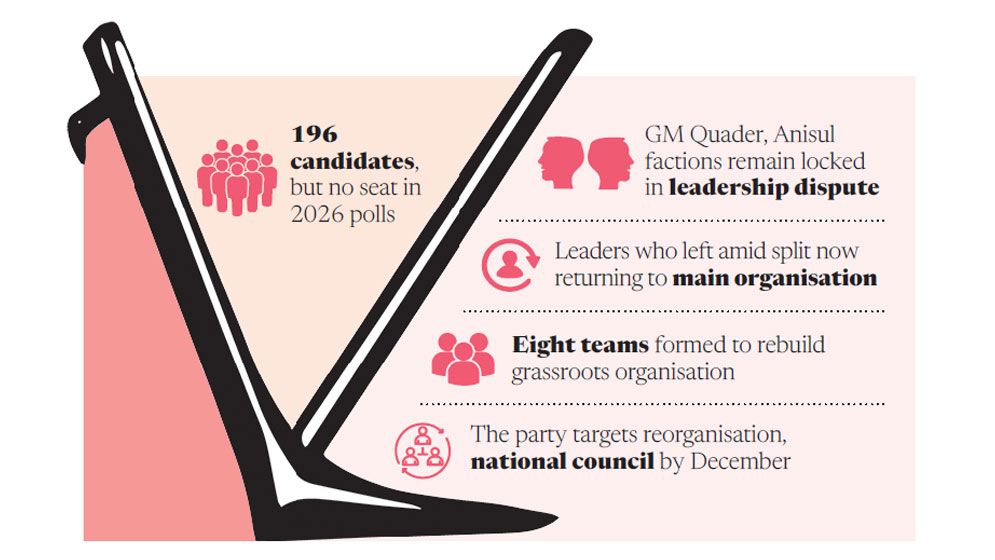
Once a significant force in Bangladesh’s electoral politics, JaPa failed to win a single seat in the 2026 national election despite fielding 196 candidates. Its poor performance in Rangpur, traditionally regarded as one of its strongest electoral strongholds, has further exposed the depth of its crisis.
The party is now attempting to rebuild its organisational strength and regain political relevance ahead of the upcoming local government elections and its next national council.
As part of the effort, JaPa has formed eight organisational teams, one for each division, to assess its grassroots strength, reorganise expired committees and establish new ones where necessary.
JaPa Secretary General Barrister Shameem Haider Patwary told the Daily Sun that the party is gradually recovering after facing political pressure, internal divisions and an electoral setback following 5 August 2024.
“The local government elections are approaching. There is still no level playing field. We will assess how much confidence the government can gain in the local government elections and how committed the Election Commission is to holding a fair election before making our decision,” he said.
At the same time, he said, the party is concentrating on rebuilding its organisation.
“We are working to reorganise the party. Many new people are joining us. Gradually, the party is getting organised. We are preparing for larger programmes and democratic political activities,” he said.
Leaders return after split
JaPa leaders claim that a number of senior leaders and grassroots activists who left the party following its latest split are now returning to the main organisation.
Shameem Haider Patwary said several presidium members and senior leaders had already returned.
“Many of those who were with them are coming back. Several presidium members and some senior leaders have already returned to our party,” he said, describing the development as the “beginning of a process of reunification” within JaPa.
“I think the beginning of JaPa’s return has started, and the party is gradually becoming united,” he said.
JaPa Additional Secretary General Rezaul Islam Bhuiyan also claimed that most of the leaders and activists who had joined the rival faction were now returning.
“Most of the presidium members who had gone to the other side have returned. Except for a few senior leaders, almost everyone from the lower ranks is coming back. Many grassroots leaders and activists are also returning,” he said.
The claims of reunification come as the party continues to struggle with a leadership dispute that has weakened its organisational structure and confused its grassroots supporters.
Leadership dispute persists
The leadership conflict between the factions led by GM Quader and Anisul Islam Mahmud remains one of JaPa’s biggest challenges.
The dispute became more pronounced after the Anisul Islam Mahmud-led faction held a “10th Council” in Dhaka on 9 August 2025 and announced a new committee. The GM Quader faction rejected the council as illegal. Both sides subsequently approached the Election Commission over control of the party’s registration and its electoral symbol, the “plough”.
The prolonged dispute has created uncertainty among grassroots leaders and activists and further weakened the party’s ability to operate as a united political organisation. Rezaul Islam Bhuiyan said JaPa had experienced several splits in the past but had managed to recover.
“In my personal experience, JaPa has split nine times. Every time, the party managed to recover. Many of those who split the party later became politically irrelevant or were banned from politics,” he said. He recalled that the party also faced a serious crisis following the political change of 1990.
“After 1990, the party also faced such a disaster in 1991. The party chairman and most of the leaders contested the election at that time. Many thought JaPa would never be able to stand again after 1990. But we recovered,” he said.
Eight teams tasked with rebuilding party
Despite the electoral setback, JaPa says its organisational activities have continued.
Party Office Secretary Mahmud Alam said the party is focusing on strengthening its grassroots organisation rather than allowing its activities to stagnate.
“Our organisational activities have not stopped for a single day. Alongside preparations for the next election, work is also underway for the national council,” he said.
According to him, eight senior leaders have been assigned to oversee organisational activities in the eight divisions. The teams are visiting districts, meeting grassroots leaders and activists, assessing the organisational situation and reviewing existing committees.
“Rezaul Islam is leading the team in the Chattogram division. He will visit Chattogram on the 22nd and hold a meeting with leaders and activists from the division. We have already visited Rajshahi, and there will be a visit to Sylhet on the 29th,” Mahmud Alam said.
The divisional coordinators are Secretary General Shameem Haider Patwary for Rangpur; Presidium Member Fakhrul Imam for Mymensingh; Presidium Member Mir Abdus Sabur Asud for Khulna; Presidium Member Haji Saifuddin Ahmed Milon for Sylhet; Presidium Member Advocate Md Rezaul Islam Bhuiyan for Chattogram; Presidium Member Alamgir Sikder Loton for Dhaka; Presidium Member Md Emran Hossain Mia for Rajshahi; and Presidium Member Engineer Iqbal Hossain Tapas for Barishal.
Reorganisation targeted by December
Rezaul Islam Bhuiyan said the party is giving priority to organisational councils and grassroots programmes to restore the morale of leaders and activists following the internal split and electoral defeat.
“The shock to our organisation has also affected the morale of our leaders and activists. We are working to boost their morale. Eight teams have been formed. They are visiting different areas and communicating with leaders and activists,” he said.
The party aims to complete the reorganisation of expired district and other organisational committees by December, he said. It then plans to organise a major political programme in Dhaka.
JaPa is also planning to hold its national council around December, according to party leaders.
Seeking inclusive elections
JaPa wants the upcoming local government elections and the next national election to be neutral, inclusive and participatory, with all political parties given the opportunity to contest.
Shameem Haider Patwary said the party would closely monitor the electoral environment during the local government elections before deciding its future political course.
On Awami League President Sheikh Hasina’s announcement that she would return to Bangladesh in December, the JaPa secretary general said she had the right to return to the country. He acknowledged, however, that the death sentence handed down against her would make the issue a matter for the government to address. He also called for the protection of her human rights.
“I believe the government must ensure that her human rights are not violated and that no harm comes to her. The government should formulate its strategy keeping that in mind,” he said.
He further said the Awami League has the right to engage in politics.
“I believe the Awami League also has the right to do politics, and they will do politics. We all have to accept that,” he said.
JaPa, he added, does not support excluding or banning any political party from elections.
Rezaul Islam Bhuiyan said those accused of wrongdoing or crimes should face justice, but argued that Awami League leaders should be allowed to return to Bangladesh and face trial.
For JaPa, the immediate challenge is therefore twofold: resolving its long-running leadership dispute and rebuilding an organisation weakened by repeated splits and electoral setbacks. Whether the party can turn its latest reorganisation drive into a meaningful political revival will largely depend on its ability to restore internal unity and regain the confidence of its grassroots supporters.