


 For all latest news, follow the Daily Sun's Google News channel.


The Ministry of Agriculture has completed the major commitments assigned under the government's 180-day action plan, with the Farmer Card scheme, canal excavation and tree plantation emerging as three areas where work has moved from policy pledges to implementation on the ground.
The ministry now wants to focus on expanding these programmes, improving transparency and ensuring benefits reach farmers at field level.
Md Selim Khan, secretary of the Ministry of Agriculture, told the Daily Sun that farmer cards, tree plantation and canal excavation were among the key commitments included in the government's election manifesto.
"Within the 180-day target set by the government, the Ministry of Agriculture has already accomplished these three tasks. In the coming days, within the timeframe set by the Prime Minister, we hope to implement these programmes properly, transparently and without controversy," he said.
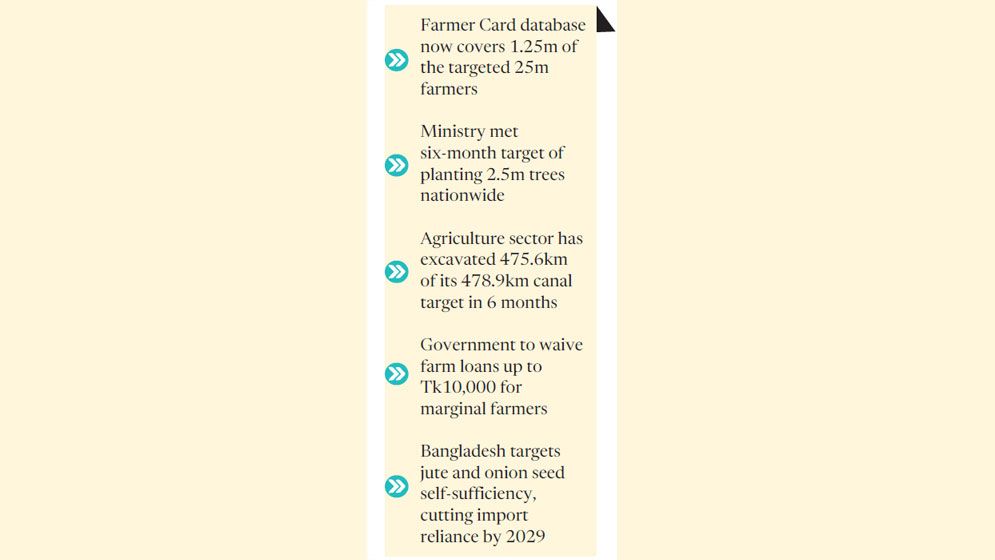
The ministry has completed a database of 1.25 million farmers under the Farmer Card initiative, against a broader plan to register around 25 million farmers nationwide. The card is expected to become a key mechanism for delivering agricultural services, including inputs, machinery, irrigation and other government support, directly to farmers.
Under a separate priority programme, the ministry has met its six-month target of planting 2.5 million trees, part of a wider drive to plant 30 million saplings over five years.
Canal excavation is another major component of the government's development agenda. The national target for excavation and re-excavation of canals stands at 20,000 kilometres, with the agriculture sector responsible for 6,000 kilometres of that total. Around 475.61 kilometres have been completed so far, while the six-month target 478.9 kilometres. A separate project has also been launched to accelerate the work, in coordination with agencies responsible for water resources and local government, aimed at improving irrigation and restoring water flow.The ministry also plans to waive outstanding agricultural loans of up to Tk 10,000, including interest, for marginal farmers in the crop, livestock and fisheries sectors, fulfilling another election pledge.
Among its notable achievements, the ministry has expanded cultivation of BRRI dhan118 in haor areas during the Boro season. The variety matures around ten days earlier than conventional strains, giving farmers a larger window to harvest before flash floods strike.
The ministry has also revised its fertiliser policy to improve timely availability and distribution efficiency, while placing greater emphasis on reducing dependence on imported seeds and inputs.
Officials said Bangladesh aims to achieve self-sufficiency in jute seed by 2029, with the Bangladesh Jute Research Institute developing domestic capacity. Similar efforts are under way for onion seed: of the roughly 2,319 tonnes required annually, private sources supply around 1,919 tonnes and the government 228 tonnes, leaving about 200 tonnes to be imported. BARI Onion-5, a locally developed summer variety, is seen as key to closing this gap.
The ministry is also promoting green chilli and ginger cultivation to ease monsoon-season shortages, targeting roughly 50,500 tonnes of green chilli production between March and November, alongside incentives to boost ginger output by 2029.