



 For all latest news, follow the Daily Sun's Google News channel.


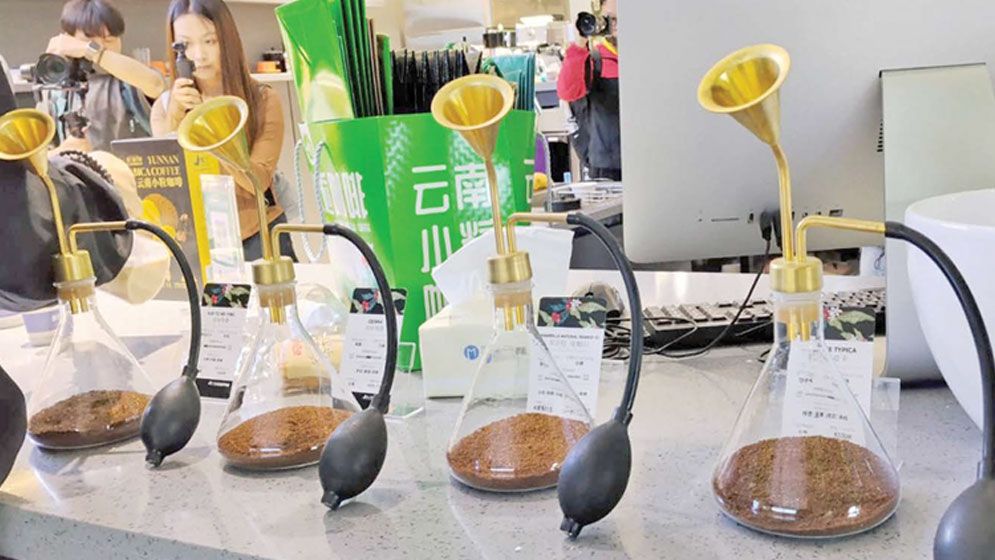
China is one of the world’s largest coffee-consuming countries, but its presence as an international coffee exporter has long remained limited. Determined to change that, the country is pursuing a long-term strategy centred on the production, processing, branding and export expansion of Arabica coffee in Yunnan Province.
China aims to transform coffee from a traditional agricultural product into a high-value export industry.
A recent visit to Baoshan in Yunnan Province revealed how this vision is taking shape. Through coordinated efforts by local authorities, coffee enterprises and entrepreneurs, the city has developed a comprehensive coffee industry ecosystem. From cultivation and harvesting to quality control, processing, branding and international marketing, the entire coffee value chain has been integrated into a modern industrial system.
As part of the visit, the delegation toured Baoshan Specialty Coffee Industrial Park, where the complete production process – from coffee bean collection and quality inspection to roasting, packaging and export-ready production – was demonstrated.
The delegation also visited Baoshan Zhongka Food Co., Ltd., where advanced coffee deep-processing facilities showcased how agriculture, technology, research, manufacturing and marketing have been combined to create a modern coffee industry.
Despite China’s growing ambition to expand its coffee exports, Chinese coffee has yet to establish a presence in the Bangladeshi market. However, Bangladesh may begin importing coffee from China in the future if the quality meets expectations, according to Ruhul Amin, logistics officer of North End Coffee Roasters, one of Bangladesh’s leading coffee importers.
Speaking to the Daily Sun, Ruhul Amin said, “At present, we import most of our coffee beans from Singapore and Brazil. We also import coffee from Malaysia and Vietnam.”
Regarding imports from China, he said, “Chinese Arabica coffee is gaining popularity. We have not yet entered the Chinese market, but if the quality and standards meet our requirements, we will certainly consider importing it.”

Focus on value-added coffee processing
One of the most striking aspects of Baoshan’s coffee industry is its strong emphasis on value-added production. Instead of relying primarily on the sale of raw coffee beans, the city now produces roasted coffee, instant coffee, coffee extracts, drip bags, cold-brew products and various specialty coffee items.
Lao’n Farank, chief administrative officer of Baoshan Zhongka Food Co., Ltd., said exporting raw coffee beans alone was no longer sufficient to compete in the international market.
“To establish a sustainable position globally, we are placing special emphasis on research and development (R&D), advanced technology, branding and high-value processed coffee products,” he said.
He added that the company had integrated coffee cultivation, bean collection, processing, e-commerce, online marketing and offline experience centres into a single industrial ecosystem.
According to him, Baoshan Arabica coffee is distinguished by its unique flavour profile – it is not overly acidic or harsh, is rich in taste without excessive bitterness, and carries a subtle natural floral aroma. These characteristics, he said, have helped establish Baoshan coffee as a distinctive brand in the global coffee market.
Baoshan’s growing coffee industry
According to official data, Baoshan currently has around 12,040 hectares under coffee cultivation, producing approximately 26,800 tonnes of coffee annually. Of this, around 1,133 hectares are dedicated to certified green and organic coffee production, reflecting the city’s commitment to sustainable and high-quality cultivation.
The total output value of Baoshan’s coffee industry has reached 22.328 billion yuan.
The city is home to 82 coffee enterprises, including 29 deep-processing companies and 34 coffee estates. It has also developed 26 major coffee brands, including Zhongka, Beaton, Jinglan, Gaosheng Manor, Baihushan and Zuoyuan.
More than 100 coffee products across 10 categories are currently being manufactured, while over 600 registered coffee trademarks have been established.
Official data also show that more than 50,000 farmers have benefited from the coffee industry. The average monthly income from coffee farming is approximately 4,000 yuan per farmer, while the average annual household income reaches 15,700 yuan.
Targeting global markets
Lao’n Farank said demand for Yunnan coffee had been increasing in Europe, the Middle East, Southeast Asia and Africa. He noted that major international coffee companies and specialty coffee shops were also showing growing interest in Yunnan Arabica coffee.
He acknowledged that competing with established coffee-producing countries such as Brazil, Vietnam, Colombia and Ethiopia would not be easy.
“That is why, alongside increasing production, we are focusing on improving quality, strengthening our brands and adding value through deep processing,” he said.
Baoshan has also integrated coffee with tourism. Visitors can explore coffee plantations, coffee culture, industrial parks and processing facilities, while attractions such as the Gaoligong Mountains, hot springs, volcanoes and the historic Qinglong Street are also being promoted as part of the city’s tourism strategy.
Baoshan’s strategic location
Beyond coffee production, Baoshan holds significant geographical and economic importance. Located in southwest China’s Yunnan Province, the city serves as a strategic corridor connecting South Asia, Southeast Asia and even Europe. It is situated approximately 498 kilometres from the provincial capital, Kunming.
Baoshan also shares a 168-kilometre border with Myanmar, making it an important gateway for cross-border trade and international exports.
(This is the first instalment of a five-part series on China, exploring the country’s economic transformation, heritage, culture, trade and growing global engagement through the writer’s experiences during his recent visit.)