


 For all latest news, follow the Daily Sun's Google News channel.


Bangladesh’s river sands may fuel semiconductor industry
GSB study finds vast quartz-rich reserves, but purity testing is needed to assess their potential for high-tech applications
Daily Sun Report, Dhaka
Published: 13 Aug 2026, 12:00 AM
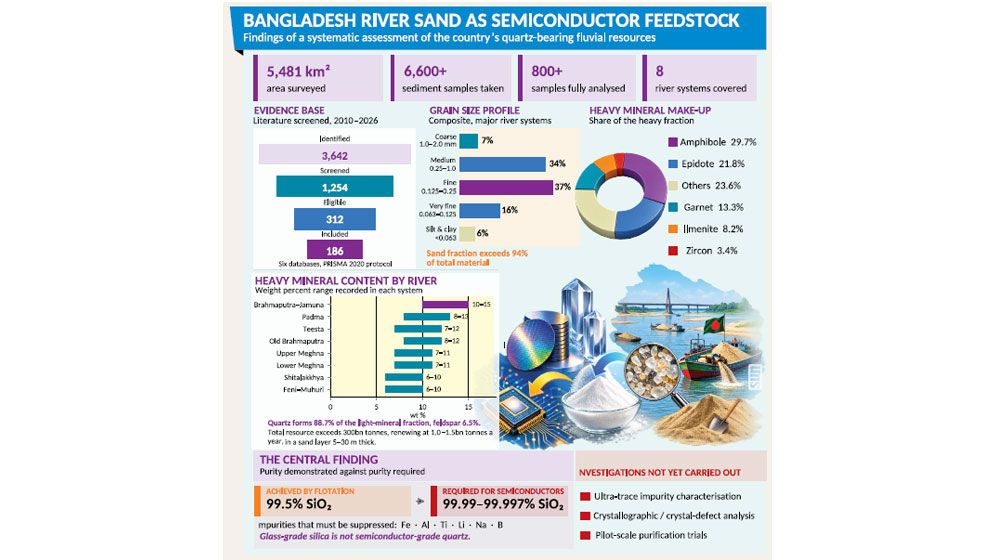
Bangladesh’s major river systems contain an estimated 300 billion tonnes of quartz-rich sand that could anchor a semiconductor materials industry, according to a review by the Geological Survey of Bangladesh (GSB).
While the material can produce silica suitable for glass and general industrial uses, actual chip manufacturing remains a distant prospect.
Bangladesh has yet to determine whether its river sand meets the extreme purity standards required for microelectronics, making rigorous testing the crucial first step toward unlocking its high-tech potential.
From quartz to chips
Silicon is used in more than 90% of semiconductor devices worldwide. Global chip sales crossed US$600 billion in 2024 and are expected to exceed $1 trillion before 2030.
The semiconductor supply chain runs from high-purity quartz and silica to metallurgical-grade silicon, electronic-grade polysilicon, single-crystal ingots, wafers and chips.
Impurities in the original quartz can carry through the chain, making the quality of the starting material critical.
High-quality quartz deposits are relatively rare, with major commercial sources in the United States, Norway, Brazil and Australia.
Bangladesh’s resource advantage
The Geological Survey of Bangladesh (GSB) assessment spans eight major river systems covering roughly 5,481 square kilometers.
Driven by natural flow, the sand deposits replenish by an estimated one billion to 1.5 billion tonnes annually.
Quartz makes up about 88.7% of the lighter mineral fraction, while heavy minerals – including zircon, ilmenite, rutile, garnet, and monazite – account for 8% to 15%.
These heavy minerals represent valuable high-tech co-products alongside the primary quartz reserves.
The Brahmaputra-Jamuna, Padma, and Teesta rivers show the highest potential.
To map the resource, researchers collected more than 6,600 samples across the target region, with over 800 already analysed.
Purity is the big hurdle
Initial processing has produced silica containing about 99.5% SiO2, suitable for glass and several industrial uses.
Semiconductor applications generally require more than 99.99% to 99.997% SiO2, along with extremely low levels of key impurities. Electronic-grade polysilicon requires about 99.9999999%, or 9N, purity.
Bangladesh still needs trace-impurity testing, crystal-structure analysis and pilot-scale purification trials to determine whether its sand can meet those standards.
Glass-grade silica is not automatically semiconductor-grade quartz.
Where Bangladesh should start
The study, led by GSB Deputy Director Dr Md Sohel Rana, advises Bangladesh to skip costly wafer fabrication for now.
Instead, the country should focus initial efforts on high-purity silica, specialty glass, optical fibre materials, integrated circuit (IC) design, and outsourced semiconductor assembly and testing (OSAT).
Capitalising on its lower labor costs, Bangladesh could find OSAT a much more accessible entry point than capital-heavy wafer fabs.
Similarly, IC design relies primarily on technical expertise rather than massive infrastructure, making it a natural fit for the country’s workforce.
A 25-year ambition
The GSB study outlines a phased, quarter-century timeline to transform raw river sand into an integrated high-tech industry.
While later milestones hinge on sustained investment, technical breakthroughs, and policy support, the roadmap sets a clear progression:
2026-2030 (Foundation): Focus on comprehensive resource mapping, pilot purification plants, targeted R&D, and workforce development.
2031-2035 (Initial Scaling): Target annual high-purity quartz (HPQ) output of over 1,000 tonnes, launch specialty glass and silica facilities, and establish domestic IC-design capabilities.
2036-2040 (Advanced Operations): Expand annual HPQ and silica production beyond 5,000 tonnes while initiating pilot wafer projects and advanced OSAT packaging.
2041-2045 (Commercial Manufacturing): Launch full commercial wafer fabrication and position Bangladesh as a regional hub for IC design, assembly, and testing.
2046-2050 (Full Ecosystem Integration): Scale HPQ production past 15,000 tonnes annually, cementing a fully self-sustaining, end-to-end semiconductor ecosystem.
The later stages remain ambitious and would depend on successful research, investment and ecosystem development.
The next move
The paper recommends a national HPQ exploration programme, international-standard trace-element testing and the establishment of a Sand Processing and Research Centre for pilot-scale beneficiation and purification.
It also calls for university programmes in semiconductor materials, VLSI design, mineral processing and electronics, as well as a national semiconductor roadmap covering incentives, public-private partnerships, environmental safeguards and resource management.
Bangladesh has already formed a National Semiconductor Taskforce, while BIDA has identified IC design, VLSI, packaging, testing and advanced electronics as priority sectors.
For Bangladesh, the near-term opportunity is not making chips, but supplying materials and services that the chip industry needs.
If further testing confirms the purity potential of its quartz-rich sand, an everyday river resource could become the foundation of a new high-value industry. The heavy-mineral fraction could provide an additional revenue stream.