


 For all latest news, follow the Daily Sun's Google News channel.


All are Bangladeshis, none are indigenous: Salahuddin
Daily Sun Report, Dhaka
Published: 12 Aug 2026, 12:00 AM
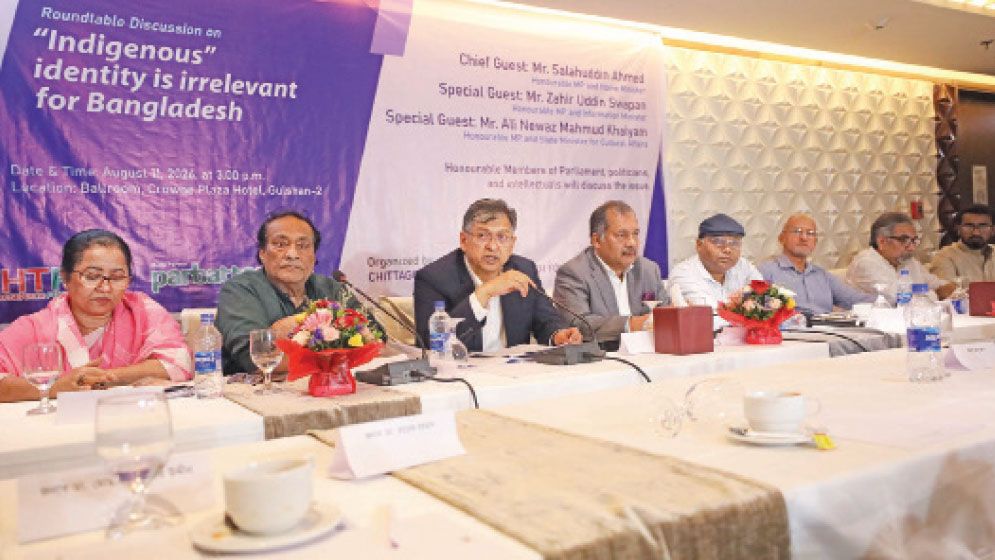
Home Minister Salahuddin Ahmed speaks at a roundtable titled ‘Indigenous Identity is Irrelevant for Bangladesh’ organised by the Chittagong Hill Tracts Research Foundation at the Crowne Plaza Hotel in Gulshan, Dhaka, on Tuesday. Information and Broadcasting Minister Zahir Uddin Swapon and State Minister for Cultural Affairs Ali Newaz Mahmud Khaiyam are also present. Daily sun Photo
Home Minister Salahuddin Ahmed said on Tuesday that all people of Bangladesh are “inhabitants” of the country, rather than “indigenous” people.
“We are the inhabitants of Bangladesh, not indigenous. Here, all citizens have equal rights. All of us — regardless of religion, caste, culture or language — are Bangladeshi citizens, and as citizens, our constitutional rights are equal. This is the identity we hold on to,” he said.
The minister made the remarks as the chief guest at a roundtable discussion titled “Indigenous Identity is Irrelevant for Bangladesh” at a hotel in the capital. The Chittagong Hill Tracts Research Foundation organised the discussion.
On the issue of indigenous identity, Salahuddin Ahmed said the matter would not have arisen if certain individuals had not raised it at various events at the United Nations, nor if certain countries had not signed the United Nations Declaration on the Rights of Indigenous Peoples, adopted on 13 September 2007.
“As Bangladesh, we abstained from voting. Some influential nations opposed it there, meaning they voted against it. However, as to whether this declaration applies to our case — the answer is that it does not apply; we are not a party to it. The same holds true for ILO Convention 169,” he said.
“Even so, if some of you are looking for a solution within sentences, within words … then it can be said that if, instead of all being indigenous (adibashi), we become inhabitants (odhibashi) of Bangladesh, then that itself is the solution,” the minister said.
Salahuddin said the state provides various facilities and benefits not only to people living in the plains but also to women, children and disadvantaged communities, as is the case in many other countries.
“In our neighbouring country too, there are quota reservations and other benefits for scheduled castes as well as other disadvantaged communities, so that within the state … meaning, equality can be achieved in terms of development. That is why this is a state provision. The Constitution has granted that recognition, that facility. Accordingly, they receive that benefit,” he said.
‘Battle of narratives underway’
Speaking as a special guest, Information and Broadcasting Minister Zahir Uddin Swapon said a “battle of narratives” was underway over the issue.
“The context in which the term ‘indigenous’ was originally raised — in the convention where it was introduced — has no fundamental similarity with the context of our own country,” he said.
“When we speak on this subject, or respond to it, or express our reaction, we must also be careful not to fall into some contrived trap that ends up popularising this term all over again — a term that is, more often than not, irrelevant to our context,” Swapon said.
He said the term originated in contexts where settlers drove out indigenous populations and established settler states.
Speaking as another special guest, State Minister for Cultural Affairs Ali Newaz Mahmud Khaiyam said the Constitution states that the state shall adopt measures to protect and promote the distinctive culture and traditions of various tribes, minor races, ethnic sects and communities.
“Because of this wording, we are now offering various interpretations — interpreting those from smaller communities, meaning small in size or small in number. We have been bringing them under various adjectives,” he said.
He said greater attention should be given to the psychological aspect concerning smaller communities, regardless of whether they live in the hills or the plains.
“In any choice of words, they are somewhat undermined. They are treated as somewhat minor or as something entirely different. Because of this, a certain objection or a kind of dissatisfaction develops among them,” Khayyam said.