


 For all latest news, follow the Daily Sun's Google News channel.


In the reading room of the Sufia Kamal National Public Library in Shahbagh, hundreds of students appear engrossed in study. Look closer, though, and most are not preparing for university exams at all – they are poring over guidebooks for the Bangladesh Civil Service (BCS) examination, or study materials for the IELTS and GRE tests required to go abroad.
Asked why so many young people gather at the library for such preparation, Shahrin Shaheen Shanta, a third-year Electrical and Electronic Engineering student at Bangladesh University of Engineering and Technology (BUET), said, “We have very limited options to ensure a good future. There is no other job that offers you the same social status, power and earnings of a BCS cadre. That is why I am here, to prepare myself in a calm and quiet environment.”
Joyonto Majumder, an Accounting student at Dhaka College preparing for the GRE, was blunter still. “To be very honest, talent is never enough for you to have a good career in Bangladesh. Apart from study, you need influential relatives or money. I am trying to go somewhere I will be evaluated only for my talent and hard work.”
Their experiences are far from unique. Increasingly, Bangladesh’s most talented graduates are narrowing their ambitions to just two paths: sitting the BCS examination, or leaving the country altogether for higher education and work abroad.
The trend, observers say, raises serious questions about the country’s ability to retain skilled graduates and build a broader range of career opportunities – a concern that comes into sharper focus as Bangladesh marks International Youth Day today.
The BCS bottleneck
Government jobs remain highly prized in Bangladesh for their security, status, steady income and pension benefits, with the rank of cadre officer carrying particular prestige. But the numbers illustrate just how narrow the path has become.
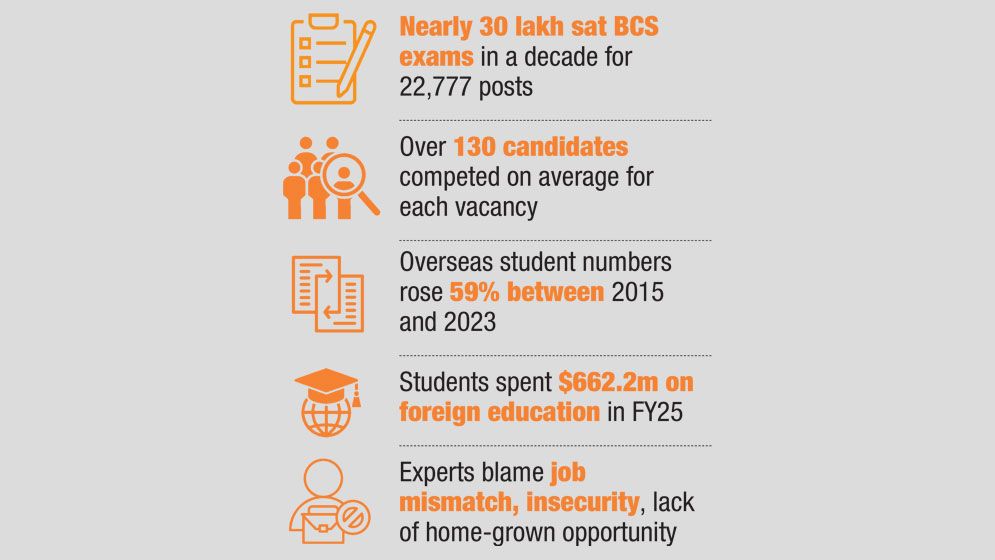
Over the past decade, nearly 2.97 million candidates have sat BCS examinations – including three special rounds – competing for just 22,777 posts, an average of more than 130 applicants per vacancy.
Figures from the Bangladesh Public Service Commission (BPSC) show the scale of the contest: roughly 475,000 candidates for 2,135 posts in the 41st BCS; 31,026 for 2,000 posts in the 42nd (special); 435,190 for 2,163 posts in the 43rd; 350,716 for 1,710 posts in the 44th; around 318,000 for 2,309 posts in the 45th; about 338,000 for 3,140 posts in the 46th; 374,747 for 3,487 posts in the 47th; 41,025 for roughly 3,000 posts in the 48th (special); 312,752 for 683 posts in the 49th (special); and 290,951 candidates for 2,150 posts in the 50th BCS.
Professor Sabbir Ahmed of Dhaka University’s Department of Political Science said the figures reflect a mismatch between graduate output and the job market. “Bangladesh is producing hundreds of thousands of graduates every year, but the economy is not creating enough quality, skill-matched jobs for them,” he told the Daily Sun.
“On one hand, there are low starting salaries and long working hours; on the other, uncertain career growth and intense competition. Young people in Bangladesh don’t trust the system and feel insecure about their future, so they seek stable options and economic and social security.”
The exodus abroad
Meanwhile, the number of Bangladeshis choosing to study overseas has climbed sharply. UNESCO data show outbound student numbers rising from 33,139 in 2015 to 52,799 in 2023 – a 59% increase – though comparable figures for 2024 and 2025 were not available.
Bangladesh Bank figures add further weight: students spent $533.2 million on overseas education services in FY24, rising to $662.2 million in FY25. The number of students going abroad is now 2.19 times the level recorded a decade ago.
Professor Hosne Ara Begum, acting director of the Institute of Education and Research at Dhaka University, warned the pattern points to deeper structural problems.
“If talented young people see only government jobs or migration as desirable options, Bangladesh may lose valuable human resources,” she said, adding, “Universities should provide practical skills, career counselling and stronger links with industries so that graduates can identify opportunities beyond traditional career choices.”
She added that fostering diverse, secure career paths at home could help Bangladesh retain talent and convert its large youth population into a genuine driver of national development.