


 For all latest news, follow the Daily Sun's Google News channel.


Govt moves to formalise gold sector
Draft policy aims to legalise commercial gold imports, curb smuggling, increase govt revenue

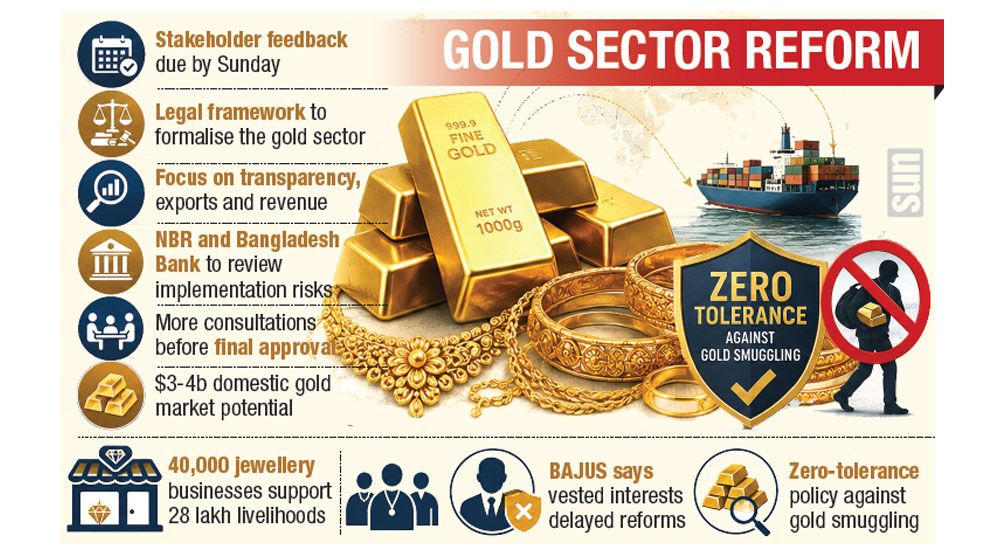
Despite strong domestic demand and a rich tradition of gold craftsmanship, Bangladesh’s gold industry has long operated without a comprehensive legal framework.
Reliance on baggage gold and informal supply channels has constrained exports and government revenue, according to industry insiders.
The government has now launched a major initiative to transform the sector into a formal, regulated and accountable industry through a revised national policy aimed at increasing transparency, legal trade, jewellery exports and revenue collection.
The move came at a meeting at the Ministry of Commerce on Thursday, where Commerce Minister Khandakar Abdul Muktadir directed all relevant agencies and stakeholders to submit written comments on the draft “Gold Policy 2018 (Revised) 2026” by Sunday.
The minister said the gold sector has remained outside a proper institutional framework for years due to policy and regulatory shortcomings, despite its significant contribution to the economy.
Legalising the sector
Muktadir said the government’s objective is to establish gold trading as a fully recognised industry operating under the same legal and regulatory framework as other sectors.
He said formalising the industry would create jobs, encourage legal imports, increase government revenue and ensure greater transparency in gold transactions and reserves.
Under the proposed policy, every stage of legally imported gold, from import and storage to sales, will be brought under a monitoring system, enabling regulators to track inventories, transactions and the source of gold.
Highlighting gold’s strategic economic importance, the minister said legally imported gold retained in the country helps preserve national wealth, much like foreign exchange reserves.
Curbing smuggling
To discourage smuggling, Muktadir said domestic gold prices should remain closely aligned with international market rates.
He noted that large price differences with neighbouring countries create incentives for illegal cross-border trade and suggested that duty and tax structures should be designed with reference to global markets, particularly major trading hubs such as Dubai.
Focus on jewellery exports
The draft policy also prioritises expanding jewellery exports by facilitating imports of raw materials at rational and competitive duty rates, enabling local manufacturers to become more competitive in international markets.
The minister said Bangladesh has strong domestic demand for gold, particularly for weddings and other social occasions, adding that a well-designed policy would improve competition and allow consumers to buy gold at fair prices.
Before finalising the policy, the government will examine regulatory models in three or four leading jewellery-exporting countries, including India, focusing on import procedures, duty structures, storage management and export incentives.
Agencies asked to identify challenges
The minister directed the National Board of Revenue (NBR), Bangladesh Bank and other agencies to identify implementation challenges and potential risks in their written recommendations, saying the government’s goal is to establish a transparent, sustainable and nationally beneficial framework rather than create new complications.
After reviewing stakeholders’ feedback, the government may hold further consultations before finalising the revised policy.
BAJUS welcomes initiative
Bangladesh Jewellers’ Association (BAJUS) President Enamul Haque Khan Dolan welcomed the initiative, saying the industry had long demanded legal recognition.
“If the sector is formalised, it will increase government revenue, improve business operations and discourage gold smuggling,” he told the Daily Sun.
He said Bangladesh’s handcrafted gold jewellery has significant export potential.
Ensuring legal access to imported raw materials would help develop a new export industry, generate foreign exchange earnings and strengthen the legal status of gold owned by people across the country.
“For many years, the sector remained largely informal due to resistance from vested interests. However, we have been able to convince the present government that formalising the sector is both necessary and timely,” he said.
Dolan said Bangladesh currently lacks an effective mechanism for the commercial import of gold, with the domestic market relying largely on gold brought in by returning travellers under baggage rules.
“That is neither sustainable nor a long-term solution. We do not want to depend on baggage gold. Instead, licensed traders should be allowed to import gold directly through a transparent and regulated system,” he said.
Based on preliminary estimates, he said, the industry’s market size could be worth between US$3 billion and $4 billion, although the final figure will depend on an ongoing survey.
According to BAJUS, Bangladesh has around 40,000 jewellery businesses, directly and indirectly supporting the livelihoods of approximately 28 lakh people.
Simpler import system proposed
Dolan said BAJUS has proposed liberalising the licensing system so that any qualified and legally registered gold trader can import gold directly through a simple, transparent and lawful process.
He reiterated that the baggage gold system should no longer serve as the country’s primary source of supply.
“A formal commercial import system will create a transparent supply chain, strengthen regulatory oversight and support the industry’s long-term growth,” he said.
“We maintain a zero-tolerance policy on smuggling. We are committed to bringing this industry fully under a legal, transparent and accountable framework,” he added.