


 For all latest news, follow the Daily Sun's Google News channel.


BSEC reforms spark mutual fund rally
Open-end funds surge by up to 103% in a month as reinvestment rules boost investor confidence

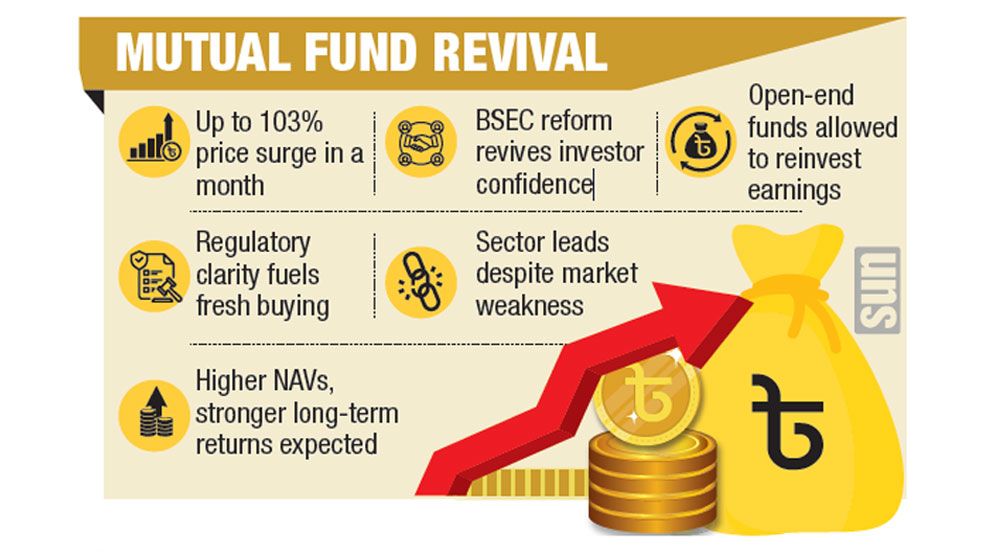
Bangladesh’s mutual fund sector, long one of the most neglected segments of the country’s capital market, is showing signs of revival following a series of regulatory reforms by the Bangladesh Securities and Exchange Commission (BSEC).
For years, the sector struggled with waning investor confidence. Most funds traded at steep discounts to their Net Asset Value (NAV), while mandatory cash dividend requirements restricted fund managers from reinvesting earnings for long-term growth.
Sentiment shifted after the BSEC permitted open-end mutual funds to retain and reinvest their earnings rather than pay out cash dividends.
The policy change has sparked a surge in investor interest, driving up the unit prices of some funds by as much as 103% over the past month.
The sector has also emerged as one of the market’s top performers in recent trading sessions.
Market insiders say mutual funds are essential to a healthy capital market, yet the sector had remained neglected for years.
They believe sustained momentum could help protect investors from excessive exposure to high-risk securities while contributing to a more stable market.
Regulatory reforms revive the sector
On 1 July, the BSEC relaxed the mandatory cash dividend distribution requirement for open-end mutual funds.
Previously, fixed-income schemes were required to distribute at least 70% of their profits as cash dividends, growth schemes 30%, and other open-end funds at least 50%.
Under the new policy, trustees, acting on recommendations from asset managers, may retain profits within the fund instead of distributing them as cash dividends.
The change means funds are no longer required to pay out annual earnings to unit holders. Instead, retained earnings can be reinvested, increasing fund assets and potentially boosting long-term unit values.
According to the BSEC, the policy is expected to benefit investors through greater capital appreciation.
The move effectively reverses a 2019 decision that abolished the Reinvestment Unit (RIU) mechanism and introduced mandatory cash dividends, ending mutual funds’ ability to benefit from compound growth.
Clarification removes uncertainty
The 1 July decision initially created confusion over whether the reinvestment facility applied to all mutual funds or only open-end schemes.
To remove the ambiguity, the BSEC issued another directive on 29 July, clarifying that only open-end mutual funds are eligible to retain and reinvest profits. Closed-end and other categories of mutual funds remain outside the scope of the facility.
Market analysts say the clarification eliminated uncertainty and further strengthened investor confidence.
Mutual funds lead the market
The impact of the reforms quickly became evident on the stock market.
On 27 July, after three consecutive sessions of market decline, mutual funds led the market recovery.
Prices of 31 mutual funds listed on the Dhaka Stock Exchange (DSE) rose that day, while none declined.
The momentum continued on 2 August, the first trading day of the week, when several mutual funds hit their upper circuit limit shortly after trading opened.
By the close, 32 funds had gained in value, while only one posted a decline.
The rally extended to 3 August. Although the DSE benchmark index fell due to losses in large-cap stocks, 24 mutual funds still recorded price gains, underscoring the sector’s resilience.
Top performers
An analysis of trading data through 3 August shows that nearly all major listed mutual funds posted strong gains over the past month.
The best performer was ICB AMCL Third NRB Mutual Fund, whose unit price jumped from Tk3.40 to Tk6.90, a gain of 102.94%.
It was followed by EXIM Bank 1st Mutual Fund, which climbed 97.06% from Tk3.40 to Tk6.70.
MBL 1st Mutual Fund gained 92.50%, rising from Tk4.00 to Tk7.70, while AIBL 1st Islamic Mutual Fund advanced 66.67% from Tk4.20 to Tk7.00.
Phoenix Finance 1st Mutual Fund rose nearly 49%, from Tk9.60 to Tk14.30.
Other strong performers included LR Global Bangladesh Mutual Fund One (33.33%), First Janata Bank Mutual Fund (32.26%), Trust Bank 1st Mutual Fund (32.26%), Capitec Grameen Bank Growth Fund (32%), Popular Life First Mutual Fund (29%), AB Bank 1st Mutual Fund (28.13%) and DBH First Mutual Fund (27.66%).
Anam Ataullah Nayem, president of the Bangladesh Capital Market Investors’ United National Alliance, said the rally has been driven by several factors.
“First, the opportunity to reinvest earnings has increased the future income and asset growth potential of mutual funds. Second, when funds are not required to distribute cash dividends, the retained earnings remain within the fund, creating greater opportunities for new investments and strengthening the NAV of the units over the long term,” he told Daily Sun.
He added that lower cash dividend distributions also reduce the tax burden on fund assets, allowing more value to remain within the funds.
At the same time, investors increasingly view mutual funds that have long traded at steep discounts to their NAV as undervalued assets.
Expecting those discounts to narrow, many are increasing their exposure in anticipation of stronger long-term returns.