



 For all latest news, follow the Daily Sun's Google News channel.


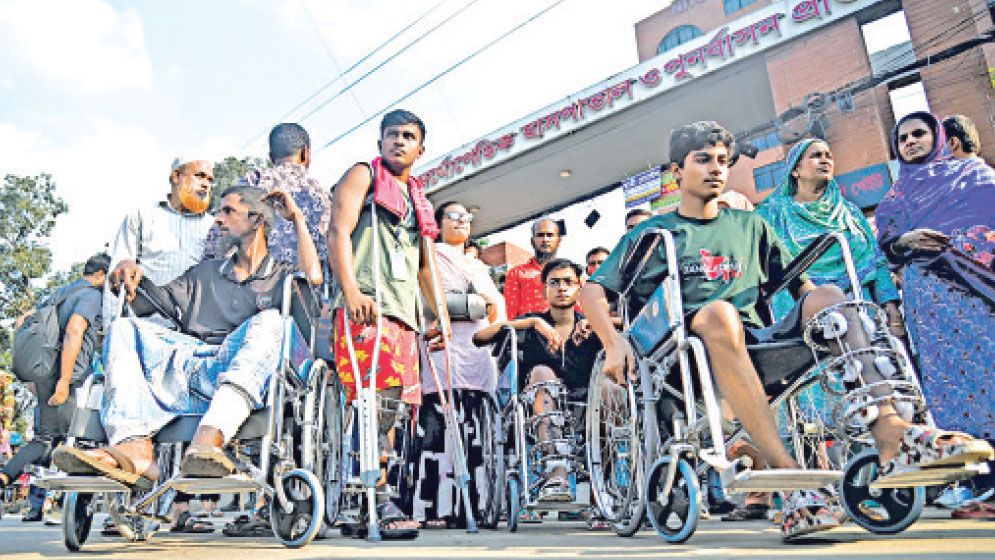
Two years after they braved bullets to help topple the fascist Awami League government, protesters left permanently injured in the July uprising say those closest to them have turned their sacrifice into a joke.
Jannatul Nayeem was 13 when a bullet tore through his right thigh at around 11am during the movement.
His father, Rafikul Islam, told the Daily Sun he spent that day running between hospitals trying to save his son.
The boy’s treatment cost around Tk2 lakh and kept him under care for over a month. His leg has since recovered about 80%, but he still needs a cane to walk.
Rafikul, who runs a clothes shop and a broiler business, bore the entire cost of his son’s treatment himself.
He is now in debt, including unpaid rent on the family home.
He never applied for government compensation, unaware he needed to go through the official gazette process. His relatives and friends, he said, now mock him for having let his son join the protests.
“Sometimes as a passing comment, some would ask me in a mocking tone about how my son will grow up and work to earn money. I have nothing to say to them,” he said.
Md Ali, 36, lost his right eye when a scattered pellet struck his face during the uprising. His left eye has since lost nearly 60% of its vision, and doctors have told him he has six months to a year before he loses sight in it entirely. He experiences disorientation and occasional fainting.
Once an electrician, Ali can no longer work. Of his two children, one has left school to work at a hotel and support the family. His eye treatment cost more than Tk8 lakh; the government gave him Tk5 lakh in compensation.
“Where I should be providing for my family, I have instead become a burden to them. My son should be doing his homework now, but he is out there earning money,” Ali said.
“The compensation was not enough. Both the interim and BNP governments failed people like us. They came to power because of us. Now they no longer care about us.”
Md Waliul Hasan, 24, a student at Mohammadpur Kendriya College, was hit by a flurry of pellets in his left hand. The bones have slowly healed, but the nerves were permanently damaged after the interim government arranged treatment abroad eleven months too late.
His parents had forbidden him from joining the protests, he said, but he went anyway – and today they are proud of him. Not everyone in his family feels the same.
“Relatives sometimes taunt me, saying I should not have joined, that it was not worth it,” he said.
An official gazette recognises 843 people as martyrs of the uprising and 14,370 others as injured, sorted into three compensation categories ranging from Tk10,000 to Tk20,000 monthly. Injured protesters say the payments, while helpful for survival, have not addressed their long-term needs.