


 For all latest news, follow the Daily Sun's Google News channel.


File Photo
Two years after the July uprising reshaped Bangladesh’s political landscape, the movement’s defining question remains unresolved: has the country’s most significant political transition in recent history fulfilled the aspirations that drove thousands onto the streets?
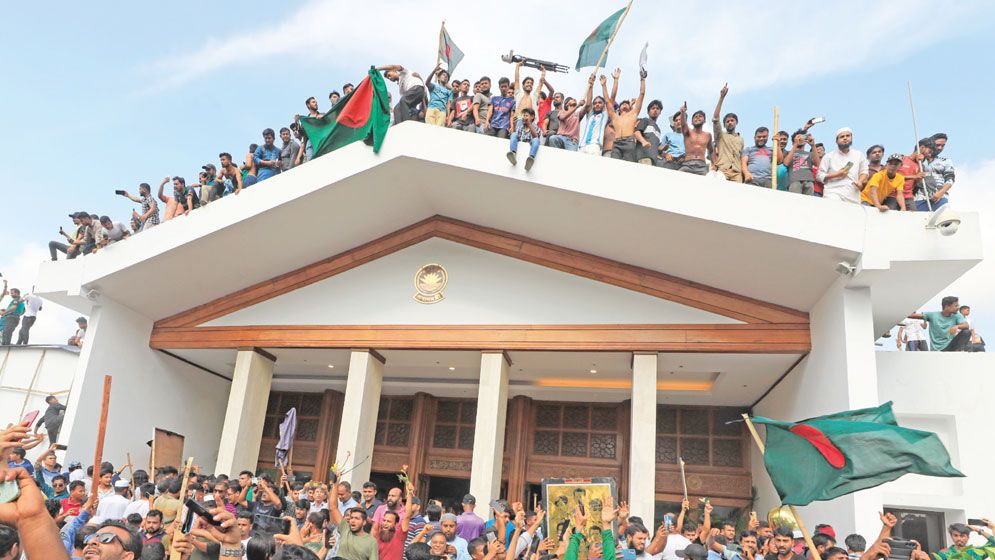
Today marks another 5 August – also remembered by many as “36 July” – the day fascist Sheikh Hasina fled the country after weeks of student-led protests that evolved into a nationwide uprising.
According to official accounts, at least 844 people were killed and around 20,000 injured during the movement.
What began as protests demanding reform of the quota system in government jobs quickly transformed into a broader campaign against the fascist Awami League government, which had been in power for more than 15 years.
Protesters rejected the government’s authority, refused to recognise the arrival of August after the end of July, and adopted red instead of black as the symbol of their movement, calling for a complete overhaul of the state.
The Hasina government faced allegations of weakening constitutional institutions, undermining the electoral system, institutionalising enforced disappearances and extrajudicial killings, and allowing corruption and money laundering to flourish.
As protesters from across the country converged on Dhaka in response to the students’ one-point demand for Hasina’s resignation, hundreds of thousands gathered at the capital’s entry points while residents prepared to join them. Amid mounting public anger, Hasina left the country.
Three days later, following consultations among political stakeholders, an interim government headed by Nobel laureate Prof Muhammad Yunus assumed office to steer the country through the transition. However, critics argue that the administration fell short of public expectations.
Opponents accused the interim government of failing to curb corruption and lawlessness, while alleging that mob violence flourished under state patronage.
It also faced criticism for relying on foreign experts of Bangladeshi origin to draft reform proposals, pursuing agreements involving key terminals at Chattogram Port, and signing what critics described as an “irrational” trade agreement with the United States shortly before the general election.
Some frontline student leaders also faced allegations of influencing promotions, postings and transfers of government officials, while critics questioned the government’s political neutrality over claims that it supported student leaders in forming new political parties.
Political uncertainty persisted over the timing of the national election before power was transferred to the BNP government led by Tarique Rahman following the February polls.
Yet, two years after the uprising, many believe the broader aspirations that united students and ordinary citizens remain only partially fulfilled.
Political analyst Altaf Parvez, who participated in the movement, said the public had expected far-reaching institutional reforms rather than simply a change of government.
“No major change has been brought into the system except the change in power through elections. It is true that enforced disappearances and extrajudicial killings have stopped. But the major aspirations of the people are yet to be fulfilled,” he told the Daily Sun.
Parvez said the movement had evolved beyond student demands after 15 July as people from all walks of life joined the protests.
“The anticipation of the people was huge. They dreamt of a new Bangladesh where the administration would move away from its colonial practices, the police would be reformed, judicial independence would be ensured, the prime minister’s powers would be reduced, women’s participation in politics would increase and corruption would be significantly curbed. But most of these political promises have not been addressed,” he said.
Political analysts argue that the BNP government has yet to demonstrate a clear commitment to implementing recommendations made by the reform commissions established during the interim administration. Corruption and the deteriorating law and order situation remain among the public’s chief concerns.
They also point to partisan appointments in government institutions and public universities, as well as attacks and politically motivated cases against opponents, as developments that run contrary to the spirit of the uprising.
Many activists involved in the July movement believe its legacy cannot rest solely on annual commemorations. They argue that its promises must be translated into lasting institutional reforms, transparent governance and equal justice under the law.
National Professor Mahbub Ullah said it was unrealistic to expect any popular uprising to fulfil all public expectations within a short period.
“Neither the 1969 uprising nor the 1990 movement fulfilled all the aspirations of the people. The July Uprising is no exception. The system and the people remain the same. The structure has not changed. So it is unrealistic to expect sweeping transformation overnight,” he said.
At the same time, he noted that Bangladesh had held what he described as a free and fair election, while enforced disappearances and extrajudicial killings had come to an end.
“The media is independent now. Things are improving gradually. We have to give it time. Change does not happen overnight. I remain hopeful that there will be a national awakening,” he added.