


 For all latest news, follow the Daily Sun's Google News channel.


CEPA inked: Bangladesh, S Korea opennear-total tariff-free trade
Experts urge effective implementation to maximise the deal’s benefits

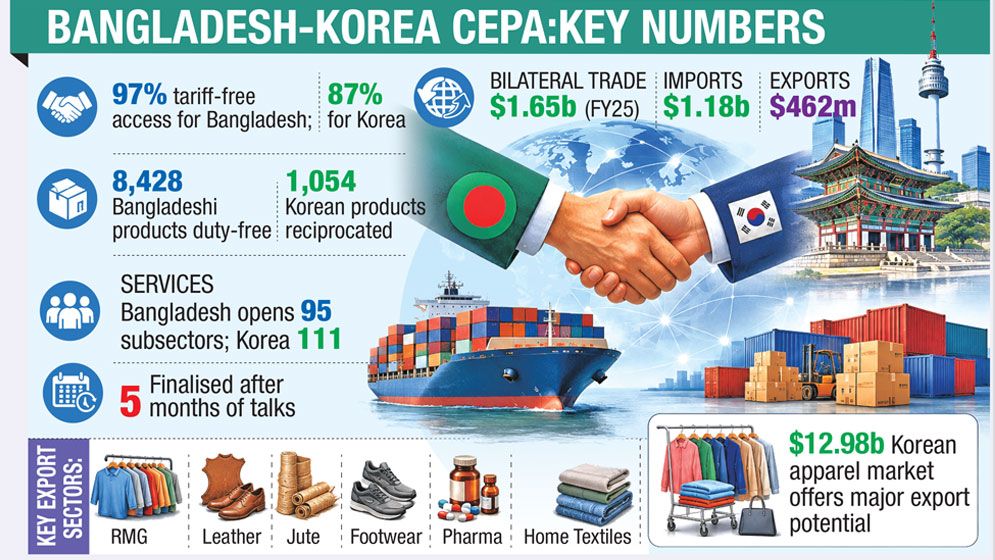
Bangladesh and South Korea on Tuesday signed a Comprehensive Economic Partnership Agreement (CEPA) granting preferential tariff treatment to 97% of Bangladeshi goods entering the Korean market, while Dhaka will reciprocate with preferential access for 87% of South Korean products.
Commerce Minister Khandakar Abdul Muktadir disclosed the details at a joint announcement following the signing ceremony at the Secretariat in Dhaka, with South Korean Trade Minister Han-Koo YEO in attendance.
The agreement is expected to boost bilateral trade, draw fresh South Korean investment and help Bangladesh cushion the loss of trade preferences it faces after graduating from least developed country (LDC) status.
It follows the Economic Partnership Agreement Bangladesh signed with Japan on 6 February 2026 – the country’s first such agreement with any nation.
Commerce ministry sources said both the EPA and CEPA will be tabled in parliament during the next session, in September, for ratification.
Economists and business leaders said the agreements have opened up considerable scope to expand trade and investment by building confidence among businesses and investors alike, and called for deeper industrial collaboration through joint ventures, technology transfer, research partnerships and workforce development.
Export Promotion Bureau and Bangladesh Bank data show bilateral trade between the two countries stood at $1.65 billion in 2024-25 fiscal year (FY25), with Bangladesh importing $1.18 billion worth of goods from South Korea against exports of $462 million.
Immediate duty-free access for thousands of products
Under the CEPA, 8,428 Bangladeshi products will gain immediate duty-free access to the South Korean market from day one, while 1,054 South Korean products will receive equivalent treatment in Bangladesh.
Muktadir said the government had concluded negotiations on a high-standard trade agreement with one of the world’s largest economies within just five months, and that the deal would sharpen the competitiveness of Bangladeshi exports, particularly ready-made garments, leather goods, jute products, footwear, pharmaceuticals and home textiles, in the Korean market.
He linked the CEPA to the government’s ambition of building a $1 trillion economy by 2034.
Han-Koo YEO noted that Bangladesh and South Korea have maintained economic ties for 56 years, historically centred on textiles, but said it was time to broaden cooperation into technology, supply chains, industrial collaboration and investment.
“The implementation of the CEPA is expected to further increase the interest of Korean companies in investing in Bangladesh,” he said.
The two sides have also agreed to substantially liberalise services trade: Bangladesh will open 95 service subsectors to South Korea, while South Korea will offer Bangladesh access to 111 subsectors across all four modes of services trade – a move expected to boost technology transfer and the movement of skilled professionals.
A milestone ahead of LDC graduation
The CEPA’s conclusion marks the end of negotiations at negotiator level; it will take formal effect once both countries complete domestic legal procedures and secure cabinet approval.
Dr Md Deen Islam, research director at Research and Policy Integration for Development (RAPID) and a Dhaka University economics professor, told Daily Sun that Bangladesh will progressively lose preferential access under schemes such as the Generalised System of Preferences after LDC graduation.
“A CEPA with South Korea can help offset part of this preference erosion by ensuring better market access, reducing tariff and non-tariff barriers, and providing a predictable framework for trade and investment,” he said, adding that Bangladesh must also strengthen infrastructure, logistics, customs efficiency and workforce skills to face stronger Korean competition.
Korea-Bangladesh Chamber of Commerce and Industry Secretary General Million Park called the deal a major milestone, saying it would “help preserve market access, strengthen investor confidence and expand cooperation in trade, investment, technology and supply chains,” and would provide “a stronger foundation for a long-term economic partnership.”
He flagged regulatory differences, customs procedures, logistics and trade imbalance as the main obstacles to expanding ties.
BGMEA Vice-President Shehab Udduza Chowdhury said the deal opens significant scope for garment exports to Korea but that Bangladesh must strengthen its man-made fibre sector, currently dominated by China, while also resolving the energy crisis pushing up production costs.
Mohiuddin Rubel, founder of Bangladesh Apparel Voice, said Korea – which imported $12.98 billion in apparel globally – represents a huge opportunity, though Bangladesh’s focus on basic garment lines has historically clashed with Korea’s preference for high-end, trendy fashion, compounded by intense competition from China and Vietnam.