


 For all latest news, follow the Daily Sun's Google News channel.


Two years on from the July uprising, Bangladesh still cannot agree on how many of its people died in it.
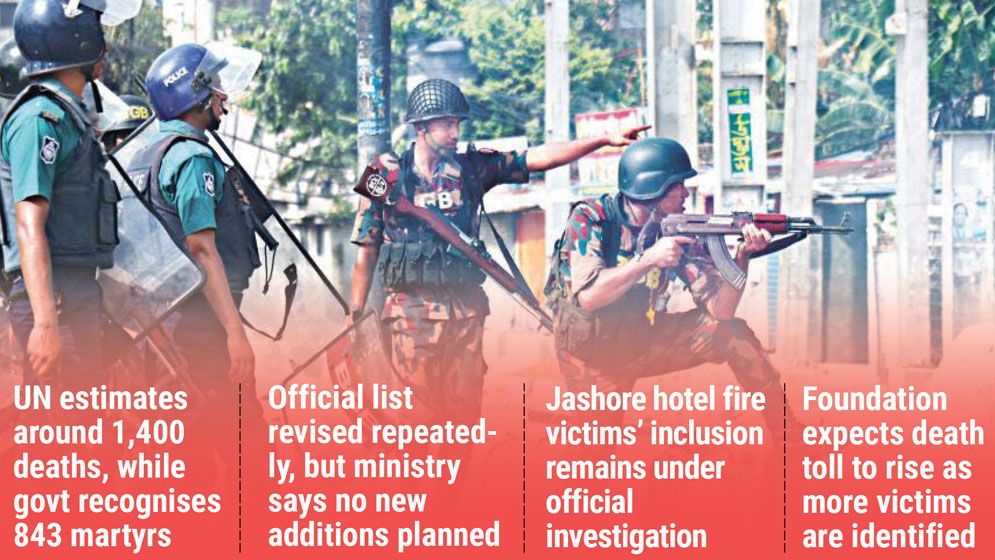
The United Nations puts the toll at around 1,400. The state’s own list, revised and re-revised since the movement ended, currently recognises 843.
Between those two figures sits a gap that families, campaigners and officials have yet to close – and, if one ministry official is to be believed, may never be asked to.
“According to the official count, the number of martyrs stands at 843 and this is the verified figure. There is no ‘if’ or ‘but’ about it,” said Dr Md Zahirul Islam, deputy secretary of the July Mass Uprising Cell under the Ministry of Liberation War Affairs.
Of the UN’s estimate, he was blunter still. “The number cited by the UN is just an assumption. It is not our job to contact them. We have our own survey and verification methodology and we work accordingly.”
The UN figure comes from a report published on 12 February 2025 by the Office of the High Commissioner for Human Rights, which estimated that roughly 1,400 people were killed between 1 July and 15 August 2024 – among them 118 children. Zahirul’s office, he confirmed, has never taken the matter up with Geneva.
“The data they have actually originated from us. They may not have the updated information, which is why there are differences. We have not held any discussions with them on this matter and it is not our responsibility to do so. If they have any new findings, they can submit them to us and we will review them.”
The official list itself has been anything but static.
The first gazette of July martyrs, published in January 2025, named 834 people. It grew to 844, then shrank to 836 after eight entries were struck off – duplicates, and names of people later found to have had no direct involvement in the movement.
This year alone it has moved four more times: down by four names in January and February, up by twelve in April, down by one in May. The tally now stands at 843 martyrs and 14,370 recognised “July warriors.”
Zahirul insists the roll is closed to new additions, even as it may yet shrink further. Under review are the 23 people who died in a fire at the Hotel Zabeer International in Jashore on 5 August 2024, whose place on the martyrs’ list is now in question.
“There is a question surrounding the incident at a hotel in Jashore. An investigation is already underway to determine whether the 23 people who died there should indeed be recognised as martyrs,” he said, adding that the inquiry – being carried out by the Jashore deputy commissioner – has run for three months already, with no end in sight. “It is difficult to give a timeline as the matter is sensitive.”
Not everyone accepts that the list is approaching its final form. At the July Shaheed Smrity Foundation, which has spent two years independently documenting the dead, the expectation runs the other way.
“Rather, the number is more likely to increase,” said Mohammad Sohel Miah, the foundation’s general manager for HR and admin.
“Many unidentified bodies and mass graves have already been found, and forensic teams from the CID and abroad are working to identify them.”
He stopped short of calling the UN’s estimate an assumption, but said he believed the eventual figure would exceed the government’s own. “Even if some names are removed, many more could eventually be added.”
The foundation, he said, cross-checks every case against medical records and supporting documents, and has itself struck off names found unconnected to the uprising. What has changed, he added, is its working relationship with the ministry.
“There was coordination before. Several ministry officials used to work from our office and coordinate with us to verify the names of July martyrs. But that is no longer the case. As a result, we are now facing greater difficulties than before.” For Shamsi Ara Zaman, general secretary of the foundation and mother of martyred journalist Tahir Zaman Priyo, the ministry’s pace after two years amounts to a kind of neglect.
“The Foundation has done much more work on July than the ministry,” she said. “They have not even done one-fifth of what we have done.”
Others go further still.
Saleh Rayhan, convener of the July Revolutionary Alliance, says his organisation has compiled its own list running to 914 names – higher than the state’s, though still well short of the UN’s estimate. He argues the entire exercise should never have been left to the ministry in the first place, and that an independent body should have compiled the list from the outset.
Two years after the uprising, then, Bangladesh is left with at least four different counts of its own dead – and no clear mechanism for reconciling them.