



 For all latest news, follow the Daily Sun's Google News channel.


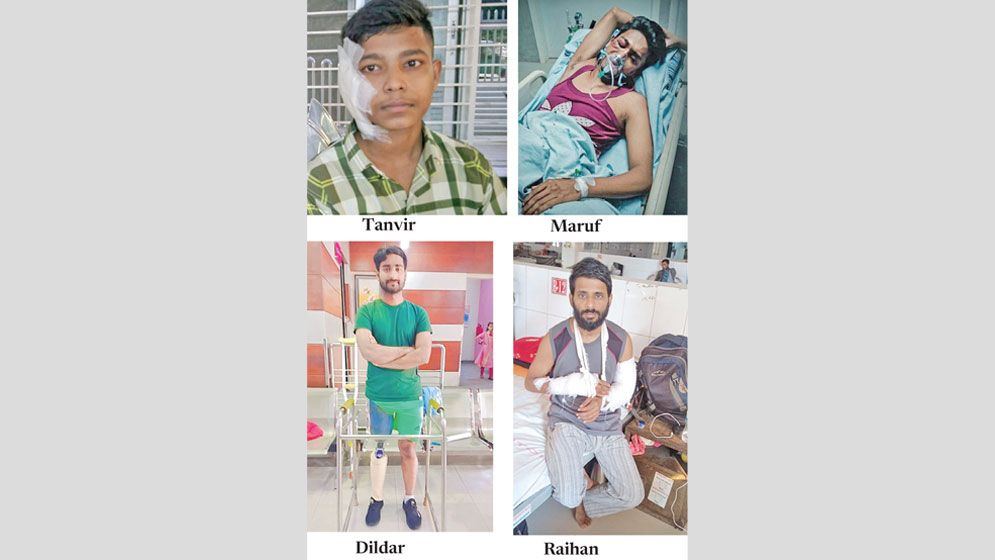
Maruf once had a reputation at Shah Amanat Market in Chattogram for diagnosing faults in mobile phones almost instantly. Colleagues said he could read the language of machines with a single glance.
Today, he has almost lost his sight.
His right eye is permanently blind, while the vision in his left eye has also deteriorated. Three stab wounds to his hip have left him with lasting injuries, and doctors fear his kidney may also have been affected.
On 4 August 2024, a day before Bangladesh’s mass uprising reached its climax, activists of the now-banned Bangladesh Chhatra League and Jubo League allegedly attacked a student-led protest near New Market in Chattogram. Maruf was among the demonstrators.

He was beaten with iron rods and other sharp weapons, suffering severe damage to the retina, cornea and lens of his right eye. Nearly two years later, he is still searching for specialised treatment. His story is far from unique. Of the more than 550 people injured during the July uprising in Chattogram, at least 30 continue to suffer from critical injuries.
Thirteen-year-old Tanvir is among them.
A seventh-grade student at UCEP Pahartali Technical School, Tanvir joined protesters at Dewanhat on the afternoon of 5 August 2024, as the country awaited the final hours of the government’s collapse.
Police opened fire. A bullet entered beside his right ear and exited through the other side of his head.
The injury severely damaged his salivary gland, leaving him unable to eat solid food. Nearly two years on, he survives on liquid meals and has received treatment at several hospitals in Chattogram and Dhaka, with little improvement.
Chattogram Civil Surgeon’s Office Medical Officer Dr Mohammad Nurul Haider said Bangladesh does not currently have the facilities needed for Tanvir’s treatment. “For the past two years, my son has not been able to eat rice. He has almost lost hearing in one ear and vision in one eye,” his father, Kamal Hossain, a day labourer, told the Daily Sun.
“He needs a major operation to live a normal life. But despite trying for two years, we have not been able to arrange it,” he added.
For Mohammad Dildar of Hathazari, the uprising cost him not only a limb but also his livelihood.
Having recently returned from overseas, he was the sole breadwinner for his family when he joined a victory procession in Hathazari on 5 August. Police gunfire blew off his right leg.
The interim government later arranged a prosthetic limb, but it requires regular replacement, a cost Dildar says he cannot afford. The man who once supported his family now depends on others for survival. “The prosthetic leg was arranged with the help of the Civil Surgeon’s Office and some fellow July warriors,” he said.
“But it is not a permanent solution. Those who are now enjoying power do not even know that people like me still exist.” Raihan, a garment worker formerly employed by Four H Group, faces a similar struggle.
He was shot while taking part in a protest at Bahaddarhat on 3 August 2024. Despite treatment at Chattogram Medical College Hospital and later at the National Institute of Traumatology and Orthopaedic Rehabilitation (NITOR) in Dhaka, his condition has improved little.
Doctors say nearly 400 metal splinters remain embedded in both of his hands, causing severe nerve damage.
The father of two now lives in a rented room in Chattogram’s Oxygen area, rather than his home in Sitakunda, so that he can continue receiving regular therapy.
According to official records from the Chattogram Civil Surgeon’s Office, 11 people were killed and 555 injured during the uprising in the district.
Although the government pledged free treatment for those injured, victims and volunteers say many continue to face significant barriers. Students assisting the injured, including Mohammad Enam, Jashim and Rakibul Islam, say the main obstacles are the absence of clear treatment guidelines, bureaucratic delays, costly medicines, and the need for patients to pay for laboratory tests outside government hospitals.
“Even with the promise of free care, long waiting times for approval and careless staff make life painful for us,” Rakibul said. “After sacrificing so much, we are trapped in hospital red tape.”
Chattogram Civil Surgeon Dr Jahangir Alam said a board of specialist doctors had been formed to oversee the long-term treatment of those injured.
Divisional Health Director Dr Sekh Fazle Rabbi said, “When the Civil Surgeon’s Office informs us about patients requiring complex surgery or treatment abroad, we immediately recommend them to the ministry. If anyone is left out, please ask them to report to us.”
National Citizen Party (NCP) Chattogram city Convener Mir Mohammad Shuaib said, “Our resources and capacity are limited, but we are doing as much as we can within our limits.”
Chattogram City Mayor and BNP leader Dr Shahadat Hossain said, “We provided treatment at two hospitals during the uprising and continue to help those who reach out. However, I believe much more still needs to be done.”
Read More