



 For all latest news, follow the Daily Sun's Google News channel.


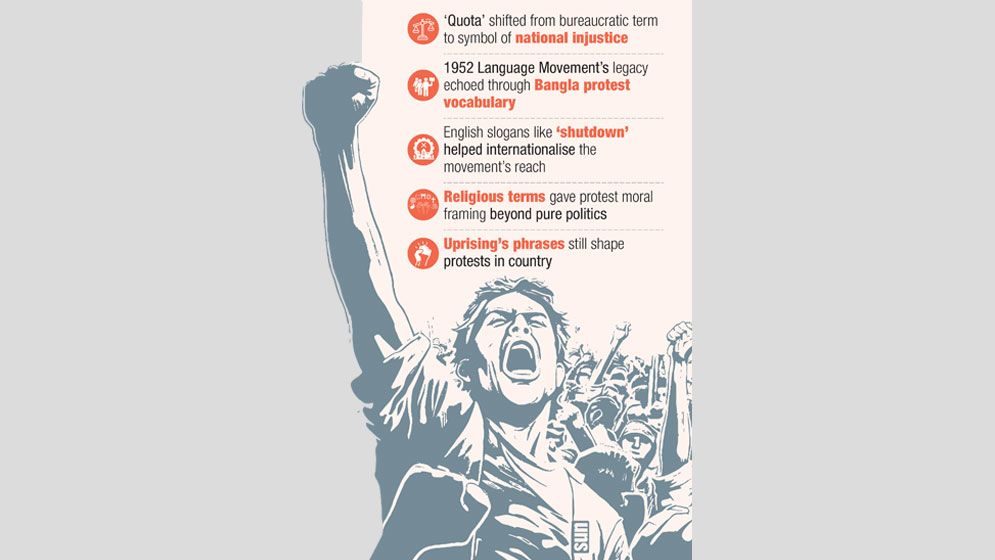
The multi-layered language deployed during the July uprising of 2024 functioned as a political weapon in its own right, forging a shared identity among protesters and carrying the movement’s message to audiences at home and abroad, a new study has found.
The research, titled “The Language of Uprising: Multi-Layered Linguistic Practices During the July 2024 Movement in Bangladesh”, was conducted by Musharraf Hossain Tansen, a doctoral researcher at the University of Dhaka, and published in the latest issue of Mother Language, the journal of the International Mother Language Institute.
The study traces how the bureaucratic term “quota” was transformed into a byword for discrimination and injustice as the protests gathered pace. Bangla words such as “boishommo” (inequality), “zalem” (oppressor), “mazlum” (the oppressed) and “rastro meramot” (repair the state) resonated deeply with demonstrators, echoing the language of the 1952 Language Movement.
Alongside this, English phrases including “Bangla Blockade”, “shutdown”, “complete shutdown” and “March to Dhaka” entered common usage, helping draw the attention of international media.
Religious and revolutionary vocabulary lent the movement further moral weight, according to the research.
Words such as “insaf” (justice), “inqilab” (revolution), “azadi” (freedom) and “zindabad” framed the protests as a struggle for justice and dignity rather than a purely political contest. Younger protesters, meanwhile, turned to memes and satirical social media posts to widen the movement’s reach.
Researchers found that demonstrators deliberately blended Bangla, English and Arabic-derived terms to speak to different audiences simultaneously.
The study argues that this multilingual style reflects Bangladesh’s wider political history, drawing together the legacy of 1952, postcolonial politics and contemporary global protest culture. Professor Dr Mohammad Ashaduzzaman, director of the International Mother Language Institute, said the uprising had produced not just new vocabulary but new modes of expression altogether. “During the movement, protesters developed a new narrative through language. They expressed their ideas using poetry, philosophical lines and creative forms of communication,” he said. He added that studying the uprising’s language would help preserve these expressions and shed light on how protesters shaped their narrative through words.
Ashaduzzaman stressed that language cannot be separated from its social, cultural, economic and educational context.
“If a word is not used appropriately in the right context, its meaning can have far-reaching consequences and even shake the foundations of the state,” he said, citing the term “razakar” as one example from the July uprising.
“Language is contextual. People need to understand which word is appropriate in a particular context.”
A Daily Sun analysis found the uprising’s linguistic imprint has persisted well beyond 2024. Slogans such as “blockade”, “shutdown” and marches “to the Secretariat”, “to the ministry” and “to the PM Office” have since been adopted by the anti-discrimination committee, the Titumir College movement, the Seven College movement and nurses’ protests – evidence that July’s protest vocabulary has become embedded in Bangladesh’s political mobilisation.
Read More