


 For all latest news, follow the Daily Sun's Google News channel.


Top AI tools tighten grip on web traffic
Report finds top 100 platforms capture nearly 90% of AI web traffic as ChatGPT extends its market lead

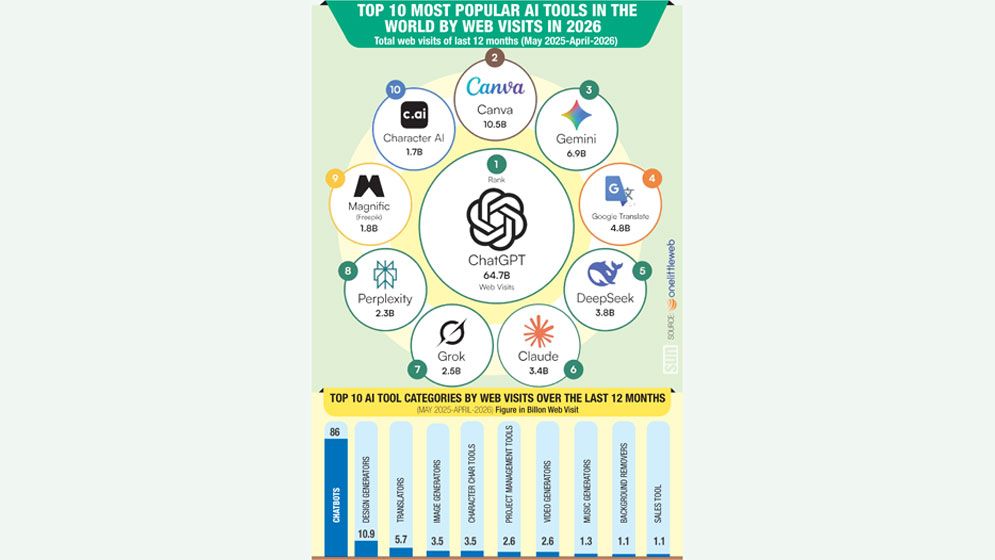
Artificial intelligence has become an integral part of everyday digital life, but a handful of platforms are tightening their grip on the rapidly expanding market, according to a new global study by Dhaka-based analytics firm OneLittleWeb.
The report, Inside the AI Tools Market 2026, found that AI tools attracted 144.5 billion web visits over the past 12 months, up 40.12% from a year earlier.
Despite the rapid growth, the market is becoming increasingly concentrated. The top 100 AI tools accounted for 129.6 billion visits, or 89.69% of all AI web traffic, meaning nearly nine out of every 10 visits went to just 100 platforms.
Speaking to the Daily Sun, OneLittleWeb co-founder Mohammad Sujan Sarkar said AI has quietly become part of people’s daily online experience.
“Artificial intelligence is no longer just another technology trend. If you’ve used the internet today, there’s a good chance you’ve already used AI without even realising it,” he said.
“Whether it’s asking ChatGPT instead of searching Google, designing a presentation in Canva, drafting an email with Claude or translating a webpage using Google Translate, AI has become part of how millions of people work, learn and create.”
The study analysed 9,531 AI tools across more than 170 categories using 24 months of web traffic data from May 2024 to April 2026, based on estimates from Semrush and Ahrefs.
ChatGPT widens lead
ChatGPT remained the dominant AI platform, attracting 64.7 billion web visits over the past year.
It captured 44.76% of the entire AI tools market and nearly half of all traffic among the top 100 AI platforms. Its traffic exceeded that of second-ranked Canva by more than six times.
While ChatGPT maintained its commanding lead, rivals expanded much faster. Gemini’s traffic surged 450.33%, Claude grew 250.07%, and Grok recorded the fastest growth at 731.26%, highlighting intensifying competition among AI assistants.
Chatbots replace specialised tools
The report also found a major shift in user behaviour, with people increasingly abandoning specialised AI applications in favour of all-in-one conversational assistants.
Traffic to platforms such as Google Translate, Chegg, Quizlet and QuillBot declined as users turned to chatbots for translation, writing, studying and other everyday tasks.
Google Translate recorded the largest absolute decline, losing 1.5 billion visits, or 23.46%. Chegg’s traffic fell 61.45%, while Quizlet and QuillBot declined 29.09% and 25.24%, respectively.
As a result, chatbot traffic jumped 90.82% year on year to 86 billion visits, giving the category a 59.52% share of the AI tools market.
In contrast, translator tools lost 1.6 billion visits, or 22.52%, as users increasingly opted for general-purpose AI assistants.
AI still a small share of the internet
Despite its explosive growth, AI still accounts for only a small portion of overall internet activity.
OneLittleWeb’s broader database of 10,173 major websites recorded 3.44 trillion web visits during the same period, with AI tools making up just 4.20% of the total tracked traffic.
“This shows AI has already become a major technology market, but compared with the wider internet, there is still significant room for further adoption,” Sarkar said.
Singapore leads in AI usage
The country-level analysis found that the United States generated the highest overall AI traffic, with 29.2 billion visits.
However, Singapore ranked first in AI usage intensity after adjusting for population, recording 16.1 million AI web visits per one lakh people despite having a population of only 5.9 million.
The Netherlands ranked second with 9.8 million visits per one lakh people, followed by the United States with 8.4 million.
The report concludes that although thousands of new AI tools continue to enter the market, future growth is likely to be driven by a relatively small group of indispensable platforms that become deeply embedded in users’ daily lives, rather than by the sheer number of new entrants.