



 For all latest news, follow the Daily Sun's Google News channel.


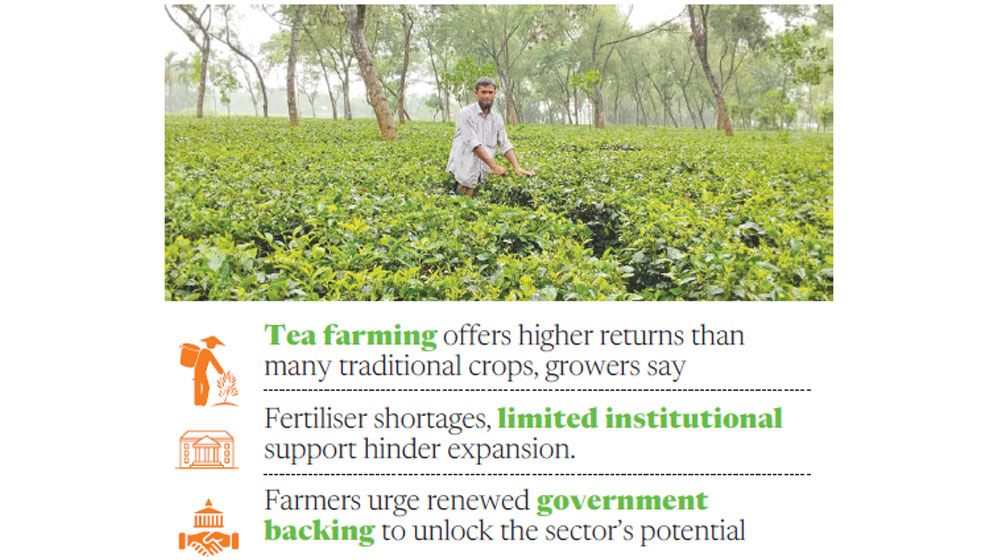
Tea cultivation is emerging as a promising alternative to tobacco farming in the northern border district of Lalmonirhat, with growers and officials saying the crop has the potential to transform the local economy if key challenges, particularly fertiliser shortages and limited institutional support, are addressed.
Farmers say tea cultivation is proving more profitable than many traditional crops and has attracted increasing interest across the district. However, they warn that inadequate fertiliser supplies, a shortage of quality seedlings and limited support from the Bangladesh Tea Board are hindering further expansion.
Tea cultivation in Lalmonirhat began on an experimental basis in 2016 at Taluk Dulali Mouza under Velabari Union in Aditmari upazila. The initiative was launched by entrepreneur Jamal Uddin Sarkar, a lawyer at the Dhaka Tax Bar, who pioneered commercial tea farming in the area.
Inspired by his success, many farmers in Aditmari and neighbouring upazilas followed suit. The government later launched the “Eradication of Rural Poverty through Extension of Smallholding Tea Cultivation in Lalmonirhat” project, aiming to bring 100 hectares under tea cultivation with an annual production target of 250,000kg.
Tea cultivation subsequently expanded to Patgram, Hatibandha, Kaliganj and Aditmari upazilas, while the Bangladesh Tea Board established an office in Lalmonirhat under the Northern Tea Belt programme.
The sector, however, suffered a major setback during and after the Covid-19 pandemic due to labour shortages and a sharp fall in tea prices. At one stage, green tea leaves were sold for only Tk12-Tk15 per kg, making production unprofitable.
As Lalmonirhat lacks its own tea processing factory, growers had to transport their produce to Panchagarh for sale, where buyers deducted 20-30 per cent from the price, causing heavy financial losses. As a result, many tea growers abandoned their plantations.
With the current market price rising to around Tk38 per kg, tea cultivation has once again become profitable, prompting many former growers to consider returning to the sector.
Unlike seasonal crops such as rice, maize and potatoes, tea offers repeated harvesting throughout the year. Farmers can pluck tea leaves up to seven times annually, with production increasing after each harvest. Growers estimate that mature plantations can produce up to 3,000kg of green leaves per bigha annually.
According to farmers, production costs, including fertilisers, pesticides, labour and transportation, range between Tk11 and Tk13 per kg, while tea currently sells for around Tk38 per kg. They claim profits can reach nearly Tk300,000 per bigha annually under favourable market conditions.
However, growers say access to fertiliser remains their biggest challenge. Tea plants require regular applications of urea, TSP, DAP and potash after each harvest to maintain production, but farmers allege they often fail to receive adequate supplies through official channels.
They claim that while growers of rice, maize and potatoes receive fertilisers under government allocation programmes, tea farmers are excluded, forcing them to purchase fertilisers from the open market at significantly higher prices.
Jamal Uddin Sarkar, who cultivates tea on 36 bighas of land, said the Tea Board initially supplied seedlings, spraying equipment, irrigation pumps and harvesting machinery. However, since the project ended three years ago, no further assistance has been provided.
"There is enormous potential for tea cultivation in Lalmonirhat. With uninterrupted fertiliser supplies, quality seedlings and stronger institutional support, tea farming could significantly improve the livelihoods of local people and contribute to the district's economy," he said.
Officer-in-Charge of the Bangladesh Tea Board's Lalmonirhat office Amir Hossain acknowledged the challenges, saying the project that previously supported farmers had expired three years ago.
"We are currently unable to provide assistance because the project has ended. The manpower shortage is another major challenge. I have to oversee tea activities in Panchagarh, Thakurgaon, Nilphamari and Lalmonirhat simultaneously," he said.
He added that new government projects and additional manpower would help remove existing barriers to tea cultivation, benefiting both farmers and the national economy.