



 For all latest news, follow the Daily Sun's Google News channel.


Despite being blessed with abundant water sources such as rivers, 30% of Chattogram city, regarded as the country’s commercial capital, still remains outside the water supply network, even 63 years since the establishment of Chattogram Water Supply and Sewerage Authority (CWASA).
Founded in 1963, CWASA currently supplies 56 crore litres of water per day against a demand of 65 crore litres.
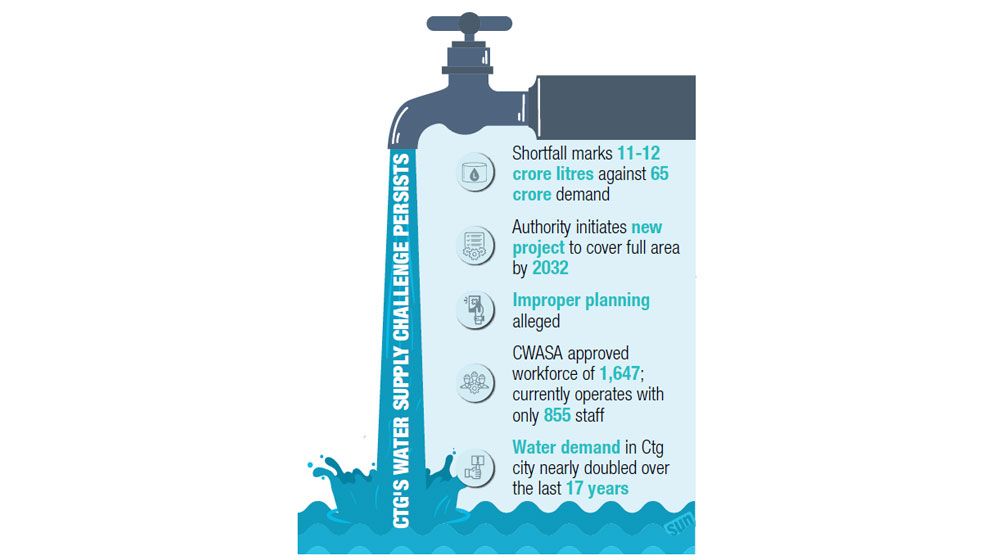
In reality, however, the shortfall is even greater – around 11 to 12 crore litres – due to factors including pilferage and system losses, leaving residents of 30% of the city without access to this essential civic amenity.
Although CWASA has implemented several large-scale projects over the decades at a cost of crores of taka, the non-availability of piped water in parts of four Chattogram City Corporation (CCC) wards has raised questions about the effectiveness of long-term planning and project implementation.
Bridging the gap
To bridge the gap between water demand and supply, the authority has undertaken initiatives to install additional deep tube-wells and implement a new mega project.
According to sources, CWASA now operates six water treatment plants and 53 deep tube-wells. The agency supplies water to 98,553 residential and industrial subscribers through 1,172 kilometres of pipelines.
Of the total supplied water, 93% comes from surface sources – the Halda and Karnaphuli rivers, while the remaining 7% is drawn from underground sources, in line with the World Health Organization standards.
Against an approved workforce of 1,647, the service agency currently operates with only 855 staff, including outsourced and daily-wage workers, and generates annual revenue of Tk337 crore.
Guided by a vision to build an efficient water supply and sewerage management system, CWASA has seen demand nearly double in the city over the last 17 years.
CWASA data show that in 2009, the demand stood at 37 crore litres per day, against a supply of just 13 crore litres. By 2017, the supply had risen to 30 crore litres against a demand of 45 crore litres. In 2020, demand soared to 50 crore litres while supply reached 36 crore litres. Currently, demand stands at 65 crore litres against a supply of 56 crore litres.
To overcome the ongoing crisis and meet the future demand projected for 2050, CWASA plans to set up a 61-crore-litre-capacity water intake.
A 30-crore-litre-capacity water treatment plant, an 810-metre river-crossing pipeline and a reservoir will be developed in the first phase under the project through the relocation of the intake of Mohora Water Treatment Plant and capacity enhancement.
CWASA Chief Engineer Makshud Alam told the Daily Sun that the pre-DPP for the project has already been sent to the ministry with an estimated cost of Tk4,380 crore.
“Economic Development Cooperation Fund (EDCF) of South Korea has expressed interest in financing the project, and the feasibility study for it is expected to begin in October,” he said.
Makshud said parts of the city’s Dakkhin Madhyam Halishahar, Dakkhin Halishahar, Uttar Patenga and Dakkhin Patenga still remain outside the CWASA service area. However, the proposed project will help bring the entire area under coverage by 2031-2032, and meet the demand of 110 crore litres of water in 2050.
Asked about the failure to ensure supply to all in 63 years, the chief engineer said water demand had increased significantly over the years. Besides, the capacity had to increase in phases as development partners generally do not provide the entire funding at once.
Moreover, securing successive rounds of donor assistance takes considerable time, he added.
Makshud also said that another Tk49 crore project has been proposed to boost supply in the salinity-prone areas of Patenga and Kattali, and improve customer service.
The process of implementing three other projects for generating four crore litres of water and setting up 20 tube-wells is also going on, he added.
CWASA Managing Director (MD) Engineer Salim Md Jane Alam said they were working to address the ongoing crisis by installing deep tube-wells in the crisis-prone areas.
“We expect the situation to improve in the coming days through various ongoing efforts,” the MD said, adding that the effective daily shortfall remains around 11 to 12 crore litres due to various factors.
Consumers Association of Bangladesh (CAB) Vice President SM Nazer Hossain described the prolonged water crisis as unfortunate and called for immediate action to resolve it.
He alleged that several mega projects had been implemented without proper planning and were designed more to serve the interests of contractors and officials than to address the needs of the city's residents.
Ismail Hossain Nayan, a resident of the city's Dakkhin Patenga area, said they had yet to get piped water despite staging a series of demonstrations over the decades.
“We still have to buy water to meet our daily needs. We don’t know when the problem will be solved,” said a frustrated Nayan.