


 For all latest news, follow the Daily Sun's Google News channel.


Supply chains inflate food prices by 116%: CPD
Commerce minister stresses cutting “unaccounted expenses” across supply chains
Daily Sun Report, Dhaka
Published: 31 Jul 2026, 12:00 AM
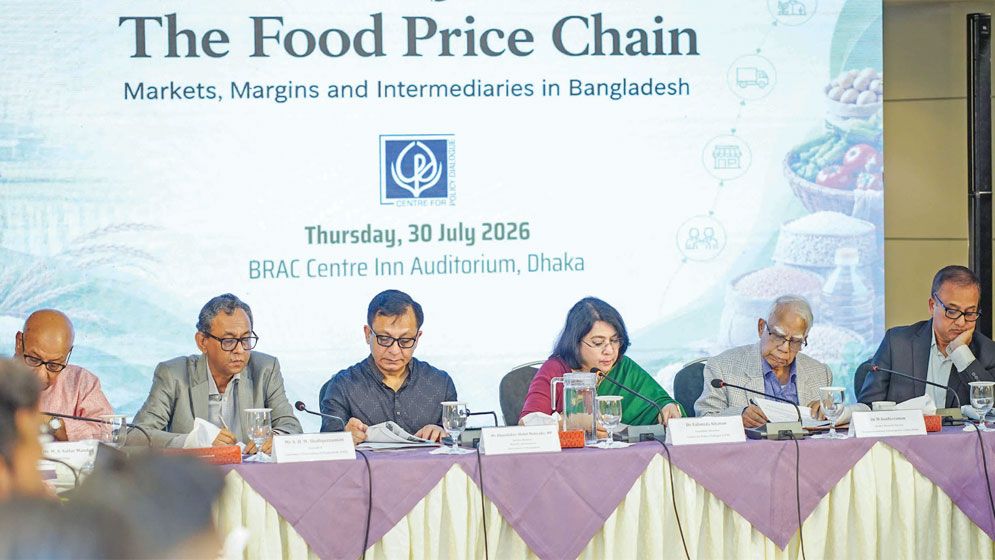
Lengthy supply chains are driving up essential food prices in Bangladesh by up to 116% between farm and retail, heavily burdening low-income households, a new study by the Centre for Policy Dialogue (CPD) reveals.
The report, titled “The Food Price Chain: Markets, Margins and Intermediaries in Bangladesh,” was presented Thursday by CPD Senior Research Associate Foqoruddin Al Kabir at a dialogue in Dhaka on Thursday.
Commerce Minister Khandakar Abdul Muktadir attended the event with CPD Executive Director Dr Fahmida Khatun in the chair.
According to the study, green chillies saw the steepest price jump at 116%, followed by medium-quality rice (100%), onions (87%), lentils (78%), brinjal (72%), and potatoes (50%).
Conversely, items with shorter supply chains saw far milder increases, including eggs (25%), chicken (22%), beef (13%), and ruhi fish (10%).
The study found that commodities passing through longer marketing chains generally experience larger price increases, highlighting the need to simplify food distribution systems.
Based on a survey of 820 market participants across 10 markets in Dhaka division, the research traced the supply chains of 10 domestically produced essential food commodities.
It found that retailers rely heavily on urban aratdars to source six of the 10 commodities – onion, potato, green chilli, brinjal, eggs and ruhi fish – contributing to market
concentration, weaker competition and greater price volatility.
For medium-quality rice, farmers receive only about 50.8% of the final retail price, while auto-rice millers capture the highest marketing margins among intermediaries and exert considerable influence over storage, pricing and supply.
Foqoruddin said food inflation in Bangladesh is driven by more than production costs, with supply shortages, market concentration, middlemen, hoarding and market dominance also playing significant roles.
He noted that nearly 30% of the country’s population remains food insecure, while persistent inflation has eroded real wage growth and purchasing power despite increases in nominal wages.
Many households are reducing food consumption, depleting savings or borrowing to cope with rising living costs.
According to the study, food accounts for 59% of Bangladesh’s Consumer Price Index (CPI) basket, while more than 60% of households spend at least half of their income on food.
The poorest 5% of households spend 59.8% of their consumption expenditure on food, compared with 28.9% among the richest 5%, making them particularly vulnerable to food price shocks.
The report identified supply shortages, trader collusion and hoarding as the most frequently cited causes of high food prices.
It also highlighted inadequate storage and cold-chain facilities, post-harvest losses, rising transport costs and higher production expenses as key contributors to food inflation.
However, the study cautioned that its findings do not establish that intermediaries alone are responsible for excessive prices, nor do they prove that market concentration by itself amounts to collusion.
The CPD said multiple intermediaries contribute to higher consumer prices and stressed the importance of streamlining supply chains to moderate the prices of essential commodities.
It also found that heavy dependence on urban aratdars increases market concentration, bargaining power imbalances and price volatility.
In most cases, farmers, millers, urban aratdars and retailers account for the largest shares of consumers’ spending through gross margins.
The think tank recommended making food supply chains more efficient, increasing competition in wholesale markets, improving price and market information transparency, strengthening market monitoring and accountability, upgrading storage, transport and market infrastructure, and reducing production costs and constraints faced by farmers.
Addressing the programme, Commerce Minister Khandakar Abdul Muktadir stressed the need to reduce logistics costs and raise agricultural productivity to curb persistently high food inflation.
“High logistics expenses, rising production costs and market irregularities remain key factors behind elevated food prices,” he said.
The minister noted that logistics costs in Bangladesh account for around 16% of GDP, significantly higher than the global average of about 10%.
To improve market efficiency, he said the government is introducing a traceability system across the entire food supply chain – from production to the consumer level – to identify abnormal price increases, eliminate informal charges and improve transparency.
Muktadir said nearly 1.78 crore farming families have limited incomes and savings, restricting their ability to invest in modern technology.
He also identified information asymmetry as a major challenge, saying farmers often lack reliable market information needed for production planning and fair pricing.
Calling for a technology-driven transformation of agriculture, he said the country must move beyond input subsidies toward an integrated agricultural management system tailored to Bangladesh’s soil, climate and farming conditions.
While successive governments have subsidised fertilisers, seeds and irrigation, he said a coordinated approach based on research and innovation is now essential to improve productivity and strengthen food security.
Describing agriculture as a high-risk sector dependent on natural conditions, unlike controlled industrial production, the minister underscored the need for sustained government support, scientific research and modern farming practices to ensure long-term food security.