



 For all latest news, follow the Daily Sun's Google News channel.


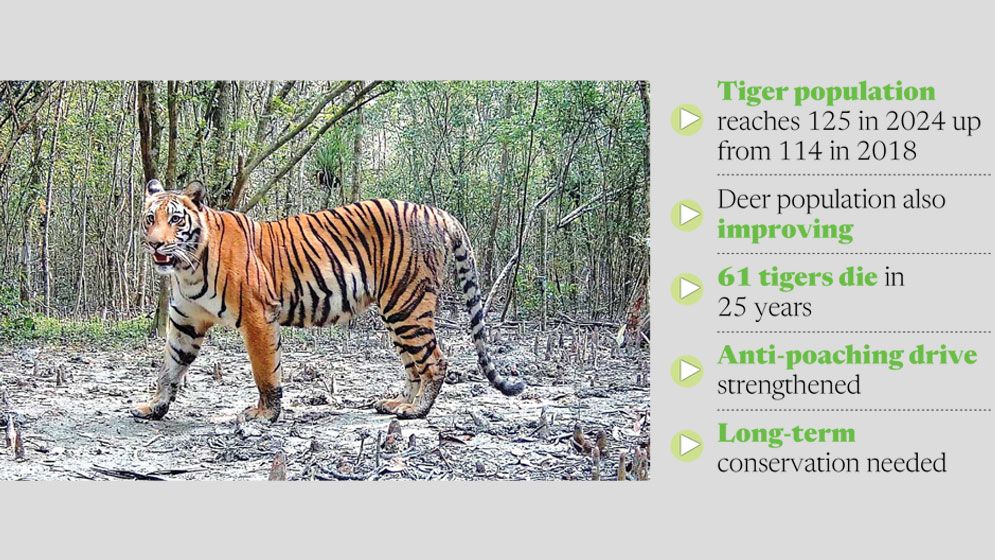
Photo: Collected
The number of Royal Bengal Tigers in the Sundarbans has increased to 125, according to the latest camera-trap census, displaying a rare conservation success despite continued threats from poaching, climate change and criminal activities.
The Sundarbans is the country’s only habitat for the Royal Bengal Tiger and is home to a large number of animals. Forest Department data showed that tiger numbers have risen steadily over the past decade: 106 in 2015, 114 in 2018, and 125 in 2024.
Besides, according to the Sundarbans Division, a total of 61 tigers died between 2001 and 2025. Of them, 26 were killed by criminals, 14 by local people, 19 died of natural causes, and two died from other causes.
The deaths were almost evenly divided between the East Sundarbans Division (30) and the West Sundarbans Division (31). During the same period, tiger skins and bones were recovered in several incidents. A total of 13 people were killed in tiger attacks in the East Sundarbans Division.
Forest Department officials attribute the growth to intensified conservation efforts, including regular patrols, drone surveillance and anti-poaching operations. The department said tiger habitats are now safer than before and expects the population to increase further in future censuses.
Sundarbans East Divisional Forest Officer (DFO) Md Rezaul Karim Chowdhury said a large number of traps used to hunt tigers and deer were recovered during the past year. He added that 70 deer poachers were arrested, a list of 150 suspected poachers was handed to law enforcement agencies, and no Tiger deaths have been recorded in the Sundarbans in recent years. The latest survey was conducted in October 2024, he said.
Wildlife experts welcomed the increase but cautioned that the species remains vulnerable. Prof Dr Anwarul Islam, wildlife expert and chief executive of WildTeam, said tigers in the Sundarbans continue to face threats from climate change, poaching, poisoning linked to fishing activities, and pressure from armed groups and other human activities.
He said the tiger population has not declined for more than a decade and that the recent increase is a significant achievement. However, he stressed that Bangladesh needs a long-term conservation plan addressing all major threats to both the tiger and the Sundarbans ecosystem.
Dr Anwarul also called for reducing local peoples’ dependence on forest resources, strengthening the capacity of the Forest Department, enforcing wildlife protection laws, and restoring silted rivers and canals that are essential for the tidal flow sustaining the mangrove forest.
Globally, tiger numbers have fallen sharply over the past century, and three tiger subspecies have become extinct. Bengal tigers now survive mainly in Bangladesh, India, Nepal and Bhutan. Conservationists said the latest census provides a ray of hope, but warned that the future of Bangladesh’s tigers remains inseparable from the long-term survival of the Sundarbans itself.
Read More