


 For all latest news, follow the Daily Sun's Google News channel.


DCCI urges national roadmap for chemical backward linkage
With $6.2b in annual chemical imports, experts push for domestic production boost
Daily Sun Report, Dhaka
Published: 26 Jul 2026, 12:00 AM
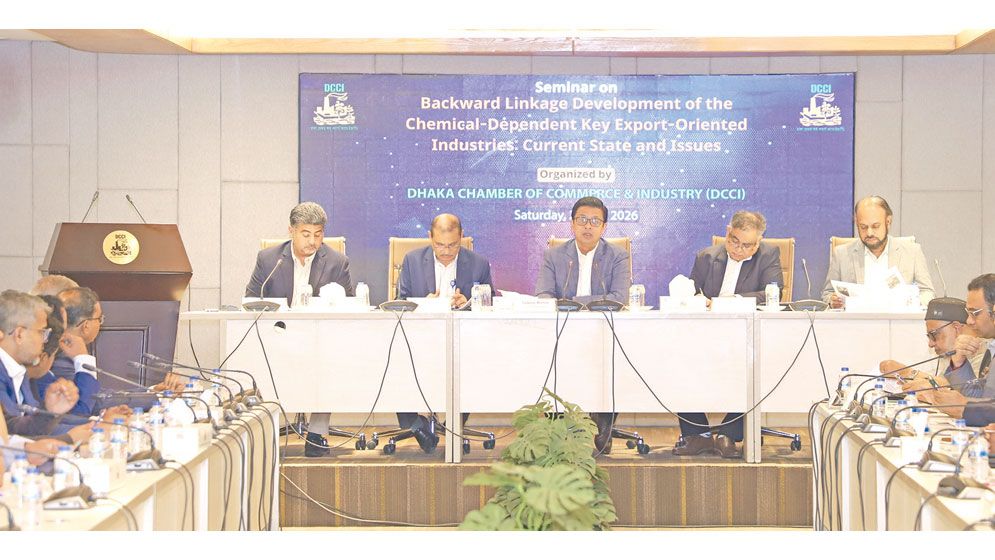
Business leaders and policy experts called for a national roadmap to strengthen Bangladesh’s chemical backward linkage industry, warning that heavy reliance on imported chemicals threatens the country’s export competitiveness.
Speaking at a Dhaka Chamber of Commerce and Industry (DCCI) seminar on Saturday, experts noted that while Bangladesh’s domestic chemical market exceeds US$6 billion, growth remains hampered by high tariffs, unreliable energy, complex licensing, and weak logistics.
DCCI President Taskeen Ahmed highlighted that key sectors – including ready-made garments, textiles, leather, and pharmaceuticals – depend heavily on competitive local supply.
“Developing a comprehensive roadmap for the chemical backward linkage industry is no longer optional; it is a strategic necessity to safeguard the future of Bangladesh’s export sector,” Ahmed said.
Md Salim Ullah, director general of the Bangladesh Institute of Management (BIM), said the government is revising the National Industrial Policy and suggested the private sector assess whether the chemical industry needs a separate policy or a dedicated chapter within the existing framework.
He stressed that developing backward linkage industries for chemical-dependent export sectors is essential to accelerate industrialisation and called for stronger public-private collaboration to build a skilled workforce.
Abul Fatah Md Baligur Rahman, member (development) of the Bangladesh Council of Scientific and Industrial Research (BCSIR), underscored the need to strengthen industry-academia collaboration and encouraged businesses to commercialise research developed by BCSIR.
He said Bangladesh has strong potential to produce import substitutes by utilising local resources, adding that uninterrupted electricity and energy supply, along with supportive government policies, are essential to unlock opportunities in sectors such as light engineering.
Presenting the keynote paper, Asif Rabbani, managing director of SR Chemical Industries Ltd, said Bangladesh’s chemical market is worth between $6 billion and $8 billion and is growing by 10%-15% annually.
He noted that the country imported around $6.2 billion worth of chemicals in the fiscal 2024-25, most of which were used by the garment, pharmaceutical and leather industries.
He identified logistics bottlenecks, high tariffs, inadequate infrastructure and inefficient supply chains as the main barriers to developing a competitive domestic chemical industry.
Industry representatives echoed similar concerns.
Sheikh H M Mustafiz, a director of the Bangladesh Garment Manufacturers and Exporters Association (BGMEA), emphasised the need for uninterrupted energy supply, internationally compliant chemical production and specialised industrial zones.
Md Moniruzzaman, a director of the Bangladesh Knitwear Manufacturers and Exporters Association (BKMEA) and chairman of Badon Fashion Ltd, said the successful development of backward linkage industries in the RMG sector through supportive government policies could serve as a model for the chemical industry, encouraging greater investment and employment.
Representatives from the pharmaceutical, leather and agrochemical sectors urged the government to reduce import-stage duties on raw materials, strengthen research and skills development, and expedite infrastructure projects, including the API Industrial Park.
Speaking on behalf of the National Board of Revenue (NBR), Suraiya Sultana, second secretary (Customs: Export & Bond), said tariff rates are being reduced gradually to encourage local chemical production, while the bonded warehouse licensing process has been fully digitised to improve ease of doing business.
Md Ziaul Haque, additional director general (current charge) of the Department of Environment, said chemical management must remain environmentally responsible to protect public health and urged industries to exercise greater vigilance in the import and use of hazardous chemicals.
Senior officials from government agencies, trade bodies and the private sector, along with DCCI Senior Vice-President Razeev H Chowdhury, Vice-President Md Salem Sulaiman and members of the chamber’s board, attended the seminar.