



 For all latest news, follow the Daily Sun's Google News channel.


A single mechanical fault at one floating gas terminal has been enough to bring much of Bangladesh to a standstill – starving factories of power, leaving households unable to cook and forcing drivers to queue for hours at CNG pumps.
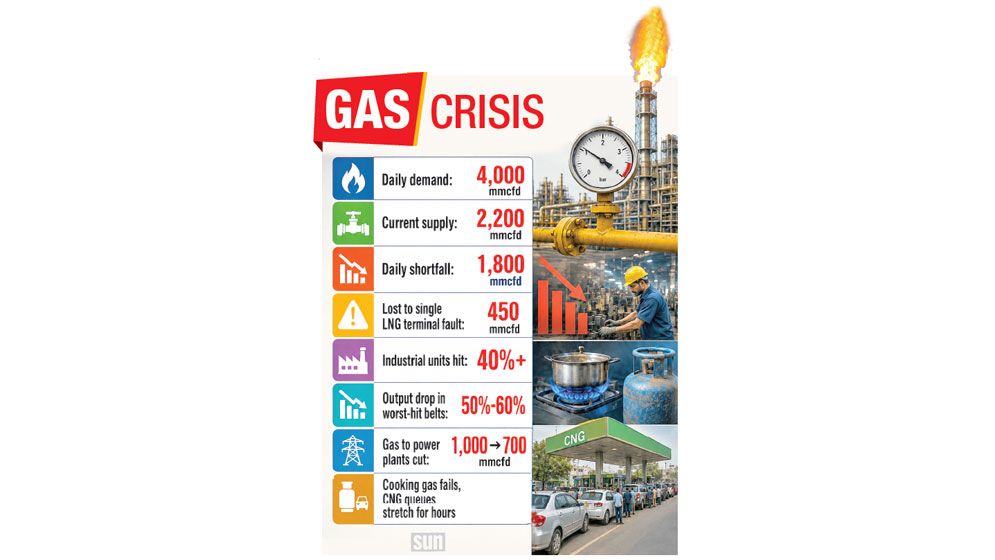
The trigger was a technical failure at a floating storage and regasification unit (FSRU) off Maheshkhali in Cox's Bazar, which has cut supplies to the national gas grid by roughly 450 million cubic feet a day.
But the scale of the fallout has laid bare something more troubling: a country that has grown reliant on imported LNG even as its own gas fields run dry, with almost no spare capacity to absorb a shock.
Petrobangla figures show supply has fallen to around 2,200 million cubic feet a day, against demand of nearly 4,000 mmcfd – a shortfall of about 1,800 mmcfd.
Factories grind to a halt
The industrial toll has been severe.
The Bangladesh Textile Mills Association says more than 40% of factories have either suspended production entirely or been badly disrupted, with output down by half or more across several major industrial belts.
BTMA president Shawkat Aziz Russell said the crisis had hit even his own operations hard.
"About 90% of the factories in my own industrial group have been forced to shut because of the gas crisis," he said, warning that prolonged disruption could see mills miss export deadlines while still having to cover wages and fixed costs.
Gazipur, Savar, Ashulia and Narsingdi have been worst affected. In parts of Gazipur, gas pressure has dropped to just 1-2 psi against a required 5-10 psi; one factory in Kaliakair has seen daily output collapse from 60 tonnes to 10.
In Narsingdi, several units have halted dyeing, finishing and knitting lines altogether.
Savar and Ashulia, home to roughly 1,200 factories, have seen production fall by around half. Many manufacturers are now paying a premium for alternative fuels simply to keep shipments moving.
Households left without gas
The crisis has reached deep into ordinary homes.
In Dhaka and beyond, weak gas pressure has left families unable to cook, pushing many towards electric stoves or LPG cylinders – and higher bills.
Moumita Islam, who lives in Shewrapara, Mirpur, said the pressure at her home had been failing for two to three weeks.
"After 10am, there is usually no gas at all. Sometimes the supply returns in the afternoon, but the pressure remains extremely low," she told the Daily Sun. "Previously, gas pressure would fall slightly during winter, but we had never experienced a situation where the stove completely stopped working."
She said residents in her area had gone days without any gas whatsoever.
"We have been using an induction cooker, while many residents are cooking on wood-burning stoves in the garages of their buildings."
Officials who inspected the area reportedly found problems with underground lines, possibly damaged by ongoing sewerage works nearby.
Drivers stuck in queues
Transport has not been spared either.
Long queues have built up at CNG filling stations, many of which are struggling to operate at all because of poor pressure.
Drivers describe waiting for hours, only to come away empty-handed.
Aminur, a CNG driver who had been queuing at a Shahbagh filling station since dawn, said he had still not managed to refuel after several hours.
Fellow driver Ikram said the wait was eating directly into his working hours – and his earnings.
Power plants also squeezed
Electricity generation has taken a hit too, with gas supplies to power plants falling from around 1,000 mmcfd to roughly 700 mmcfd, adding further strain to a system already stretched thin.
State minister for power, energy and mineral resources Aninda Islam Amit said on Saturday that repairs to the FSRU were under way and supplies would improve gradually.
"Gas supply would return to normal soon and pressure at power plants, industries, households and CNG filling stations would gradually improve," he said, adding that Petrobangla and a private contractor were working together on the fix and that the energy department was monitoring the situation around the clock.
Petrobangla says domestic and foreign technical teams are working to identify and repair the fault, though no firm timeline has been given.
A crisis years in the making
While the terminal fault is the immediate cause, the roots of the problem run deeper. Domestic gas production has fallen by around 900 mmcfd over the past six years – from about 2,500 mmcfd in 2020 to roughly 1,600 mmcfd today – even as demand has kept climbing.
The gap has increasingly been plugged with imported LNG, leaving the whole system exposed whenever import infrastructure falters.
Energy economist Prof M Tamim said the crisis had been almost inevitable.
"A single floating terminal going offline should not be enough to create such a nationwide crisis," he said, adding, "But Bangladesh has very little spare capacity in its gas supply system." A serious fault at a major domestic gas field, he warned, could trigger a similar shock.
Even once the FSRU is repaired, the underlying shortage will remain.
A senior official said Titas Gas was receiving around 1,200 mmcfd against demand of roughly 1,900 mmcfd – down from about 1,500 mmcfd before the fault, much of which was earmarked for power and fertiliser production. That points to a structural deficit that predates the current emergency.
Energy expert Dr Ijaz Hossain said Bangladesh needed at least 15 days of gas storage capacity, along with additional regasification facilities and a land-based LNG terminal, arguing that floating units remain exposed to bad weather and operational failures.
Government response
The government says it is working to cut reliance on imported gas, with plans to drill 100 new wells and a recently approved Tk729 crore project to sink five wells in Begumganj and Sunamganj.
Officials are also weighing a fourth FSRU, additional LNG import routes, ways to bring gas from Bhola into the national grid, and fresh drilling and workover programmes at existing fields, alongside efforts to draw in new exploration investment. Recommended Stories