


 For all latest news, follow the Daily Sun's Google News channel.


New US tariffs hit 60 countries; Bangladesh gets lowest rate
Dhaka’s 10% rate keeps it ahead of key rivals, but economists warn a separate bilateral deal could still push the burden to 19%

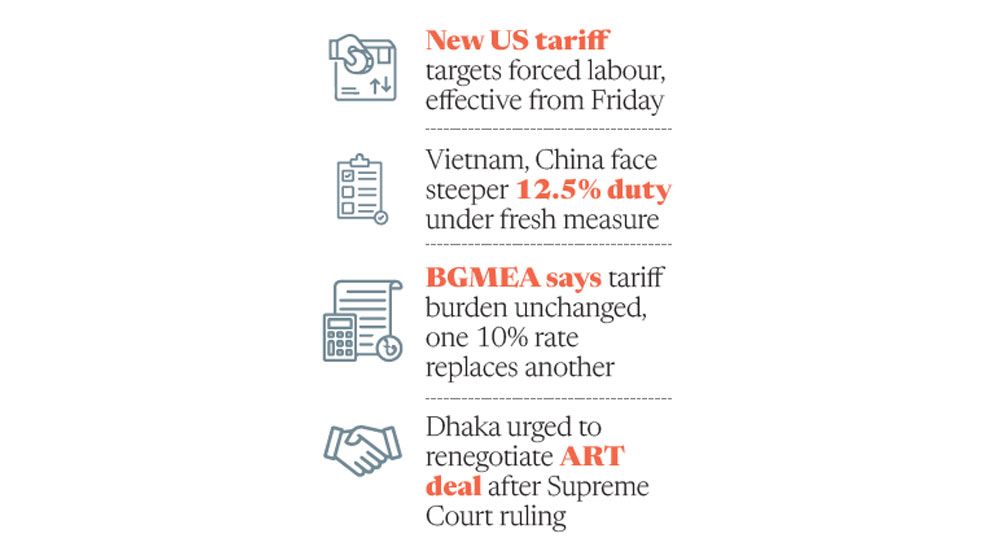
Bangladesh has landed in the lowest tariff bracket as the United States imposed fresh duties on imports from 60 economies worldwide, with Dhaka assigned a 10% rate – the bottom rung of a scale that runs up to 12.5% and puts it ahead of major apparel rivals such as Vietnam and China.
The new tariffs, effective from Friday, target countries Washington accuses of failing to curb forced labour in their supply chains.
The measure, announced on Thursday under Section 301 of the Trade Act of 1974, follows USTR investigations into 86 countries and now covers 99.4% of US imports, with exemptions carved out for oil and gas, fertiliser and certain food products.
Bangladesh joins just 16 other economies, including Argentina, Britain, Canada, India, Indonesia, Pakistan and Sri Lanka, in the lowest 10% tier, while 38 countries, among them Vietnam and China, face the steeper 12.5% rate.
The EU, Japan, South Korea, Taiwan and Switzerland were assigned rates that, combined with existing most-favoured-nation duties, also total 10% or 12.5%.
USTR Ambassador Jamieson Greer said the action was taken “at President Trump’s direction” after two rounds of public hearings and more than 2,100 public submissions.
“President Trump recognises that decades of moral suasion have not eradicated forced labour from global supply chains,” he said, adding that the US had enforced a forced labour import ban for nearly a century and expected trading partners to do the same. He described the move as correcting “both a human rights abuse and distortive trade practice.”
For Bangladesh, the new levy effectively replaces an outgoing 10% tariff imposed under Section 122, which expires on 24 July – meaning little immediate change to the overall duty its exporters face, even as the country’s relative standing improves.
‘No real change’
Mahmud Hasan Khan, president of the Bangladesh Garment Manufacturers and Exporters Association (BGMEA), told Daily Sun that one 10% tariff was simply being swapped for another.
“One 10% tariff is ending, but another 10% tariff is beginning. So, in terms of the tariff rate, there is effectively no change,” he said.
He noted the actual burden varies by product, with cotton goods, polyester items, T-shirts and denim taxed differently.
“On average, Bangladeshi exports previously faced duties of around 16% to 17%. With the additional 10% tariff, the average duty will rise to around 26% to 27%,” he said, adding that the broader bilateral agreement with Washington extends well beyond garments and that its ultimate benefit “will become clear over time.”
Industry: build capacity, don’t rely on tariffs alone
Mohiuddin Rubel, additional managing director of Denim Expert Ltd and a former BGMEA director, said the new structure was hardly a surprise, having long been signalled by Washington.
What were once temporary measures, he said, had now been written into a formal legal framework, making them far harder to contest internationally. Bangladesh’s low rate, he argued, reflects early lobbying and negotiating commitments, and could yet prove an advantage, particularly if the country retains preferential access to US cotton while Vietnam does not.
He also suggested Bangladesh’s position would strengthen further should India lose similar cotton-related benefits.
“Overall, Bangladesh has not been treated unfairly. Compared with many competitors, its position is relatively favourable, and there is still scope to negotiate in future,” Rubel said.
But he cautioned that tariff changes alone would not cut costs for buyers in the US market, and that global competition would stay fierce. Bangladesh, he said, must lift productivity, diversify its product base, add more value and invest in innovation – noting that Cambodia, another major apparel exporter, also now faces the 10% rate.
Economist: scrap the reciprocal trade deal
Professor Mustafizur Rahman, distinguished fellow at the Centre for Policy Dialogue (CPD), said the low tariff still leaves Bangladesh’s competitive standing broadly intact, given rivals such as Vietnam now face 12.5%.
He warned, however, that higher import costs would push up US retail prices and dampen consumer demand, hurting all exporters, Bangladesh included. His sharper concern lies with the separate Agreement on Reciprocal Trade (ART), signed with Washington in February, which sets a 19% tariff on Bangladeshi goods.
“Under that agreement, Bangladesh would face a 19% tariff, while countries that have not signed similar agreements would only face the newly imposed tariffs – 10% in most cases and around 12.5% for Vietnam. That would put Bangladesh at a clear competitive disadvantage,” he said.
Pointing to Malaysia, which has withdrawn from a comparable arrangement after the US Supreme Court struck down the legal basis for reciprocal tariffs, Rahman urged Dhaka to follow suit.
“Bangladesh should also immediately begin discussions with the United States to review or cancel the agreement because the original basis for signing it no longer exists,” he said, adding that Bangladesh must sharpen its competitiveness regardless of which tariff regime prevails.
Dhaka: distinct advantage over rivals
The Ministry of Foreign Affairs said Bangladesh remained committed to international labour standards and would keep engaging with partners to support its export sectors.
It stressed that Bangladesh’s place among the 17 countries in the lowest 10% tier “reinforces Bangladesh’s ongoing comparative advantage in the US market relative to its high-tariff competitors.”
Commerce Minister Khandakar Abdul Muktadir said the announcement changed nothing in practice, since the earlier tariff was simply continuing under a new name after its statutory deadline lapsed. “So, in reality, there has been no change in the tariff structure,” he said.
Beijing objects
China, hit with the highest new rate of 12.5%, condemned the tariffs on itself and 59 other economies.
“We oppose all forms of unilateral tariff measures,” foreign ministry spokesperson Lin Jian said, warning that “tariff wars and trade wars are not in the interests of any party.”