


 For all latest news, follow the Daily Sun's Google News channel.


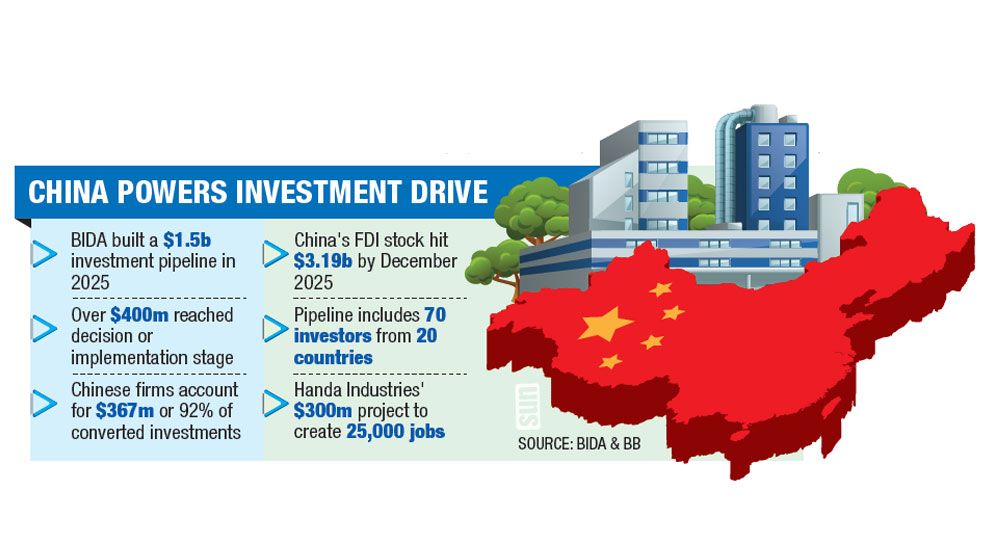
Chinese companies have emerged as the dominant force in Bangladesh’s latest foreign investment drive, accounting for nearly US$367 million – about 92% – of the more than $400 million in projects that have reached the decision or implementation stages.
The capital injection comes from a $1.5 billion investment pipeline established in 2025 by the Bangladesh Investment Development Authority (BIDA).
BIDA reported that out of 70 prospective investors across 20 countries, the pipeline has achieved a conversion rate exceeding 15%, outperforming international execution benchmarks.
The trend underscores Beijing’s growing capital footprint in South Asia, particularly across high-value sectors such as advanced textiles, automated manufacturing, and construction materials.
As of December 2025, central bank data places total foreign direct investment (FDI) stock from China and Hong Kong at $3.19 billion, making it Bangladesh’s third-largest FDI source behind the United Kingdom ($3.22 billion) and Singapore ($2.25 billion).
The latest inflow marks a welcome rebound for Bangladesh, where net FDI dropped steadily from $1.57 billion in 2021 to $1.27 billion in 2024 before bouncing back to $1.77 billion in 2025.
With another $1.5 billion pipeline currently under development, BIDA has already logged 264 new investment proposals.
High-value manufacturing lead
Among the largest pipeline conversions is a $300 million commitment by Hong Kong-based Handa Industries, which doubled its initial $150 million MoU after receiving regulatory facilitation from BIDA, the Economic Zones Authority (BEZA), and Export Processing Zones Authority (BEPZA).
The project is projected to create 25,000 jobs across two phases: an $80 million garment plant in Mirsarai and a $220 million integrated textile complex in Keraniganj.
The investment is expected to introduce advanced textile technologies and high-end fabric production, helping Bangladesh move up the apparel value chain and strengthen its export competitiveness.
China’s Hengli Group, through its subsidiary Lead Bangladesh Textile Technology Co Ltd, is investing around $35 million in an automated textile manufacturing facility at the Bangladesh Special Economic Zone in Araihazar.
The project is expected to strengthen backward linkages in the apparel sector, which remains dependent on imported high-value fabrics and accessories.
China Lesso Group has also finalised a $32 million investment to establish a manufacturing plant at the National Special Economic Zone in Chattogram.
The factory will produce PVC and PEX pipes, solar panels, sanitary ware, kitchen equipment, doors and windows, water purifiers, cables, lighting equipment and fire-fighting products.
The project is expected to reduce Bangladesh’s reliance on imported construction materials while supporting the country’s renewable energy transition.
‘Investment should generate wider economic benefits’
Mohammad Khorshed Alam, president of the Bangladesh China Chamber of Commerce and Industry, told the Daily Sun that growing Chinese investment reflected Bangladesh’s potential as a regional manufacturing and supply-chain hub.
He said Chinese investment could help Bangladesh move beyond low-value manufacturing by bringing advanced technology, modern production systems and stronger integration with global value chains.
Dr Mustafa K Mujeri, former chief economist of Bangladesh Bank and executive director of the Institute for Inclusive Finance and Development, said the real value of foreign investment lay not only in the capital inflow but also in technology transfer, skills development, management expertise and improved access to international markets.
He said investments in advanced textiles, manufacturing and construction materials could strengthen Bangladesh’s industrial base, provided they created stronger linkages with the domestic economy.
“Foreign investment should create wider benefits for the domestic economy through technology transfer, employment, skills development and stronger linkages with local businesses,” he said.
Logistics remains a major challenge
Nahian Rahman Rochi, executive member of BIDA, said improving connectivity and lowering logistics costs would be critical to attracting more investment.
He said high logistics costs continue to affect production, exports and investment decisions.
Better ports, warehouses, cold-chain facilities and industrial infrastructure would make supply chains more efficient and improve Bangladesh’s competitiveness.
Rochi said future investments should deliver more than capital by creating jobs, transferring technology, strengthening local industries and building sustainable industrial capacity.
He added that BIDA is working closely with investors through targeted country- and sector-specific initiatives to convert investment leads into actual projects.
BIDA spokesperson Md Abu Hanif told the Daily Sun that converting more than $400 million from a $1.5 billion pipeline into investment decisions and implementation within the past 12 to 15 months was an encouraging sign.
“We are working continuously with investors through country- and sector-specific targeting to convert investment leads into actual investments. In the coming days, we will further strengthen lead generation and pipeline management through dedicated teams and specialised desks,” he said.
BIDA aims to build another $1.5 billion investment pipeline in 2026.