


 For all latest news, follow the Daily Sun's Google News channel.


DEFAULT ON LARGE LOANS CROSSES 40%
Analysts blame lax credit checks, weak monitoring for the surge

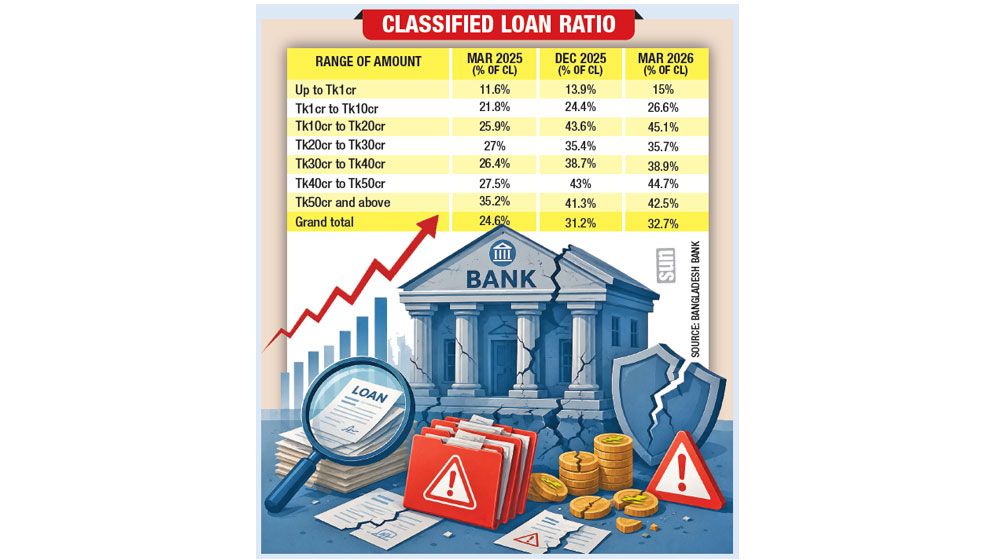
The banking sector in the country is buckling under a default crisis increasingly concentrated among its largest borrowers, with more than 42% of loans exceeding Tk50 crore now classified – nearly three times the default rate on the smallest loans.
Bangladesh Bank’s March 2026 Banking Sector Update shows the classified loan ratio for loans above Tk50 crore climbed from 35.2% in March 2025 to 42.5% a year later.
Over the same period, the volume of such loans grew from Tk5,20,400 crore to Tk5,75,600 crore, meaning both the stock of big loans and their share turning bad rose in tandem.
By contrast, the classified ratio for loans up to Tk1 crore, worth a combined Tk4,09,900 crore, stands at just 15%.
Bankers and economists attribute the divergence to weak credit assessment, poor monitoring, pressure from influential borrowers and repeated rescheduling of large exposures.
Risk climbs with loan size
Bangladesh Bank data shows defaults broadly worsening as loan size increases, though not in a straight line. Loans between Tk1 crore and Tk10 crore have a classified ratio of 26.6%, rising sharply to 45.1% for the Tk10-20 crore bracket.
The rate eases slightly to 35.7% for Tk20-30 crore loans and 38.9% for Tk30-40 crore loans, before climbing again to 44.7% for the Tk40-50 crore category and settling at 42.5% for loans above Tk50 crore.
‘Wounds’ of past rescheduling
Masrur Reaz, chairman and CEO of Policy Exchange Bangladesh, said the poor health of many banks reflects a failure to properly gauge borrowers’ repayment capacity before large loans were approved.
“We are still carrying the wounds of that period when large businesses were allowed to reschedule their loans,” he said, adding that banks must rigorously assess cash flows, project feasibility and associated risks before sanctioning big-ticket credit.
Mustafa K Mujeri, former chief economist of Bangladesh Bank, argued that small borrowers face far stricter scrutiny both at approval and repayment stages, with even minor lapses triggering reminders, notices or legal action.
Large borrowers, he said, often benefit from political connections and special privileges that delay recovery efforts and put them on a different track altogether.
Industry and trade under strain
Industry accounts for 45% of total bank lending and trade and commerce for 32%, together making up 77% of the loan book.
Quality has deteriorated sharply in both: the classified ratio stands at 31.9% in industry and 43.8% in trade and commerce.
Within industry, cottage enterprises are worst affected, with 52.8% of their loans classified, against 34% for small industry and 37.8% for medium industry.
Dr Zahid Hossain, former lead economist at the World Bank’s Dhaka office, pointed to political influence, biased loan approvals, weak monitoring and repeated rescheduling as key drivers.
Many large borrowers, he said, had secured fresh restructuring despite failing to repay substantial sums.
Weak corporate governance and diversion of loan funds away from their intended purpose meant businesses failed to generate the income needed to service their debts – turning performing loans into classified ones even as they stayed on the books.
Sector-wide slide
The strain in large loans has dragged down the sector’s overall health. Bangladesh Bank figures show the system-wide classified loan ratio rising from 24.6% in March 2025 to 31.2% in December 2025, and further to 32.7% in March 2026.